Conflicting clinical trials and emerging mechanistic evidence are reshaping how researchers think about testosterone levels, replacement therapy, and the heart’s electrical rhythm.

Association of testosterone and testosterone replacement therapy with atrial fibrillation: an updated review. Image Credit: Magic mine / Shutterstock
In a recent review published in the Journal of the Endocrine Society, researchers investigated the effects of serum testosterone levels and testosterone replacement therapy (TRT) on the risk of atrial fibrillation (AF). The evidence was not consistent across studies, but several reports pointed to a higher AF risk at both low and high testosterone levels. This may be relevant when assessing AF risk in men receiving or considering TRT, although the association still needs to be confirmed in future studies.
Historically, studies have linked low testosterone levels to heightened AF risk in men, particularly those aged 80 years and older. More recent research has produced contrasting findings, suggesting that elevated testosterone levels and TRT may also increase AF risk. AF is more common in men than women and becomes increasingly prevalent with age. Affected individuals may experience considerable morbidity and high healthcare costs. Strategies to reduce the AF burden could therefore improve individual health while easing the strain on healthcare systems.
About the review
In the present structured narrative review, researchers explored the emerging association between testosterone levels, TRT, and atrial fibrillation.
The team searched the Embase and PubMed databases for relevant records published in English through May 4, 2026. They manually screened the reference lists of relevant publications to obtain supplemental information. The review also considered material presented at the 2024 European Society of Cardiology (ESC) Congress and the 2025 Joint Congress of the European Society of Endocrinology and the European Society for Pediatric Endocrinology (ECE/ESPE).
The researchers reviewed Food and Drug Administration (FDA) safety communications and public submissions related to regulatory decisions concerning testosterone therapy in the United States (US). The study included randomized controlled trials (RCTs) evaluating cardiovascular outcomes of TRT use, as well as systematic reviews with or without meta-analyses of these trials. Large-scale observational cohort studies with testosterone measurements or TRT recipients were also included.
The team included Mendelian randomization studies, which use genetic variants to investigate potentially causal associations, as well as mechanistic investigations, society guidelines, consensus statements, and regulatory material related to TRT prescribing and labeling. They excluded narrative reviews that did not present original research findings and considered case reports only when they provided relevant information on regulatory decisions or clinical guidelines.
The team recorded details on study design, participant characteristics, and the interventions examined. They also noted outcome estimates, including hazard ratios (HRs) and odds ratios (ORs), and compared these findings across the studies. Because the included studies differed substantially in design and populations, the findings were synthesized narratively rather than pooled, and no formal risk-of-bias scoring was performed.
Results
In the 2023 TRAVERSE trial, AF occurred more frequently among men receiving 1.62% transdermal testosterone gel than among those receiving placebo, although the AF analysis was not adjusted for multiple comparisons. The men enrolled in the study also had cardiovascular disease or several cardiovascular risk factors. This differed from an earlier study in US veterans, which reported lower AF risk after testosterone levels were brought back to normal.
A 2024 meta-analysis of 106 RCTs found no statistically significant increase in AF. Real-world findings were also mixed. A TriNetX-based replication did not confirm increased AF risk, whereas a five-year cohort study found a roughly 27% higher AF hazard among cisgender men with hypogonadism receiving TRT. A 2024 analysis of the United Kingdom Biobank (UKB) data and a post hoc analysis of the ASPirin in Reducing Events in the Elderly (ASPREE) trial published in the same year supported a non-linear association between testosterone levels and AF risk. In the ASPREE trial, AF risk was nearly doubled among older men in the highest two testosterone quintiles compared with those in the middle quintile. Evidence for the higher-testosterone end of this relationship was more consistent than for the lower end.
Synthesizing the observational evidence, the authors proposed that AF risk may be lowest when total serum testosterone levels are approximately 350 to 550 ng/dL. This range may provide useful context when interpreting the broader evidence on testosterone-related cardiovascular risk, but it has not been prospectively validated as an AF-prevention threshold. These findings underscore the potential importance of maintaining testosterone within the mid-physiological range while individualizing treatment targets.
Supporting these findings, mechanistic data, including those obtained from cellular electrophysiology studies conducted in 2025, suggested a U-shaped relationship. The proposed mechanisms differ according to testosterone concentration. Lower levels may affect calcium handling. At higher concentrations, testosterone may affect potassium currents, shorten action potential duration, and favor the abnormal electrical re-entry circuits that can sustain arrhythmias. Separate observational and genetic evidence suggested that testosterone exposure may also be associated with structural changes in the left atrium over time.
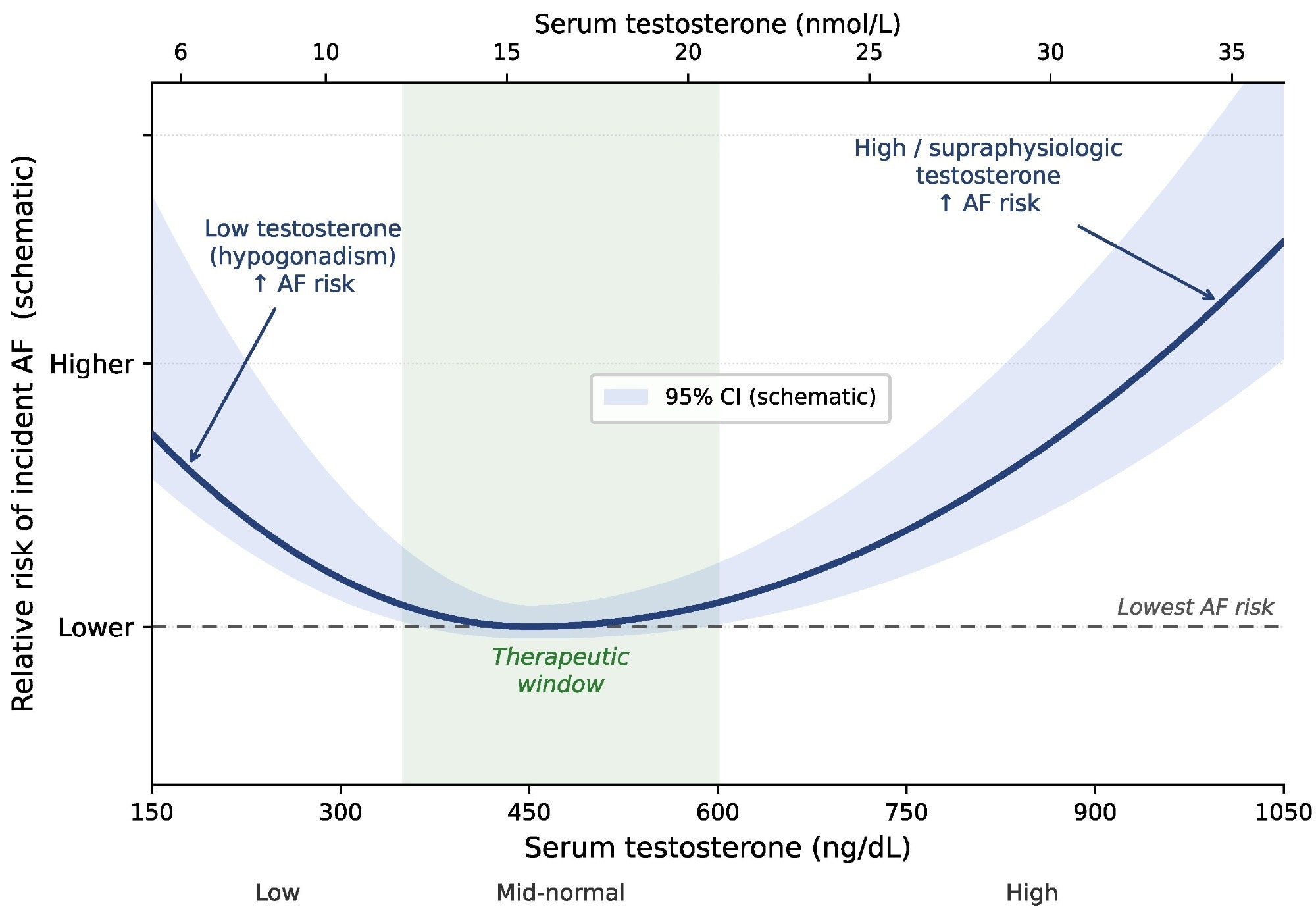
Schematic synthesis of the U-shaped relationship between serum testosterone and risk of incident AF, synthesized from the restricted cubic spline analyses of Xu et al (UK Biobank) (5) and Tran et al (ASPREE) (6). The curve is conceptual and does not represent a pooled quantitative estimate; the risk nadir lies within the mid-physiologic range (shaded therapeutic window). In Tran et al, the elevated-risk association at high testosterone was statistically significant, whereas the low-testosterone association did not reach significance. Axis conversion: 1 nmol/L = 28.82 ng/dL.
Conclusion
The findings highlight a possible non-linear relationship between testosterone exposure and AF risk, while evidence that TRT itself consistently increases AF risk remains mixed. This pattern may be clinically relevant when assessing AF risk and considering testosterone treatment. The results could help clinicians assess AF risk in hypogonadal men and inform TRT selection and monitoring.
Further research could compare different TRT formulations over longer periods while also tracking electrocardiograms, sex hormone-binding globulin (SHBG), and free testosterone levels. This may clarify whether these factors influence AF risk differently over time. Another area worth exploring is how conditions such as diabetes, obesity, hypertension, dyslipidemia, sleep apnea, thyroid disorders, and liver or kidney impairment affect AF risk in men receiving TRT.
Journal reference:
- Maligireddy, A. R., Barua, S.T., Barua, R.S. (2026). Association of testosterone and testosterone replacement therapy with atrial fibrillation: an updated review, Journal of the Endocrine Society, 10(9):bvag180, DOI: 10.1210/jendso/bvag180, https://academic.oup.com/jes/article/10/9/bvag180/8772956
 A CDC survey finds 4 in 5 US teenagers fall short of high heart health scores