Researchers put a faster form of yoga that combines movement with visual, verbal, and auditory challenges head-to-head with traditional Hatha yoga in adults aged 60 to 90.
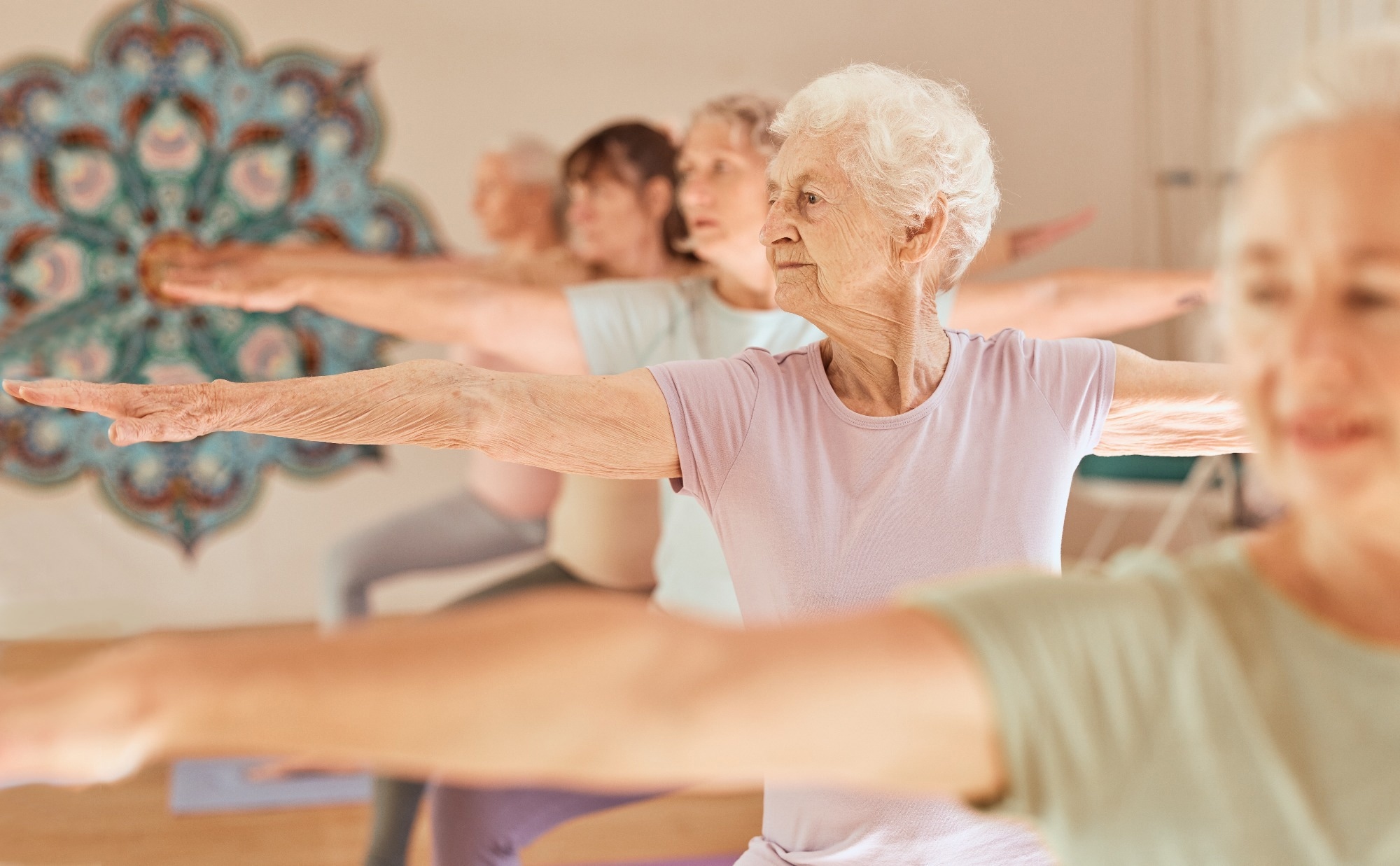
Study: Randomized trial comparing effects of high-speed cued yoga and Hatha yoga on cognitive and neuromuscular performance in older adults. Image Credit: PeopleImages / Shutterstock
A recent pilot randomized controlled trial (RCT) published in the journal Scientific Reports suggests that a novel high-speed, cued yoga intervention (YogaCue) may provide additional benefits beyond traditional Hatha yoga (Hatha) for improving cognitive and physical performance among older adults. While both forms of yoga improved cognitive and physical performance, YogaCue showed additional gains in some measures, including memory, aerobic fitness, and physical performance.
As individuals age, cognitive ability gradually declines, which can affect memory, attention, and the ability to manage everyday activities independently. Finding practical strategies to maintain cognitive function and physical abilities is therefore important for healthy aging. Studies have shown that regular physical exercise, including yoga, may help preserve cognitive function while also supporting mobility, balance, and independence in older individuals.
About the study
In the present pilot study, researchers compared the effects of Hatha and YogaCue on cognitive, functional, neuromuscular, and aerobic performance among older individuals.
The YogaCue program initially combined action observation with verbal instructions and numbered flow sequences. Numerical identifiers were later replaced with color-based cues, while verbal instruction was maintained, and visual cues using colored paddles were subsequently introduced. In addition, an auditory cue, a gong, prompted participants to switch from one flow sequence to its paired counterpart. The order of the sequences was randomized to provide additional cognitive stimulation. Hatha yoga involved gentle seated and standing poses, performed slowly and consistently throughout the study. Progression in YogaCue involved reducing the duration of each pose and the time interval between poses. In the Hatha yoga group, the team increased the complexity of poses and introduced more variability as sessions progressed.
Of the 54 participants initially tested and randomized, 34 completed the intervention and post-testing and were included in the analysis, equally divided between the two groups. They were recruited for the trial via flyers and phone lists in two waves beginning 30 October 2023 and 16 October 2024. The participants were aged 60 to 90 years, lived independently in community settings, and practiced yoga 3 times per week for 24 weeks under the supervision of certified yoga instructors. Each session lasted 60 minutes. None had memory complaints or suffered from uncontrolled neuromuscular, cardiovascular, cerebrovascular, systemic inflammatory, or autoimmune diseases.
The participants completed health history questionnaires and anthropometric evaluations, including height and weight measurements and percentage body fat analysis. To assess cognitive function, the team performed several tests, including the Hopkins Verbal Learning Test (HVLT), Trail-Making Tests (TMT), and the National Institutes of Health (NIH) Cognitive Toolbox. Neuromuscular testing included 1-repetition maximum (1RM) and power tests for chest and leg presses.
To evaluate functional mobility, endurance, and balance, the participants underwent the six-minute walk test (6MWT), the Timed Up & Go (TUG) test, and the physical performance test (PPT). Five minutes after completing cognitive testing, the researchers measured peak power during leg and chest presses at loads ranging from 40% to 80% of 1RM using pneumatic machines. Neuromuscular tests were performed as final assessments to minimize fatigue-related effects. All tests were performed before the intervention and repeated after the 24-week program. The participants were provided adequate recovery time between tests. For instance, they rested for five minutes before the 1RM test.
Results and discussion
Across the full sample, participants demonstrated significant improvements in the Flanker Inhibitory Control and Attention Test (FICA), List Sorting Working Memory Test (LSWMT), and the Fluid Cognition Composite Score (FCS), with both YogaCue and Hatha also showing significant within-group gains in the composite score. Across the sample, the team observed improvements in blood pressure, aerobic capacity, lower-limb strength, and power at specific loads. Systolic blood pressure declines were driven by Hatha, while diastolic blood pressure declined in both groups. Strength gains were primarily observed in the Hatha yoga group, whereas lower-limb power gains were more pronounced among those who practiced YogaCue.
However, HVLT scores, including total recall, delayed recall, and percentage retained, and percentage body fat decreased significantly only among participants in the YogaCue group. While Hatha group participants showed improved TUG scores, improvements in PPT scores were more evident in the YogaCue group. Although aerobic fitness improved across the overall sample, gains appeared more pronounced in the YogaCue group, although clear between-group differences were not established for all aerobic outcomes.
Traditional Hatha yoga primarily emphasizes postural control, breathing, and awareness of body position and environment, with indirect cognitive engagement through attentional regulation. These traditional forms help improve flexibility, coordination, balance, and range of motion; however, the exercise intensity is typically low and often below moderate levels. In contrast, YogaCue combines higher-speed movement intervals with auditory and visual cues that require participants to remember and respond to movement sequences. This approach may provide greater cognitive and physical stimulation than slower-paced Hatha yoga.
Conclusion
The findings suggest that both yoga programs were associated with improvements in physical and cognitive function among older individuals. The high-speed YogaCue intervention may provide additional benefits in aerobic fitness and lower-body power. Cognitive domains such as episodic and verbal memory may also improve among people practicing YogaCue. However, the authors cautioned that this was a small pilot study with no non-exercising control group, a predominantly female sample, and limited statistical power to establish differences between the two yoga interventions for several outcomes. If confirmed in larger trials, YogaCue could offer an additional approach for combining physical exercise with cognitive stimulation in older adults. In future studies, researchers could include poses targeting upper-body muscles and explore the mechanisms underlying similar cognitive responses following both interventions.
Journal reference:
- Martinez, K.J., Fitzgerald, B., Weber, M. et al. (2026). Randomized trial comparing effects of high-speed cued yoga and Hatha yoga on cognitive and neuromuscular performance in older adults. Scientific Reports. DOI: 10.1038/s41598-026-68035-2, https://www.nature.com/articles/s41598-026-68035-2
 Could eating whey protein before meals help reduce blood sugar spikes?