A major review comparing nine types of exercise reveals how different workouts may help preserve bone density after 60, why the spine and hip respond differently, and why traditional Chinese exercise deserves closer investigation.
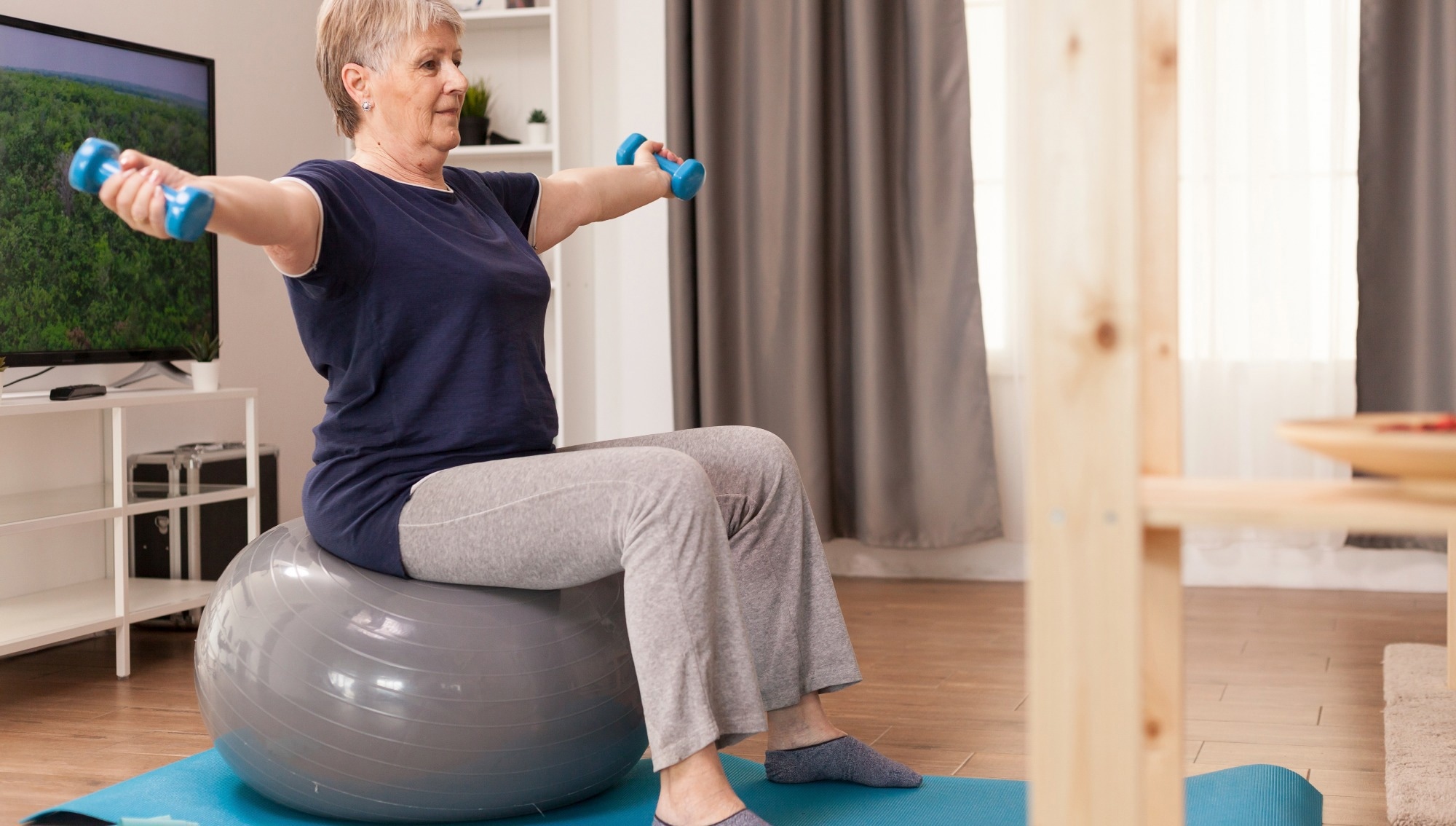 Study: Effectiveness of different exercise types for improving lumbar spine and femoral neck bone mineral density in older adults: a three-level pairwise and Bayesian network meta-analysis. Image credit: DC Studio/Shutterstock.com
A recent systematic review and meta-analysis in BMC Geriatrics concludes that exercise is associated with modest but favorable changes in bone mineral density among adults aged 60 and over. The evidence was stronger for the lower spine than for the hip.
Understanding the role of exercise in bone health
Osteoporosis is a condition in which bone mineral density (BMD) is reduced, and the internal structure of bone deteriorates, increasing fracture risk. Fractures of the hip and spine can cause disability, loss of independence, and early death, as well as increase healthcare costs. According to figures cited by the authors, low bone mineral density accounted for about 220,000 deaths worldwide in 2021, in addition to 7.76 million disability-adjusted life years (DALYs).
The lumbar spine and the femoral neck are key sites for assessing BMD, but differences in their bone composition and remodeling rates may influence how they respond to exercise. Exercise is a widely recommended intervention to protect bone, but it remains unclear which type, amount, and duration are optimal for older people. The authors say earlier analyses often compared exercise-only interventions with no exercise or focused mainly on postmenopausal women.
Comparing nine exercise types across 81 clinical trials
The team searched four major research databases and other sources up to March 2026 for randomized controlled trials (RCTs). They included 81 trials, published between 1991 and 2025, involving 5,251 adults aged 60 or older living in the community. Bone mineral density (BMD) was measured by dual-energy X-ray absorptiometry (DXA), a standard scan technique.
Nine types of exercise were examined: resistance training, aerobic training, impact exercise such as jumping, resistance combined with impact, aerobic combined with resistance, multicomponent programs, water exercise, traditional Chinese exercise such as Tai Chi and qigong, and other mind-body practices such as yoga and Pilates.
The researchers used a three-level pairwise meta-analysis to assess the benefits of exercise relative to passive controls and a Bayesian network meta-analysis to compare the relative effectiveness of different exercise types. They also examined whether participant characteristics and exercise prescription parameters influenced the results.
Resistance and impact training show promising bone benefits
Overall, exercise produced significantly more favorable changes in bone density at both skeletal sites, with BMD changes in exercise groups exceeding those in control groups by 0.013 g/cm² at the lumbar spine and 0.018 g/cm² at the femoral neck.
Despite the larger estimated benefit at the femoral neck, results varied considerably more between trials at this site. Prediction intervals included zero at both skeletal sites, suggesting that exercise benefits could be negligible or even negative in some settings. Consequently, the authors rated the certainty of the evidence as moderate for the spine but low for the femoral neck.
When the researchers compared different exercise types using network meta-analysis, traditional Chinese exercise, impact exercise, and resistance training showed significant benefits at both skeletal sites. Aerobic training also benefited the femoral neck, although its effect at the spine was only marginally significant. Combining resistance with impact training and multicomponent exercise programs offered additional options for improving lumbar spine density.
Of the nine exercise types examined, traditional Chinese exercise emerged as the highest-ranked intervention at both sites, with estimated benefits relative to controls of 0.037 g/cm² at the spine and 0.039 g/cm² at the femoral neck. Although it outperformed resistance and aerobic training at the spine in the network analysis, no exercise type was clearly superior to another at the femoral neck.
The researchers caution, however, that the findings for traditional Chinese exercise were based on only four studies, drawn almost entirely from Asian populations, with low to very low certainty of evidence.
Meanwhile, direct comparisons with control groups supported the benefits of impact exercise at both skeletal sites and resistance training at the femoral neck. However, the pairwise analysis found no statistically significant differences in pooled effects between exercise categories at either site, reinforcing the need for caution when interpreting the exercise rankings.
Age and existing health conditions influence exercise benefits
The effect of exercise also varied according to the health characteristics of the study populations. At both sites, studies involving participants with osteoporosis or in good health generally showed greater benefits for bone density than those involving participants with other conditions, such as sarcopenia (age-related muscle loss) or diabetes.
Improvements in bone density at the spine were largest in trials involving only women. In addition, the gains were larger in studies where the mean participant age was 65 years or less.
At the femoral neck, Asian studies reported larger effects. The authors say this cannot be separated from the concentration of traditional Chinese exercise trials in Asia, and is not evidence that Asian populations respond differently.
The analysis found no significant dose-response relationship for program length, session length, or weekly exercise volume, leaving the optimal exercise dose for bone health uncertain. A separate exploratory machine-learning analysis suggested that age, study size and exercise type may help explain the differences between results.
Resistance and impact training could be first-line options
Although supervised exercise appeared to be generally well tolerated, reporting of side effects was inconsistent. Where recorded, problems were almost entirely minor muscle or joint complaints, and no trial reported a serious adverse event caused by exercise.
Just over half of the trials were judged to be at high risk of bias. The evidence for some exercise types was lacking, few studies included men, and substantial unexplained variability between trials limited confidence in the femoral neck findings.
Despite these limitations, the authors describe resistance and impact training as reasonable first-line options at both sites, with combined and multicomponent programs as reasonable alternatives.
Traditional Chinese exercise is promising and may be especially useful where keeping people engaged is a concern, but its effects need to be confirmed in larger direct-comparison trials before it can be recommended in preference to other exercise types.
The researchers recommend tailoring exercise prescriptions to individuals' existing health conditions. They also stress that their study measured bone density and did not analyze fracture outcomes. The findings therefore do not constitute direct evidence that these exercise programs reduce fracture risk.
Journal reference:
-
Feng, H., Xie, Z., Wang, Y. et al. (2026). Effectiveness of different exercise types for improving lumbar spine and femoral neck bone mineral density in older adults: a three-level pairwise and Bayesian network meta-analysis. BMC Geriatrics. DOI: https://doi.org/10.1186/s12877-026-08740-9.https://link.springer.com/article/10.1186/s12877-026-08740-9
 Gut microbiome changes could potentially be harnessed to support healthier aging