January symbolizes the beginning of a new year, with many individuals viewing it as a fresh start and an ideal time to make health-improving goals. According to a 2024 study, January is the most popular month of the year for people to quit smoking, with an average of 440,670 online searches for terms related to quitting smoking.1
New Year's resolutions can be health-related or financially motivated, and quitting smoking aligns with both. Not only does it enhance general health, but it also saves money, allowing people to meet their financial objectives.
Understanding CO monitoring
Carbon monoxide is an odorless, colorless, and tasteless gas created by incomplete combustion. This gas is produced by smoking tobacco and has a significant impact on people's health.
When inhaled, CO binds to hemoglobin in red blood cells, decreasing oxygen transport throughout the body.2 Smokers often have high CO levels, which can be monitored with a CO monitoring device to aid in a quit-smoking attempt.

Image Credit: Bedfont® Scientific Ltd
The role of CO monitoring in quitting smoking
A CO monitoring device, such as the Smokerlyzer®, measures the levels of CO in exhaled breath to determine a person's smoking status. The device provides a simple test: the user exhales slowly into the device, resulting in an instant CO reading and haptic feedback.
Using a CO monitoring device during a quit attempt allows the user to take charge of their own health and, as their CO levels drop over time, pushes them to continue their quit attempt.
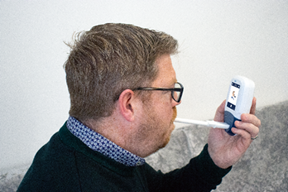
Image Credit: Bedfont® Scientific Ltd
The Smokerlyzer® range
- The Micro+™ CO breath and foetal %COHb %FCOHb device provides fast readings in parts per million (ppm) to aid with smoking cessation.
- PiCO™ is a breath CO device that provides rapid data in accurate ppm and %COHb to aid in smoking cessation.
- PiCObaby™ is a breath CO device for pregnant women to help them quit smoking. It provides rapid readings in accurate ppm, %COHb, and %FCOHb.
- Use iCOquit®, a personal CO device, at home to help quit smoking.
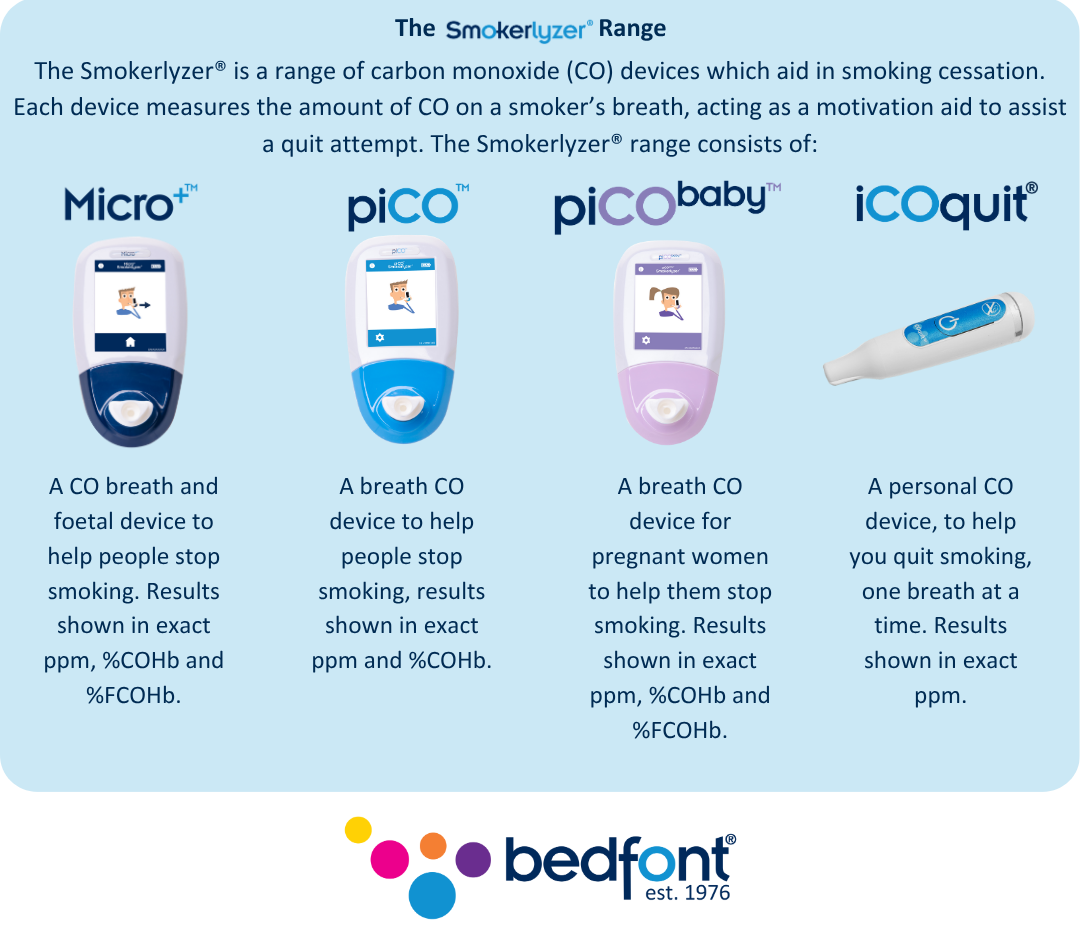
Image Credit: Bedfont® Scientific Ltd
Setting realistic quit goals
Quitting smoking is a process, and as with any substantial lifestyle change, it works best when you set specific, attainable goals. An organized strategy can help you stay focused, track your progress, and celebrate your achievements along the way. Setting SMART goals is an effective method for planning your quitting journey.

- Specific – Be clear about what you want to achieve.
- Measurable – Use CO readings or smoke-free days to track progress.
- Achievable – Set goals that challenge you but are realistic.
- Relevant – Focus on why quitting matters to you.
- Time-bound – Set a timeframe for your targets.
Tracking progress and staying motivated
Measuring CO levels during a quit attempt gives users visual feedback; seeing CO levels decline is a powerful motivator that encourages people to continue their journey.
CO monitoring is also useful for detecting relapses early and encouraging users to get back on track. Quitting smoking is notoriously difficult, and it is critical to recognize and celebrate accomplishments along the way. Lower CO levels and smoke-free days are worth celebrating.
January is the ideal time to make positive, long-term changes, and quitting smoking is one of the most effective measures you can take for your health.
CO monitoring allows you to see concrete success from the start of your quit journey. Watching CO levels fall is a sign that your lungs are repairing, your oxygen levels are increasing, and your body is recovering.
Setting specific goals, documenting your progress, and celebrating each milestone will help you stay motivated and on track, whether you are gradually reducing or quitting altogether. Visit the website to learn more about the Smokerlyzer® product line and how it can help you quit smoking.
References
- Leah (2024). New study reveals the most popular times of year to quit smoking - Digital Health Technology News. (online) Digital Health Technology News. Available at: https://www.healthtechdigital.com/new-study-reveals-the-most-popular-times-of-year-to-quit-smoking/.
- Cancer Research UK (2023). What’s in a cigarette? (online) Cancer Research UK. Available at: https://www.cancerresearchuk.org/about-cancer/causes-of-cancer/smoking-and-cancer/whats-in-a-cigarette-0.
About Bedfont® Scientific Ltd
Bedfont® Scientific has specialised in the design and manufacture of exhaled breath and gas monitoring instruments since 1976.
For medical gas monitoring, their Medi-Gas Check medical pipeline testing range verifies not only the quantity but also quality of gas administered to patients.
Bedfont's breath analysers include carbon monoxide (CO) monitors such as the Smokerlyzer®, used for smoking cessation, and the ToxCO®, used by emergency services, to diagnose CO poisoning.
The NObreath® FeNO monitor provides accurate analysis of airway inflammation for the control of asthma, and the Gastrolyzer® range aids in the detection of gastrointestinal disorders and food intolerances. Quick and non-invasive, breath analysis is the new blood test.
Sponsored Content Policy: News-Medical.net publishes articles and related content that may be derived from sources where we have existing commercial relationships, provided such content adds value to the core editorial ethos of News-Medical.Net which is to educate and inform site visitors interested in medical research, science, medical devices and treatments.