Antibody-Drug Conjugates (ADCs) are a core technology in tumor-targeted therapy, featuring a ‘tripartite integrated design’ of ‘precision carrier-stable linker-potent payload’.
- The carrier component contains specific monoclonal antibodies, typically those of the IgG1 isotype, which are rigorously screened to target ‘tumor-specific antigens (TSAs) or tumor-associated antigens (TAAs)’ (such as TROP2, CD22, and HER2).
- The payload component consists of incredibly potent cytotoxic drugs. These drugs show very strong in vitro cytotoxicity, but they are too systemically toxic for standalone clinical use. As a result, they rely on the targeted delivery of ADCs for risk reduction.
- The linker component serves as a crucial ‘bridge’ that connects the antibody and payload. This requires two key properties.
- First, high stability in the bloodstream (under low enzymatic activity conditions and neutral pH) is required to prevent premature payload detachment, which would lead to the diffusion of free drugs and off-target side effects, such as gastrointestinal toxicity or myelosuppression.
- Secondly, precise cleavage when entering tumor cells, which is triggered by the acidic environment of endosomes/lysosomes or high lysosomal enzyme activity, is required for the efficient release of free payloads.
As a result of this design, ADCs have overcome many of the limitations of traditional chemotherapy and its ‘systemic killing’ approach.
The antibody carrier, upon entry to the body, specifically binds to target antigens on the surfaces of tumor cells via its Fab region. Following this, the formed ‘ADC-antigen complex’ triggers the active uptake process of tumor cells, meaning the initially highly toxic cytotoxic payload is delivered precisely inside tumor cells, reducing the exposure of normal tissues to the drug. This complete chain of ‘targeted binding-precise delivery-low toxicity and high efficacy’ is entirely dependent on endocytosis, ADCs’ core mechanism of action.
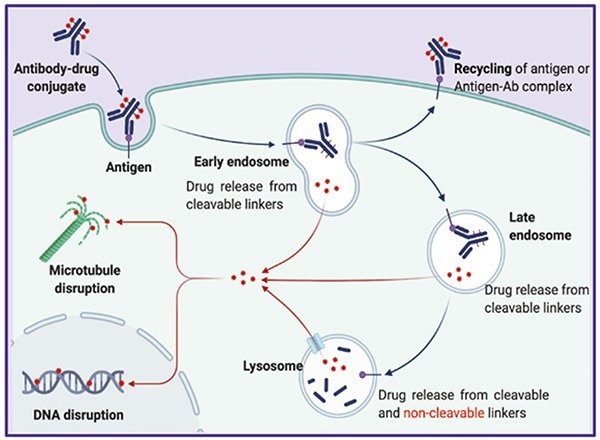
The Classic Mechanism of Action of ADCs. Image Credit: https://doi.org/10.1038/s41392-022-00947-7
Endocytosis detection, therefore, is not only a crucial step in drug screening but also a key means of mechanism optimization. By quantifying endocytosis efficiency, researchers can precisely predict the in vivo behavior of ADCs and provide critical data to support clinical trials.
This article explores the advantages and limitations of different detection methods, the core ‘code’ associated with this field, and how the endocytosis efficiency of ADCs can be evaluated.
Mainstream detection technologies for antibody internalization
Cell imaging technology
Principle
Antibodies are labeled with fluorescent dyes. After co-incubation with target cells, a fluorescence microscope is used to directly observe changes in the localization of fluorescent signals within the cells. When internalization takes place, the fluorescence enters the cell’s interior (forming vesicular or punctate signals, which can be confirmed by co-localization with lysosomal markers).
Advantages and disadvantages
Source: ACROBiosystems
| Advantages |
Disadvantages |
- Highly intuitive: Cell imaging technology can directly visualize the spatial distribution of fluorescent signals, enabling a clear distinction between antibodies bound to the cell membrane and those internalized into the cell.
- Enables co-localization: It can be used in combination with markers for lysosomes and endosomes to illuminate the antibody’s transport pathway after internalization.
|
- Qualitative-oriented: Cannot accurately quantify the internalization efficiency, since it relies on subjective counting or semi-quantitative analysis.
- Susceptible to signal interference: Fluorescence from uninternalized antibodies that remain on the cell membrane surface may overlap with intracellular signals.
|
Flow cytometry (FCM)
Principle
Fluorescently labeled antibodies are incubated with target cells. An acidic wash step is performed to remove any uninternalized antibodies from the cell membrane. Following this, flow cytometry is used to determine the intensity of intracellular fluorescent signals: The intensity of the fluorescence positively correlates with the number of antibodies internalized into the cells, enabling internalization efficiency to be quantitatively analyzed.
Advantages and disadvantages
Source: ACROBiosystems
| Advantages |
Disadvantages |
- Accurate quantification: Can directly quantify intracellular fluorescence intensity, such as MFI value, which supports the comparison of internalization efficiency under different conditions.
- Relatively high throughput: FCM is compatible with 96-well plates, making it ideal for batch analysis in the antibody screening or process optimization stage.
|
1. Qualitative-oriented: Cannot accurately quantify the internalization efficiency (reliant on subjective counting/ semi-quantitative analysis).
2. Susceptible to signal interference: Fluorescence from uninternalized antibodies remaining on the cell membrane surface can overlap with intracellular signals.
|
Toxin conjugate assay
Principle
The toxin conjugate assay is a functional indirect detection method. Its key principle is the binding of ‘primary antibodies (target antigen-specific antibodies) and secondary antibody-toxin conjugates (antibodies that recognize primary antibodies conjugated with cytotoxic toxins)’.
The internalization efficiency of primary antibodies is indirectly inferred from the survival status of the target cells. Antibody-toxin conjugates will be co-transported into the cell and release toxins to kill the cell only when successfully internalized; the cell survival rate negatively correlates with the primary antibodies’ internalization efficiency.
Advantages and disadvantages
Source: ACROBiosystems
| Advantages |
Disadvantages |
|
This technology is extremely sensitive because of the signal amplification effect mediated by toxins. It supports high-throughput screening of antibody libraries and is compatible with 96-well/384-well plates.
|
It is susceptible to non-specific cytotoxic effects and may be compromised by them; it cannot distinguish between internalization pathways (e.g., clathrin-dependent vs. clathrin-independent).
|
ADC internalization detection antibody – Labeled with pH-sensitive fluorescent dye
Given the central role of endocytosis detection in ADC (Antibody-Drug Conjugate) research and development, ACROBiosystems has developed an antibody endocytosis reagent based on pH-sensitive dyes (Cat. No.: IGG-PZF2001) to meet the demand for endocytosis detection of ADC drugs.
The reagent labels Fab fragments with a pH-sensitive fluorescent dye, and the fluorescently labeled reagent binds specifically to the Fc portion of the antibody under test. A robust antibody complex can be formed in just 10 minutes, making it ideal for quickly evaluating the process of antibody internalization. After labeling, the antibody can be detected through many different methods, such as cell imaging technology or flow cytometry.
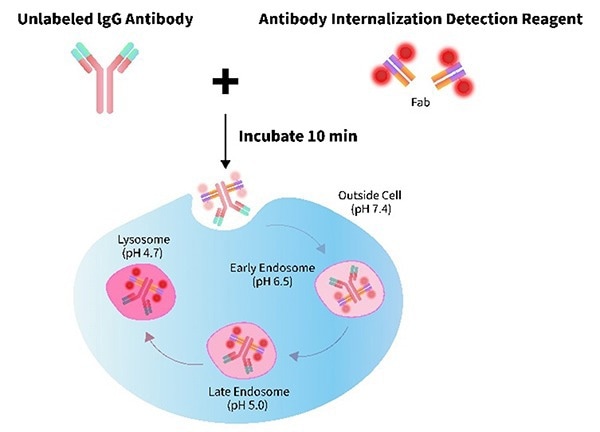
Image Credit: ACROBiosystems
Product features
- High signal and noise ratio: Strong fluorescence with minimal background.
- Quick labeling: Process is complete in just 10 minutes.
- pH-sensitive: Bright signal in acidic intracellular compartments.
- Fab region preserved: Does not affect antibody binding.
Applications
- Discovery stage: To identify antibodies that specifically bind to tumor-associated antigens and internalize efficiently.
- Lead optimization: To evaluate how variations in conjugation chemistry or antibody structure affect internalization and intracellular trafficking.
- Preclinical development: To validate that the chosen ADC candidate exhibits constant internalization behavior across relevant cell models.
- Mechanism-of-action studies: To corroborate the intracellular delivery of the payload and its correlation with cytotoxicity.
Validation data
FACS Analysis of Antibody Internalization
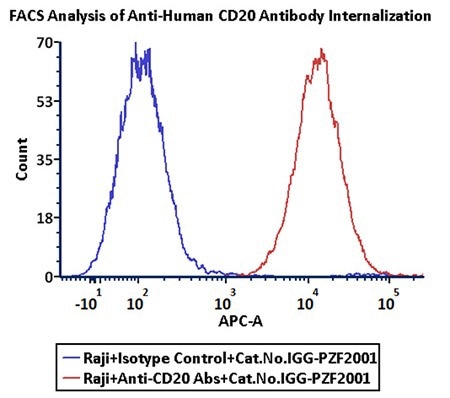
Anti-CD20 Abs and Human IgG1 isotype control were labeled with Antibody Internalization Detection Reagent (Cat.No. IGG-PZF2001). Raji cells were treated with Anti-CD20 Abs-Internalization Detection Reagent conjugate and Isotype control-Internalization Detection Reagent conjugate separately for 2 hours, then analysis by Flow cytometric. APC signal was used to evaluate the activity (Routine tested). Image Credit: ACROBiosystems
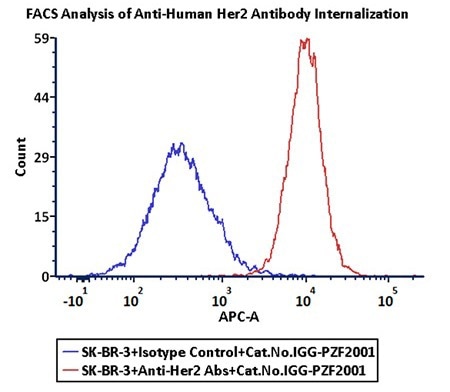
Anti-Her2 Abs and Human IgG1 isotype control were labeled with Antibody Internalization Detection Reagent (Cat.No. IGG-PZF2001). SK-BR-3 cells were treated with Anti-Her2 Abs-Internalization Detection Reagent conjugate and Isotype control-Internalization Detection Reagent conjugate separately for 2 hours, then analysis by Flow cytometric. APC signal was used to evaluate the activity (Routine tested). Image Credit: ACROBiosystems
Fluorescence imaging of antibody internalization
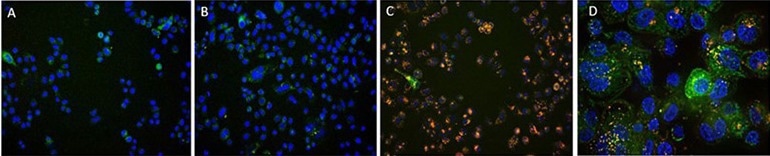
A. Antibody Internalization Detection Reagent (Cat.No. IGG-PZF2001). B. IgG1 Isotype+Internalization Detection Reagent conjugate. C. Anti-Her2 Abs+Internalization Detection Reagent conjugate. D. Anti-Her2 Abs+Internalization Detection Reagent conjugate(Z-stacking). (Green: CellLights Lysosome GFP, Blue: NucBlue Live ReadyProbes, Red: IGG-PZF2001,Cell line: SK-BR-3 Her2+). Image Credit: ACROBiosystems
IGG-PZF2001 empowers and accelerates the research and development of targeted anti-cancer drugs by providing rapid and precise capabilities in ADC endocytosis detection, driving the process forward.
Application note download
This application note presents a novel pH-sensitive fluorescent assay for the quantitative and highly sensitive detection of antibody internalization in ADC research, as demonstrated on HER2+ and CD20+ cell lines.
It exhibits strong endosomal signal detection, as validated by flow cytometry and confocal microscopy, along with unique data that helps optimize reagent concentration and incubation time across multiple cell types. This method accelerates ADC candidate screening and MOA studies.
References
- Shivatare, V. S., et al. (2023). Probing the Internalization and Efficacy of Antibody‐Drug Conjugate via Site‐Specific Fc‐Glycan Labelling of a Homogeneous Antibody Targeting SSEA‐4 Bearing Tumors. Israel Journal of Chemistry, 63(10-11). DOI: 10.1002/ijch.202300042. https://onlinelibrary.wiley.com/doi/10.1002/ijch.202300042.
- Fu, Z., et al. (2022). Antibody drug conjugate: the ‘biological missile’ for targeted cancer therapy. Signal Transduction and Targeted Therapy, [online] 7(1). DOI: 10.1038/s41392-022-00947-7. https://www.nature.com/articles/s41392-022-00947-7.
- ProBio CDMO. (2025). ADC Bioassay Service | Antibody Internalization Assay - ProBio CDMO. (online) Available at: https://www.probiocdmo.com/add-adc-bioassay-service.html.
- Nath, N., et al. (2016). Homogeneous plate based antibody internalization assay using pH sensor fluorescent dye. Journal of Immunological Methods, 431, pp.11–21. DOI: 10.1016/j.jim.2016.02.001. https://www.sciencedirect.com/science/article/pii/S0022175916300163?via%3Dihub.
- Li, Y., et al. (2015). A Cell-Based Internalization and Degradation Assay with an Activatable Fluorescence-Quencher Probe as a Tool for Functional Antibody Screening. Journal of biomolecular screening, [online] 20(7), pp.869–75. DOI: 10.1177/1087057115588511. https://linkinghub.elsevier.com/retrieve/pii/S2472555222072598.
About ACROBiosystems
ACROBiosystems is a cornerstone enterprise of the pharmaceutical and biotechnology industries. Their mission is to help overcome challenges with innovative tools and solutions from discovery to the clinic. They supply life science tools designed to be used in discovery research and scalable to the clinical phase and beyond. By consistently adapting to new regulatory challenges and guidelines, ACROBiosystems delivers solutions, whether it comes through recombinant proteins, antibodies, assay kits, GMP-grade reagents, or custom services. ACROBiosystems empowers scientists and engineers dedicated to innovation to simplify and accelerate the development of new, better, and more affordable medicine.
Sponsored Content Policy: News-Medical.net publishes articles and related content that may be derived from sources where we have existing commercial relationships, provided such content adds value to the core editorial ethos of News-Medical.net, which is to educate and inform site visitors interested in medical research, science, medical devices, and treatments.