As of 1970, cannabis has been illegal in the United States at the federal level, and to this day is not approved by the U.S. Food and Drug Administration for any medical indication. Nevertheless, state-level reform has transformed access and, as of January 2022, nearly half of the U.S. population lives in a state where recreational cannabis has been legalized. What is more, many states now operate Medical Cannabis Programs (MCPs) that permit patients with qualifying conditions to register for legal access.1,2
The scope of these MCPs differs substantially: Texas maintains a restricted Compassionate Use Program covering only eight conditions, while California allows medical cannabis for a broader range of physician-recommended indications, including chronic pain, HIV, and arthritis. 3,4
As Pittcon convenes in San Antonio, Texas, this regulatory mosaic forms an important backdrop for discussions on cannabis safety and quality. A central feature of these programs is mandatory contaminant testing of cannabis and its derivatives to protect patients and consumers. Analytical scientists and advanced analytical techniques play a central role in enabling this testing, ensuring products meet regulatory requirements and supporting the development of safer cannabis markets.
Pesticide residues in cannabis products
Among regulated contaminants, pesticide residues present a distinct and often under-characterized risk to cannabis consumers. Unlike other agricultural crops, cannabis has not been subjected to federal pesticide evaluation and tolerance-setting processes required for food plants, and little is known about appropriate pesticide use in cannabis cultivation. Yet it is understood that many pesticides detected in cannabis are classified as moderately hazardous by the World Health Organization,5 with 10–70 % of some pesticide residues volatilized during smoking.1
This is particularly concerning given that high-temperature vaporization and pyrolysis can generate toxic by-products, such as hydrogen cyanide from myclobutanil, and that pesticide residues may concentrate as cannabis is processed into oils and infused products.1
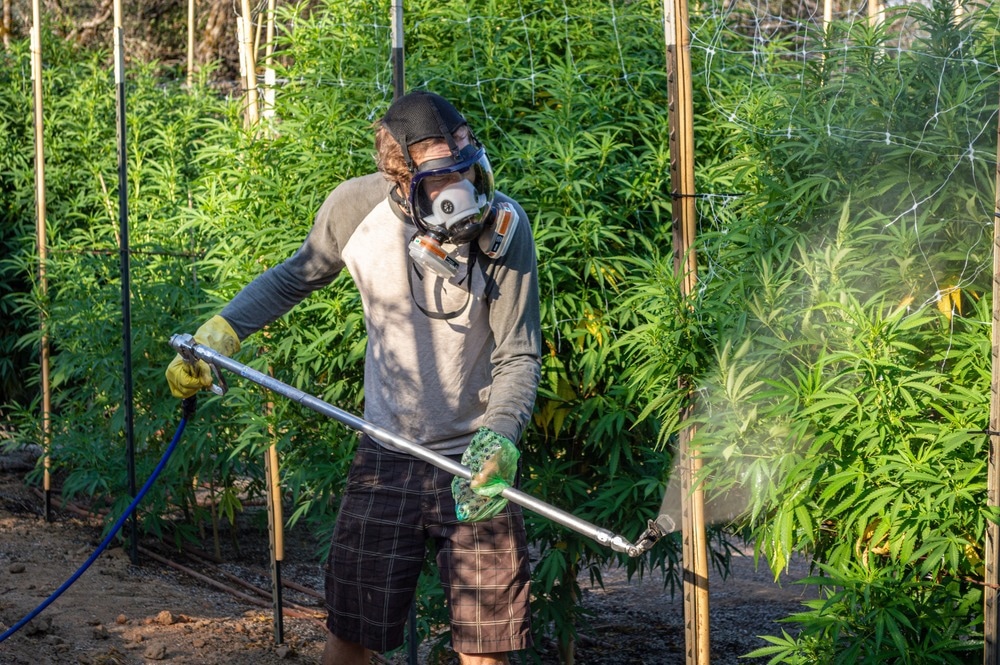 Image Credit: Sara Armas/Shutterstock.com
While this knowledge necessitates a robust regulatory system, pesticide testing requirements vary significantly between jurisdictions. The USP lists 108 pesticides for consumable crops, and the FDA monitors over 750 residues, yet states are left to define their own scopes. As a result, California mandates testing for 66 pesticides and Oregon for 58, whereas Colorado requires only 15.1
Industry experts have raised concerns that such limited panels may not reflect the range of pesticides used or the risks posed by inhalation and processing. Given the absence of federal guidance and limited toxicological data, current state programs may fail to address important exposure pathways. Without a harmonized framework, consumers may unknowingly be exposed to harmful residues.1
Illegal pesticides and fumigants: An emerging threat to cannabis safety
Illegal pesticides have been documented at both licensed and unlicensed cannabis cultivation sites across the United States - from California to Oklahoma to Maine - particularly within operations controlled by transnational criminal organizations (TCOs). For example, in California, coordinated enforcement operations have repeatedly uncovered illegal pesticide use, including bottles labeled as carbofuran and methamidophos at unlicensed grow sites in Alameda and Los Angeles counties.7
According to the U.S. Drug Enforcement Administration, Chinese and other Asian TCOs have come to dominate marijuana cultivation and distribution, operating largely outside regulatory systems and using pesticides imported from China, including chemicals banned in the United States for decades due to health and environmental risks.6
These issues will be examined in depth at Pittcon by Dr Vidia Gokool, Staff Scientist at Lawrence Livermore National Laboratory in California. As part of the Cannabis & Psychedelic track, Dr. Gokool will present a symposium titled "Illegal Fumigant Pesticides in the Cannabis Industry: Unmitigated Exposure Risks & Unknown Health Effects," focusing on the analytical characterization of illegal pesticide fumigants seized from cannabis cultivation sites and the exposure risks they pose to consumers.
Using GC-MS, pyrolysis-GC-MS, comprehensive two-dimensional GC-MS, and LC-MS/MS, Dr Gokool unpacks the chemical composition of these products and explains developments in targeted LC-triple quadrupole and GC-triple quadrupole methods for sensitive detection. These analyses generate detailed chemical fingerprints that shed light on handling and production practices, reveal limitations in current pesticide testing requirements, and support efforts to link fumigant composition with detectable residues on cannabis plants.8
Moving forward: Strengthening cannabis safety through science at Pittcon
As cannabis regulation and product complexity continue to evolve, analytical science becomes increasingly anchored in our understanding of the risks associated with pesticide residues and other contaminants. Pittcon brings together the analytical techniques, instrumentation, and scientific expertise needed to address these challenges, serving as a forum where researchers, regulators, and industry leaders can share data, methods, and perspectives in this emerging field.
Exhibitors such as Agilent (Booth 1436) will be showcasing analytical platforms that support sensitive and high-throughput pesticide residue analysis, directly reflecting the types of technologies discussed throughout the Cannabis & Psychedelic track.
For further information about these sessions, exhibitors, and the full Pittcon program, please visit: https://pittcon.org
References and further reading
- Goldman, S., et al. (2021). The analytical landscape of cannabis compliance testing. Journal of Liquid Chromatography & Related Technologies, 44(9-10), pp.403–420. DOI: 10.1080/10826076.2021.1996390. https://www.tandfonline.com/doi/full/10.1080/10826076.2021.1996390?utm_source=researchgate.net&utm_medium=article.
- Pruyn, S.A., et al. (2022). Quality Standards in State Programs Permitting Cannabis for Medical Uses. Cannabis and Cannabinoid Research. DOI: 10.1089/can.2021.0164. https://www.liebertpub.com/doi/10.1089/can.2021.0164.
- State of Texas. Texas Medical Marijuana | Texas.gov. (online) State of Texas. Available at: https://www.texas.gov/health-services/texas-medical-marijuana/.
- NORML. California Medical Marijuana Law. (online) Available at: https://norml.org/laws/medical-laws/california-medical-marijuana-law/.
- Taylor, A. and Birkett, J.W. (2020). Pesticides in cannabis: A review of analytical and toxicological considerations. Drug Testing and Analysis, 12(2), pp.180–190. DOI: 10.1002/dta.2747. https://analyticalsciencejournals.onlinelibrary.wiley.com/doi/10.1002/dta.2747.
- Larkin, P., Rumpel, V. and Victoria, B. (2025). Rumpel Senior Legal Research Fellow, The Heritage Foundation. (online) Available at: https://www.congress.gov/119/meeting/house/118449/witnesses/HHRG-119-HM09-Wstate-LarkinP-20250918.pdf.
- Governor of California. (2025). Cannabis crackdown: State officials seize 58,350 illegal cannabis plants worth $57 million in November | Governor of California. (online) Available at: https://www.gov.ca.gov/2025/12/10/cannabis-crackdown-state-officials-seize-58350-illegal-cannabis-plants-worth-57-million-in-november/.
- Pittcon. (2026). Illegal Fumigant Pesticides in the Cannabis Industry: Unmitigated Exposure Risks & Unknown Health Effects. (online) Available at: https://app.swapcard.com/event/pittcon-2026/planning/UGxhbm5pbmdfNDI4ODA1Mw==.
About Pittcon
Pittcon is North America’s largest conference and exposition in laboratory science, attracting thousands of industry, academia, and government attendees and exhibitors from around the world in. Pittcon goes beyond the typical conference; it's a global community dedicated to advancing science through education, collaboration, and philanthropy. By bringing together scientists, researchers, educators, students, and industry leaders, Pittcon creates opportunities to learn, connect, and inspire innovation. Beyond the event itself, more than 90% of Pittcon's net proceeds support science education and outreach initiatives locally and globally, funding scholarships, grants, STEM programs, laboratory improvements, and other efforts that strengthen communities and expand access to science.
Pittcon delivers world-class educational and professional development opportunities through its Technical Program, Short Courses, and Networking Workshops and Roundtables. Attendees can explore the latest scientific research through symposia, oral and poster presentations, enhance their skills with expert-led deep-dive courses, and connect with peers through interactive workshops and networking experiences designed to foster collaboration and career growth.
The Pittcon Expo brings the scientific community together in an immersive environment where attendees can discover the latest laboratory technologies, meet with leading instrument and service providers, and experience science in action. Beyond the exhibit booths, the Expo Floor features engaging attractions, educational experiences, demonstrations, and networking spaces, while receptions, parties, and social events create opportunities to build lasting connections with colleagues from around the world.
Sponsored Content Policy: News-Medical.net publishes articles and related content that may be derived from sources where we have existing commercial relationships, provided such content adds value to the core editorial ethos of News-Medical.net, which is to educate and inform site visitors interested in medical research, science, medical devices and treatments.