Organoids are three-dimensional tissue cultures made from embryonic stem cells, adult stem cells, or induced pluripotent stem cells.
They are produced in a supporting matrix and can also be created by combining epithelial progenitors with mesenchymal and endothelial cells.
Organoids' 3D microenvironment allows for cell-cell and cell-matrix interactions that closely resemble natural tissue. As a result, they have demonstrated significant promise in the realms of drug discovery, tailored diagnostics, cell therapy, and simulating human-specific aspects of growth and disease.1
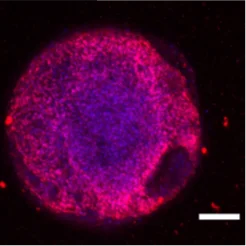
Figure 1. Embryoid Body (EB) Oct4 DAPI. Scale bar 1 mm. Image Credit: Scintica Instrumentation Inc.
Cartilaginous spheroids
Cartilaginous spheroids are multicellular three-dimensional constructs that can be used for tissue engineering, cartilage regeneration, and as in vitro models for a wide range of research. Cartilaginous microtissues are often substantially greater in size than other spheroids.
Producing spheroids has largely relied on random self-assembly within confined containers, with minimal control over size and architectural characteristics.
Increased precision in cartilaginous spheroid assembly with precise architectural elements and sizes would necessitate more automated and controlled biofabrication technologies, which laser-assisted bioprinting has enabled.
Advantages of laser-assisted bioprinting
Previous bioprinting approaches have been used to create multicellular spheroids, but they come with several limitations.
Extrusion-based bioprinting, which encapsulates spheroids in hydrogel bioink, often results in low spheroid densities and has limited control over spheroid localization within the final construct. In addition, this approach has the extra disadvantage of nozzle clogging, especially when spheroids merge into bigger agglomerates prior to bioprinting.
Although aspiration-based approaches for picking up and depositing single spheroids have been developed to address this issue, the bioprinting method's throughput remains limited.
In contrast, laser-assisted bioprinting (LAB) is a nozzle-free technology that allows for more precise manipulation of cell suspensions at a single-cell level. This nozzle-free technology is of relevance for spheroid bioprinting because it avoids the difficulties associated with extrusion-based technologies.
LAB operates by concentrating a pulsed laser on a donor substrate coated with a metallic coating and bioink. The laser energy causes the metal to ablate, resulting in a plasma that forms a cavitation bubble.
This bubble collapses, releasing a liquid jet that deposits bioink droplets with a predetermined number of cells onto a receiver, allowing for precise spheroid deposition and helping to overcome the limits of existing approaches.
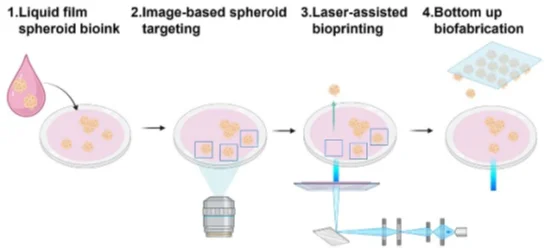
Figure 2. Spheroid laser-assisted bioprinting: Cell spheroids are imaged, targeted, and transferred by the laser to form a predesigned pattern. Image Credit: Hall, G.N., et al. (2024)
Proof of concept
Hall et al. demonstrated the effective bioprinting of cartilaginous spheroids made from human periosteum-derived cells.
After printing, the spheroids retained high cell viability and the ability to differentiate into chondrogenic structures (Figure 3). The Laser-Induced Forward Transfer (LIFT) approach was successful in bioprinting smaller spheroids (100–150 μm in diameter). However, printing larger spheroids proved challenging.
A new approach, called Laser-Induced Propulsion of Mesoscopic Objects (LIPMO), allows for bioprinting of bigger spheroids (up to 300 μm). The bioprinting procedure, combined with computer-aided image processing, enabled the successful creation of high-density, multilayered spheroid populations.
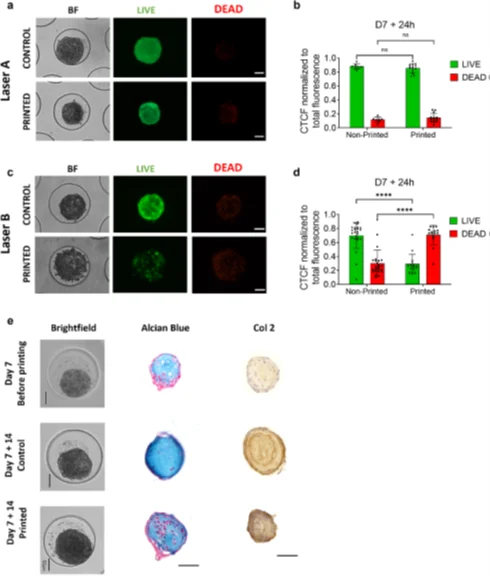
Figure 3. Cartilaginous spheroids was confirmed to be viable after printing with immunostaining and were able to undergo differentiation and maturation. Image Credit: Reproduced from Hall et.al. (2024)
Next generation bioprinting system (NGB-R™) by Poietis™
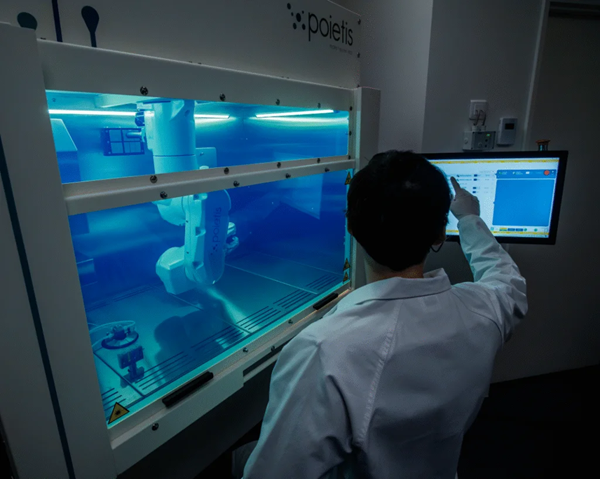
Figure 4. NGB-R™ Robotic-Assisted LAB System. Image Credit: Scintica Instrumentation Inc.
The LAB system used in this study is Poietis™'s Next Generation Bioprinting systems (NGB-R), a multimodal, 3D bioprinting platform designed for printing live tissues and organs.
The technology combines laser-assisted and extrusion bioprinting, giving researchers the versatility of bioprinting (from single cells to 3D spheroids) and the option of using a wide range of biomaterials and hydrogels. The integration of robotics and microscopes allows for the automation of the entire bioprinting process at high resolution and speed.
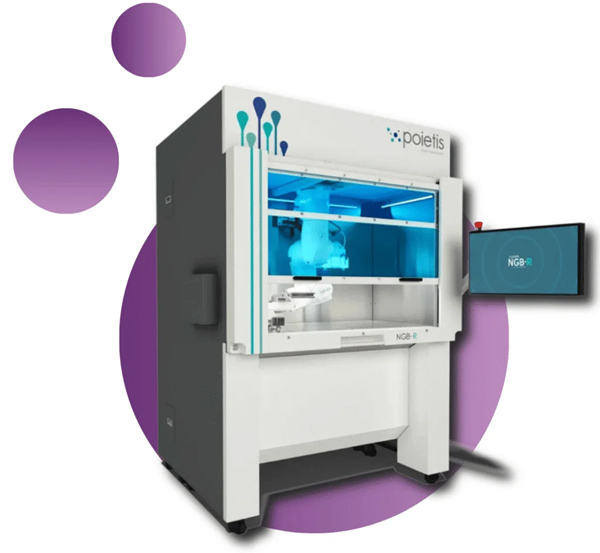
Image Credit: Scintica Instrumentation Inc.
References
- Hall, G.N., et al. (2024). Laser-assisted bioprinting of targeted cartilaginous spheroids for high density bottom-up tissue engineering. Biofabrication, 16(4), pp.045029–045029. DOI: 10.1088/1758-5090/ad6e1a. https://iopscience.iop.org/article/10.1088/1758-5090/ad6e1a.
About Scintica Instrumentation Inc.
At Scintica, we advance science and medicine by supplying researchers with reliable research instrumentation and equipment. Our carefully selected portfolio of imaging systems, research tools, and supporting technologies is designed to reduce complexity and help scientists focus on what matters most, generating
meaningful results.
We partner closely with the preclinical research community to connect teams with solutions that are scientifically robust and built to support research challenges. From system selection through long-term support, our goal is to make research more productive, efficient, and impactful.
Sponsored Content Policy: News-Medical.net publishes articles and related content that may be derived from sources where we have existing commercial relationships, provided such content adds value to the core editorial ethos of News-Medical.net, which is to educate and inform site visitors interested in medical research, science, medical devices and treatments.