Wire myography is an in vitro method that enables the assessment of functional responses and vascular reactivity in isolated small resistance arteries. This technique allows for the examination of vessels from different species - including transgenic models - across various vascular beds and pathological disease states.
The vessels are carefully dissected, cleaned, and subsequently mounted onto a channel myograph using isometric techniques. Each vessel is then normalized to ascertain the maximum active tension development.
This process facilitates the standardization of initial experimental conditions, which is a crucial factor when investigating pharmacological differences among vessels.
The classic Halpern/Mulvany style wire myograph has returned as a standard offering from Living Systems Instrumentation. The MYO-CH wire myograph chamber from Living Systems adheres closely to the fundamental design initially presented by the late Professor William Halpern, the founder of Living Systems Instrumentation, and Professor Michael Mulvany in their seminal 1976 Nature article titled "Mechanical properties of vascular smooth muscle cells in situ" (Nature 260 (5552): 617-619, 1976).
Concurrently, cutting-edge materials, machining techniques, and force technology have been incorporated.
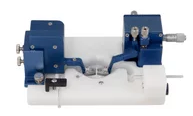
Image Credit: Scintica Instrumentation Inc.
Living Systems' wire myographs feature three varieties of tissue supports: wire-mounts for microvessels, L-bars for larger ring preparations, and a hook for handling strips.
The myograph is appropriate for a variety of applications, including force measurements in microvessel rings, large vessels such as the carotid artery and aorta, as well as in the airway, intestine, bladder, and numerous other contexts.
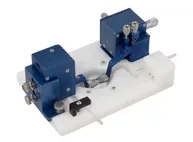
Image Credit: Scintica Instrumentation Inc.
Features
Modular tissue supports designed for the utilization of wire-mount microvessel ring preparations, including Large and Small L-bars for handling both large and small ring preparations, as well as a hook attachment for working with strip preparations.
User-friendly linear position controls are available across all three axes for the stationary tissue support. The force transducer support offers seamless up-and-down position control, thereby facilitating alignments and initial slack adjustments.
A compact bath volume of approximately 5 mL, along with an optional self-heating feature, facilitates the efficient utilization of costly peptides and reagents.
The integrated flow path is designed for convenience, facilitating an optimal flow pattern during the use of bath superfusion.
The glass coverslip chamber base promotes tissue adhesion, as it enables illumination from below. Additionally, it permits concurrent imaging and force studies.
Stimulation electrodes for optional field use are available.
A precision force transducer can measure forces ranging from a few milligrams to 20 grams.
User-friendly analog signal output facilitates straightforward data acquisition. (MYO-SC-1)
System overview: Transducer signal conditioner
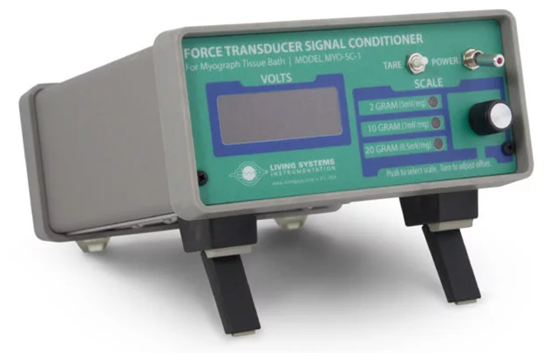
Image Credit: Scintica Instrumentation Inc.
The MYO-SC-1 Force Transducer Signal Conditioner is engineered to transform the force measurement obtained from the force transducer within our MYO-CH wire myograph chamber into an analog voltage that is appropriate for recording with either an analog-to-digital converter or a chart recording device.
- The rotary knob functions to select the force sensitivity range when pressed (2, 10, and 20 g)
- The device features a convenient analog signal output, facilitating straightforward data acquisition
- The rotary knob allows for manual adjustment of the instrument's offset voltage, should the user wish to do so
- A user-friendly Auto-Zero (Tare) push button is located on the front panel, making the adjustment of the zero-force offset a simple task
Myograph packages
Single channel
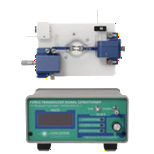
Image Credit: Scintica Instrumentation Inc.
- Power and signal output cables
- Force Transducer Signal Conditioner (MYO-SC-1)
- Wire Myograph Chamber (MYO-01) with Modular Tissue Supports (MYO-CH)
Single channel self-heated
- Force Transducer Signal Conditioner (MYO-SC-1)
- Wire Myograph Chamber with Modular Tissue Supports (MYO-CH)
Temperature controller (TC-09S)
Thermistor temperature sensor (THRS)
Heater, power, and signal output cables
Two channel self-heated
- Heater, power, and signal output cables
- Dual Bath Temperature controller (TC-09D)
- Two Thermistor temperature sensors (THRS)
- Two Force Transducer Signal Conditioners (MYO-SC-1)
- Two Wire Myograph Chambers with Modular Tissue Supports (MYO-CH)
Four channel self-heated
- Heater, power, and signal output cables
- Four Thermistor temperature sensors (THRS)
- Two Dual Bath Temperature controller (TC-09D)
- Four Force Transducer Signal Conditioners (MYO-SC-1)
- Four Wire Myograph Chambers with Modular Tissue Supports (MYO-CH)
Temperature controls
Circular heater bath
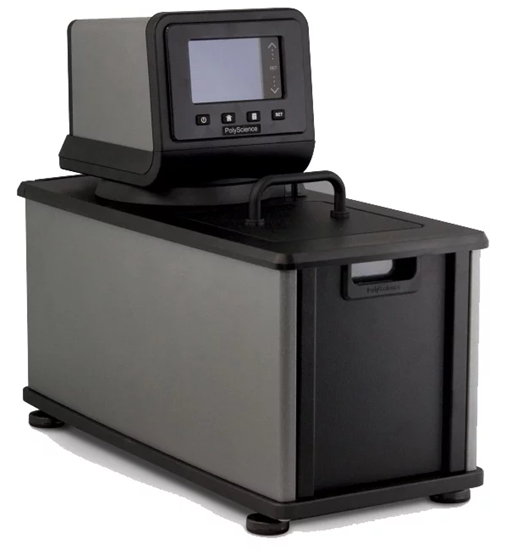
Image Credit: Scintica Instrumentation Inc.
The thermal circulating bath from Living System is a cost-effective heating circulator that comprises an immersion heater unit, a water bath, and a circulating pump. This unit features a compact design and a low profile. Living System evaluated numerous suppliers before selecting this unit, which offers reliable performance at affordable prices.
Specifications
Source: Scintica Instrumentation Inc.
| Specifications |
| Reservoir Capacity |
6 L |
| Temperature Range |
5 °C over ambient to 150 °C |
| Temperature Stability |
± 0.05 °C |
| Temperature Readout |
ºC or ºF |
| Pump Inlet & Outlet |
0.25″ FPT |
| Input Voltage |
120 V or 220 V, 50 or 60 Hz |
| Dimensions |
8.25″ W x 14.25″ H x 14″ D |
| Shipping Weight |
23 lbs |
Temperature controller for single chamber
Living System’s temperature controllers offer exceptional thermoregulatory capabilities. A new control algorithm enables a faster time to achieve the set point (6-10 min, from 22 ºC to 37 ºC). Living System’s temperature controllers now include analog outputs that generate signals compatible with the majority of data acquisition systems.
Additionally, the thermostat control can be turned off, allowing the TC-09S to function as a temperature monitoring and recording device (utilizing the analog output).
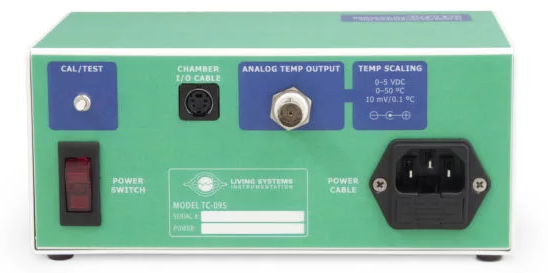
Image Credit: Scintica Instrumentation Inc.
The TC-09S is specifically designed to manage the bath temperature in Living System’s CH-1 single vessel chambers under steady-state conditions, particularly when bath superfusion is not applied. This feature is especially beneficial when dealing with a stagnant bath containing a HEPES or MOPS buffered saline solution.
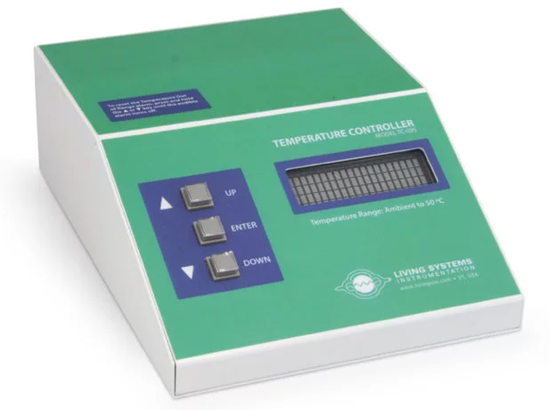
Image Credit: Scintica Instrumentation Inc.
It is important to note that the temperature controller cannot regulate bath temperature when bath superfusion is present. In such instances, it is best to employ a heat exchanger in the superfusion line to heat the bath saline just prior to its entry into the vessel bath.
Specifications
Source: Scintica Instrumentation Inc.
| Specifications |
| Power |
120 V or 220 V |
| Control Limits |
Ambient to 50 ºC |
| Accuracy |
± 1 ºC |
| Time to reach 37 ºC (from 22 ºC) |
6-10 min |
| Analog Output |
10 mV/0.1 ºC |
Temperature controller for dual chamber
The controllers of Living System exhibit unparalleled thermoregulatory efficiency. A new control algorithm enables a faster achievement of the set point (6-10 minutes, transitioning from 22 ºC to 37 ºC). Living System’s temperature controllers are now equipped with analog outputs that generate signals compatible with the majority of data acquisition systems.
The TC-09D includes two heating controllers that can independently manage the bath temperature in the two baths of our CH-2 vessel chambers. Additionally, the thermostat control can be deactivated, allowing the TC-09D to function as a temperature monitoring and recording device (when utilizing the analog output).
The panel controls facilitate the regulation of the bath temperature for both chambers, chamber 1 exclusively, chamber 2 exclusively, or monitoring only (without temperature control).
The TC-09D is specifically designed to manage the bath temperature in Living System’s CH-2 dual vessel chambers under steady-state conditions, particularly when bath superfusion is not applied. This is especially beneficial when dealing with a stagnant bath containing a HEPES or MOPS buffered saline solution.
The temperature controller is incapable of regulating bath temperature when bath superfusion is present. In such instances, it is advisable to employ a heat exchanger in the superfusion line to heat the bath saline just prior to its entry into the vessel bath.
The TC-09S is tailored to control the bath temperature in Living System’s CH-1 single vessel chambers under steady-state conditions, also when bath superfusion is not utilized. This is particularly advantageous when there is a stagnant bath with a HEPES or MOPS buffered saline solution.
Similar to the TC-09D, the temperature controller cannot regulate bath temperature in the presence of bath superfusion. Therefore, it is recommended to use a heat exchanger in the superfusion line to warm the bath saline immediately before it enters the vessel bath.
Specifications
Source: Scintica Instrumentation Inc.
| Specifications |
| Power |
120 V or 220 V |
| Control Limits |
Ambient to 50 ºC |
| Accuracy |
± 1 ºC |
| Time to reach 37 ºC (from 22 ºC) |
6–10 min |
| Analog Output |
10 mV/0.1 ºC |
Thermistor temperature meter
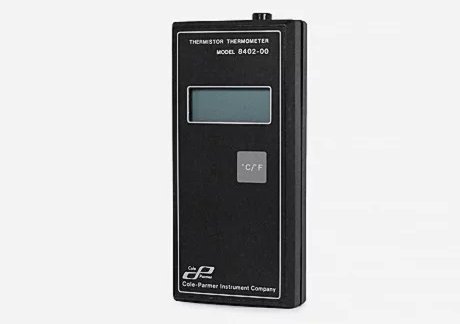
Image Credit: Scintica Instrumentation Inc.
This meter offers a visual representation of the temperature detected by any of the thermistor temperature sensors. The THS-TEE sensor connects directly to the TH-M meter. If the user wishes to observe the temperature in one of the vessel baths utilizing the THRS sensor, a specific cable is also necessary.
Accessories
pH meter and electrode
pH meter
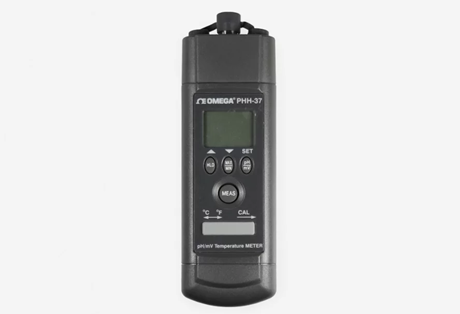
Image Credit: Scintica Instrumentation Inc.
This premium pH meter offers a constant display of pH levels. The pH electrode is linked to the meter through a BNC connector. It is compatible with PH-E or PH-TEE electrodes.
Source: Scintica Instrumentation Inc.
| Meter |
| pH Range |
0-14, 0.01 resolution |
| Power |
3 AAA batteries |
| Dimensions/ weight |
6.1″ H x 1.8″ W x 1.4″ D / 0.3 lb |
pH miniature electrode
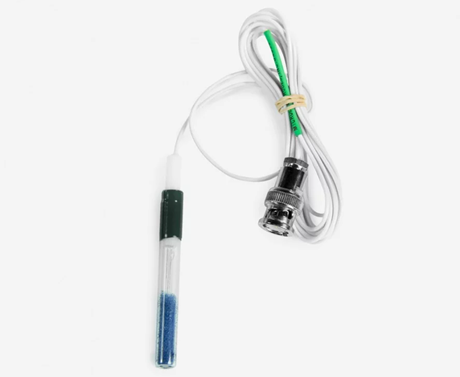
Image Credit: Scintica Instrumentation Inc.
This compact pH electrode facilitates ongoing pH monitoring within the bath solution of our vessel chambers. The PH-E is specifically designed to fit into the accessory port located on the top of our standard vessel chamber covers. A reference solution is provided. Standard BNC termination; compatible with the majority of pH meters.
Source: Scintica Instrumentation Inc.
| Electrode |
| pH Sensitivity |
0-14 |
| Response Time |
5-15 sec solution and electrode: 3 mM KCl & Ag/AgCl |
| Dimensions |
tip:∼1.2 mm diameter body: 2.5 mm diameter length: 26 mm |
pH miniature electrode
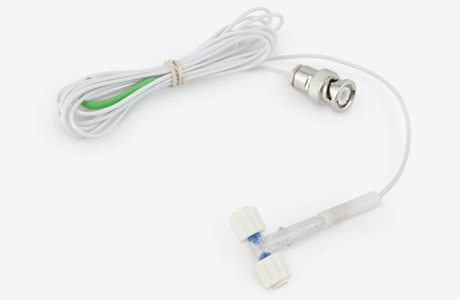
Image Credit: Scintica Instrumentation Inc.
This compact pH electrode facilitates ongoing pH monitoring within the bath solution of our vessel chambers.
The PH-E is specifically engineered to fit into the accessory port located on the top of the standard vessel chamber covers. A reference solution is provided. It features a standard BNC termination, allowing compatibility with the majority of pH meters.
Source: Scintica Instrumentation Inc.
| Electrode |
| pH Sensitivity |
0-14 |
| Response Time |
5-15 sec solution and electrode: 3 mM KCl & Ag/AgCl |
| Dimensions |
40 mm x 60 mm (excluding 2 m cable) |
Stimulators
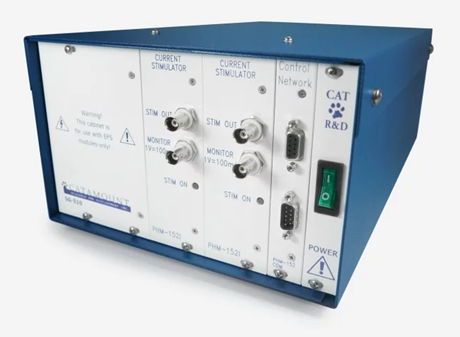
Image Credit: Scintica Instrumentation Inc.
Living System provides four packages (1, 2, 4, or 8 channels) designed for applications that necessitate electric field stimulation.
Each package comprises a constant current stimulator(s), a power supply cabinet, a computer interface card, CATSTIM software, and interface cables.
The output from each stimulator can be accessed through a BNC connector.
Features:
- Stimulator parameters are configured through the user-friendly CATSTIM software
- The isolated output removes the requirement for an external stimulus isolation unit
- A constant current stimulus is provided in a low impedance solution, such as physiological saline solution
- The isolated monitor output permits the user to observe the stimulus waveform on a separate oscilloscope
- It enables the execution of fully independent stimulation protocols within each tissue bath or vessel chamber
- It can be programmed to automatically administer a sequence of stimulations by utilizing protocol files to encode the stimuli
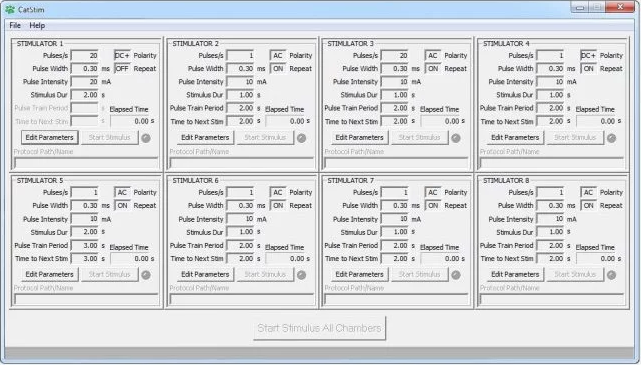
Image Credit: Scintica Instrumentation Inc.
Force transducer calibration kit
This convenient weight kit contains small weights that are beneficial for calibrating force transducers, including the one found in Living System’s wire myograph chamber.
The kit includes the following items:
- 1 gram weight
- 2 gram weight
- 5 gram weight
- 10 gram weight
- 20 gram weight
Each calibration weight is equipped with a threaded loop, facilitating easy suspension on the force transducer.
Hanging hooks of two different sizes are provided.
Accessory kit for wire myograph
This kit is provided with the purchase of a Wire Myograph Chamber. User can reorder this kit at any time, as it serves as a convenient means to maintain a collection of frequently used accessories.
The kit includes the following items:
- 3-way stopcocks (qty 2)
- 3/32″ Tygon tubing (1 ft.)
- COVER-SLIP-#1 (qty 10)
- ACC-DRIVER-T5 T5 Torx Driver Tool (qty 1)
- ACC-DRIVER-.035 0.035″ Hex Driver Tool (qty 1)
- ACC-BALL-DRIVER-1/16 1/16″ Ball Driver Tool (qty 1)
- ACC-BALL-DRIVER-.050 0.050″ Ball Driver Tool (qty 1)
- ACC-SCREWDRIVER-#1 #1 Phillips Screwdriver (qty 1)
- Glass Inflow and Outflow Tubes for Myograph chamber (qty 2 total)
- Wire for mounting microvessels (1 ft. each: 15 um, 20 um, 25 um, 30 um)
- Force Transducer Calibration Weights and Calibration Stand (1 each: 1, 2, 5, 10, 20 grams)
Wire myograph vessel holders
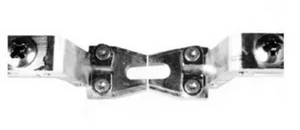
Microvessel Jaws. Image Credit: Scintica Instrumentation Inc.
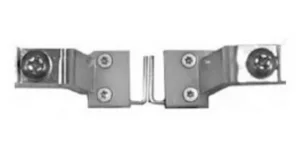
Large L-Bars. Image Credit: Scintica Instrumentation Inc.
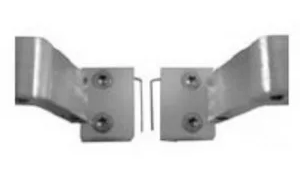
Small L-Bars. Image Credit: Scintica Instrumentation Inc.
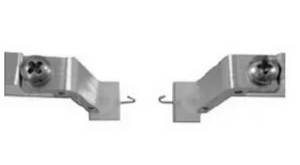
Strip Hooks. Image Credit: Scintica Instrumentation Inc.