The VelO2x system creates a controlled and isolated oxygen environment for small animal models, in particular mice and/or rats. By accurately replicating the oxygen conditions found in various disease or treatment scenarios, the VelO2x enables researchers to gain deeper insights into how O2 levels influence a range of conditions, including sleep apnea, systemic hypertension, pulmonary dysfunction, and ischemia, among others.
The VelO2x system comprises two main components: a gas mixer and an animal chamber. The ICONIC Gas Mixer provides precise control over O2 levels and is connected to the isolated chamber where the animals are housed. This chamber is available in two sizes: 31 L and 66 L, accommodating one and two cages, respectively.
Bundling systems
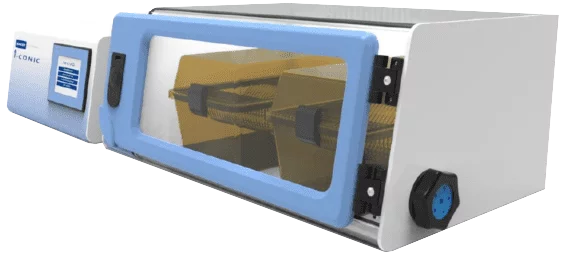
Image Credit: Scintica Instrumentation Inc
Tissue oxygen and/or flow – The OxyFlo and OxyLite systems can be used to evaluate the responses of various tissues to fluctuations in O2 levels.
Features and benefits
Full control of oxygen levels
Researchers possess the capability to regulate O2 levels ranging from 0.1 % to 23.0 % (with potential for increase). In contrast to other systems, the VelO2x is equipped by default with both static and dynamic O2 control features. This enables users to conduct studies based on chronic and intermittent hypoxia, and as research objectives evolve, the VelO2x adapts accordingly.
Rapid changes in O2 levels
In the 31L chamber, the oxygen concentration can be decreased from 20.9 % to 6 % within 15 seconds and increased from 6 % back to 20.9 % in 35 seconds. Likewise, the 66L chamber is capable of reducing oxygen from 20.9 % to 6 % in 30 seconds and raising it from 6 % to 20.9 % in 45 seconds.
Additionally, the ramping process can be conducted gradually over a duration of up to five minutes. Consequently, the user has complete authority to select the ramping method that is most suitable for their research objectives.
Ease of use
A completely integrated touch screen facilitates the easy adjustment of all parameters required for a specific experiment. Settings can be modified in real time.
All data regarding O2 and CO2 levels is continuously recorded onto a USB drive and can be transferred to any computer for analysis, validation, or verification of animal welfare.
The system's design allows for straightforward cleaning using standard laboratory cleaning agents (70 % ethanol or 70 % isopropanol) between uses.
Animal welfare
The design of the VelO2x system took into account animal welfare and safety. The system records all instances of O2 and CO2 levels in case submission to a regulatory committee is required. Additionally, sound levels have been assessed and are in accordance with animal welfare standards (less than 80 dB).
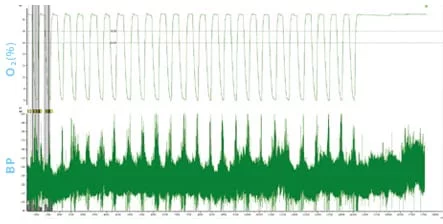
Blood pressure spikes correlate directly with exposure to chronic intermittent hypoxia. Image Credit: Scintica Instrumentation Inc
Applications
- Apnea/Apnoea - Acute hypoxia
- Apnea of prematurity - Chronic sporadic hypoxia
- SIDS (Sudden Infant Death Syndrome) - Hypoxia
- Sleep apnea - Chronic periodic intermittent hypoxia
- Atherosclerosis - Chronic moderate intermittent hypoxia
- Pulmonary fibrosis - Chronic or intermittent ozone exposure
- Developmental disabilities - Newborn chronic deep hypoxia
- Recreational hypoxia (Athletic conditioning) - Chronic periodic moderate hypoxia
- ADHD (Attention Deficit Hyperactivity Disorder) - Maternal gestational intermittent hypoxia
- Ocular angiogenesis - Abnormal blood vessel development in the eye is a significant cause of blindness.
- Ischemia - Acute hypoxia is generally associated with surgical clamping of a major artery (cardiac infarction, stroke, etc.)
- Occupational hypoxia/Altitude sickness (Airline, observatory astronomers, mining) - Chronic or periodic moderate hypoxia
- COPD (Chronic Obstructive Pulmonary Disease) -Chronic ozone exposure followed by moderate progressive chronic hypoxia
Specifications
Source: Scintica Instrumentation Inc
| General |
| Gases |
100 % N2 and O2 in N2 (percentage dependant on application) |
| Chamber volume |
31 L (1 animal cage) and 66 L (2 animal cages) chambers are available |
| Chamber working area |
31 L – 460 mm x 250 mm x 232 mm
66 L – 510 mm x 330 mm x 423 mm |
| Colour touch-screen |
Integrated |
| External USB port |
Integrated. Supports data recording |
| Physical dimensions (W x D x H) |
31 L – 592 mm x 270 mm x 363 mm
66 L – 642 mm x 350 mm x 474 mm |
| Weight |
20 Kg / 44 lbs |
| Operating temperature range (external) |
15 - 30 °C |
| Operating humidity range (external) |
Ambient and 90 % RH, Non-condensing |
| Universal cable gland |
2 included (each gland allows up to 6 cables to be inserted) |
| Oxygen |
| Oxygen control range |
0.1 % to 23.0 % (can be increased) |
| Oxygen resolution |
0.1 % |