Pressure arteriography is the gold standard for assessing function, reactivity, and mechanics in isolated perfused blood vessels. When conducting pressure arteriography, there are several aspects to consider.
In addition to the necessary surgical skills for isolating and cannulating small arteries, adequate instrumentation is critical. Pressure arteriography, while a strong instrument, is made up of several separate hardware and software components that must work together to function efficiently.
Living Systems Instrumentation is the sole provider of comprehensive pressure arteriography systems, which not only allow researchers to swiftly start their investigations but also ensure the quality and reproducibility of the data gathered.
Not only is LSI a pioneer in pressure arteriography, but they also have a lengthy and extensive publication history that demonstrates their established and cutting-edge arteriography systems.
While other options for individual arteriograph components are available from various sources, they require significant time investment to optimize, refine, and "debug," delaying the maintenance of a regular experiment schedule and frequently lacking the robustness required for data integrity and confidence.
Living Systems, with its extensive experience and vast knowledge base, is always there to assist and support all of the arteriography needs.
As with any research procedure, the primary focus should be on the data - not the tools. So, if the user is contemplating pressure arteriography, they can depend on the tried, tested, and true systems provided by Living Systems Instrumentation to produce reliable findings in a rapid and easy manner.
Constant pressure
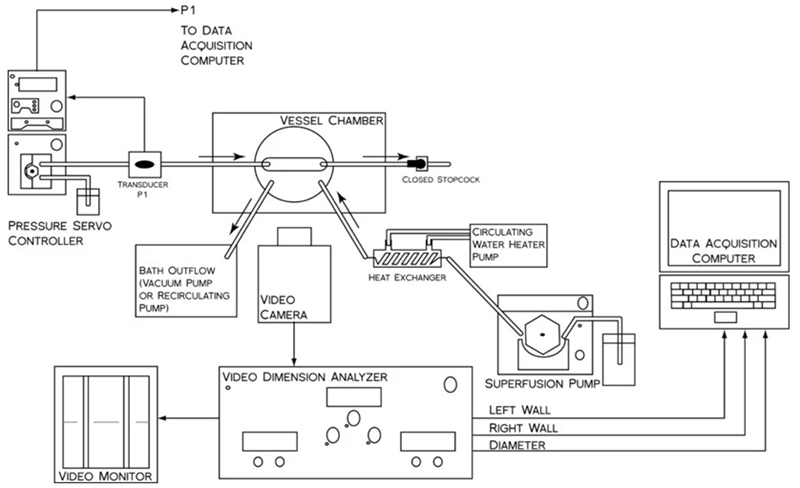
Image Credit: Scintica Instrumentation Inc.
- Key components include a pressure source, vessel chamber, means for temperature control, and data acquisition hardware/software
- The vast majority of applications are well-served by constant pressure with no intraluminal flow configuration
- Distal end of vessel is occluded
Constant pressure and flow
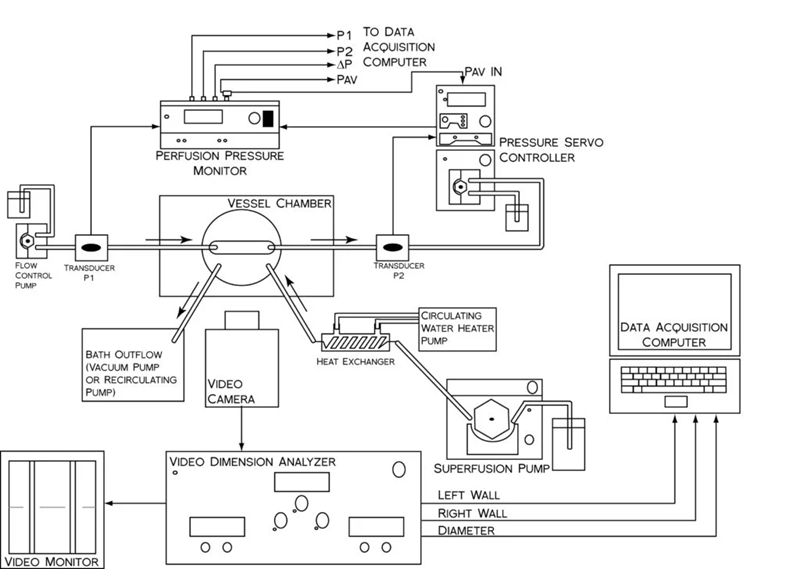
Image Credit: Scintica Instrumentation Inc.
- In addition to the basic items for managing intravascular pressure, users will require a pump to control intraluminal solution flow and a mechanism to monitor pressure on both sides of the cannulated vessel
- The setup for intravascular flow is a bit more difficult
- Distal end of vessel remains open
Parts of a pressure arteriography
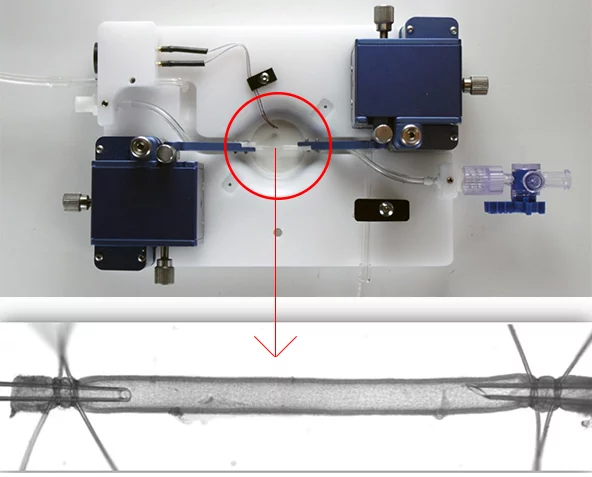
Image Credit: Scintica Instrumentation Inc.
- Vessel is mounted between the cannulae and tied in place with nylon thread (provided with the chamber)
- Superfusion of the desired buffer into the chamber and into the vessel
- Cannulae offer access to the vessel’s lumen
- Blood is flushed out of the vessel
Vessel chambers
Single vessel chamber
Most versatile chamber design
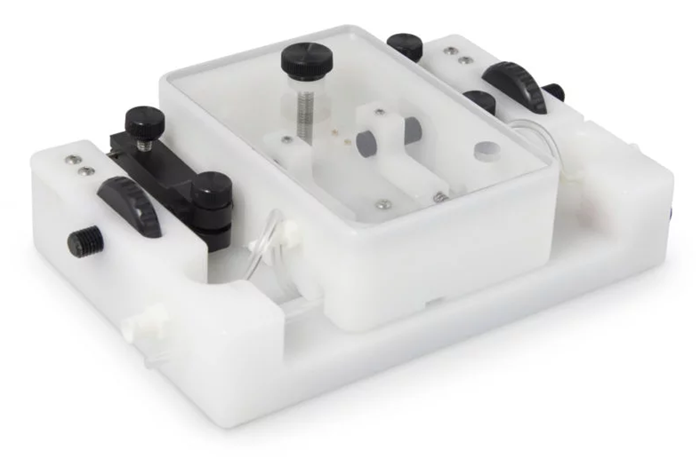
Image Credit: Scintica Instrumentation Inc.
Living Systems - Single Vessel Chamber
Video Credit: Scintica Instrumentation Inc.
The CH-1 is Living Systems’ most adaptable chamber design, and it is suitable for experiments that need vessel diameter measurements. This chamber is suitable for widefield and confocal microscopy, as well as standard transmitted light microscopy. It can visualize blood vessels as tiny as 30 µm in diameter.
The Living System temperature controller (TC-09S) allows users to directly regulate or monitor bath temperature. A bath thermistor sensor (THRS) is also required to monitor and manage bath temperature.
- Angled cannula holders help with placing the vessel at the bottom coverglass surface for confocal use or when operating distance is a concern
- Removable cover with gas ports for controlling atmospheric gas composition (e.g., hypoxia or anesthetic gases)
- Platinum stimulation electrodes (STIM-1) can be utilized for nerve/muscle electrical field stimulation
- Can be utilized with the temperature controller (TC-09S) for self-heating applications
- Bath temperature control is carried out by superfusion
- Straight cannula holders for general use
Source: Scintica Instrumentation Inc.
| Bath Volume |
Dimensions |
| 3-8 ml |
13.08 cm W x 3.58 cm H x 9.0 cm D |
Dual vessel chamber
Optimized experimental throughput
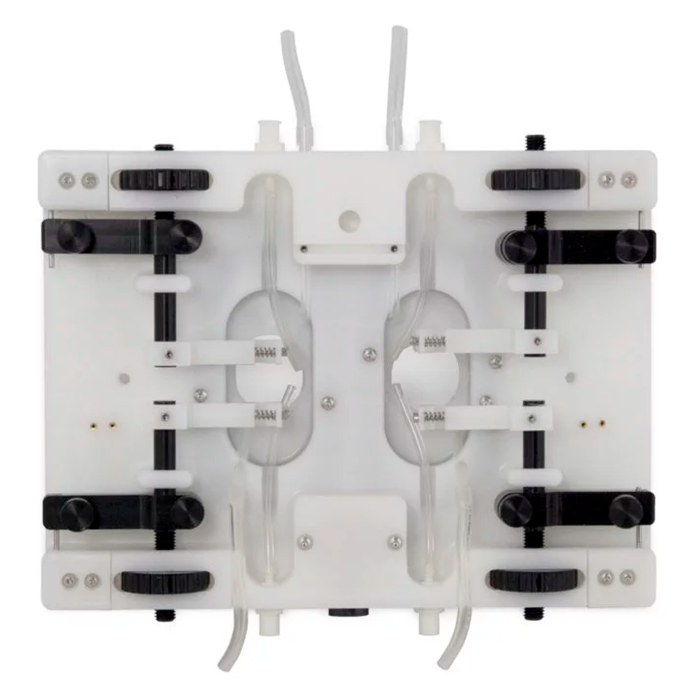
Image Credit: Scintica Instrumentation Inc.
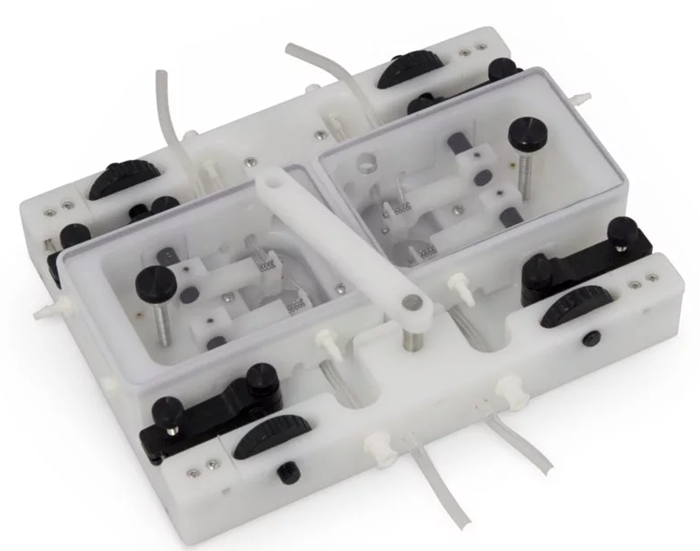
Image Credit: Scintica Instrumentation Inc.
Living Systems - Dual Vessel Chamber
Video Credit: Scintica Instrumentation Inc.
The CH-2 chamber optimizes experimental throughput by allowing two containers to be installed side by side. This chamber is suitable for wide-field or confocal fluorescence microscopy, as well as conventional transmitted light microscopy. The twin vessel chamber is useful for bioassays in which perfusate is channeled from one vessel to the next.
It can visualize blood vessels as tiny as 30 µm in diameter. The Living System temperature controller (TC-09D) allows users to directly regulate or monitor bath temperature. Each of the two vessel baths requires a bath thermistor sensor (THRS) to monitor or adjust bath temperature.
- When working distance is a problem, angled cannula holders enable the vessel to be positioned close to the bottom coverglass surface for confocal usage
- For electrical field stimulation of nerves and muscles, optional platinum stimulation electrodes (STIM-2) are available
- Removable covers with gas ports for controlling atmospheric gas composition (e.g., hypoxia or anesthetic gases)
- Check the temperature in each bath using a thermistor temperature sensor (THRS) (a meter is also necessary)
- Use with temperature controller (TC-09D) for self-heating applications
- Holder for pH electrode (PH-E) to monitor pH in either bath
- Used when two vessels need to operate at the same time
- Independent perfusion and superfusion ports
- Straight cannula holders for general use
Linear alignment vessel chamber
Ideal for new users
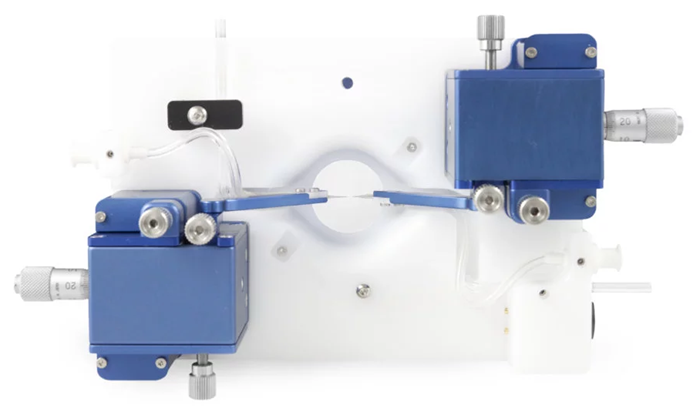
Image Credit: Scintica Instrumentation Inc.
Living Systems - Linear Single Vessel Chamber
Video Credit: Scintica Instrumentation Inc./YouTube.com
The CH-1-LIN Linear Alignment Vessel Chamber is Living System's most recent arteriograph design. Living Systems has added three-axis (X-Y-Z) linear controls to both the proximal and distal cannula arms. Cannulae can be readily aligned in three dimensions in seconds using simple thumb screws.
No special tools are required. The chamber is appropriate for new users of pressure arteriographs since cannula alignment has been substantially simplified.
- Cannula alignment is linear in all three axes. Greatly facilitates cannula alignment
- Proximal and distal cannulae are easily changed in three-dimensional space
- Available as a stand-alone chamber, or with self-heating capabilities
- Replacing broken glass cannulae has been simplified
- Optical window facilitating imaging studies
Self heated single vessel chamber
Heat the vessel chamber directly
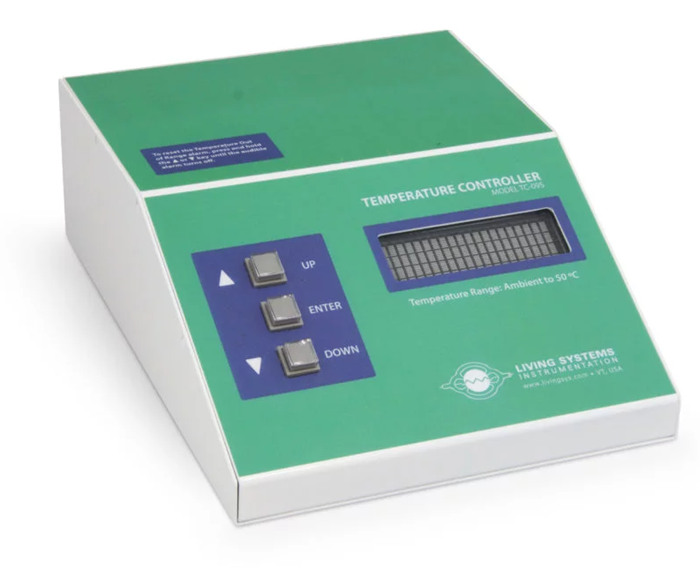
Image Credit: Scintica Instrumentation Inc.
Bath superfusion is not always a possibility, particularly when using costly peptides or other drugs. To reduce the amount of reagents required, many applications require a small volume of bath fluid. In these instances, heating the bath to physiological temperatures might be difficult.
However, the Living System's single vessel chamber (CH-1) and temperature controller (TC-09S) allow users to heat the vessel chamber directly to physiological temperatures. This package includes everything necessary to execute these self-heating experiments in a single vessel chamber.
Package components
- Heater, power, and signal output cables
- Thermistor temperature sensor (THRS)
- Temperature controller (TC-09S)
- Single vessel chamber (CH-1)
Self heated dual vessel chamber
Run experiments at physiological temperatures
Living System's CH-2-SH package is intended to give dual vessel chamber users the option of doing experiments at physiological temperatures in the absence of bath superfusion. This package includes everything necessary to conduct dual vessel chamber experiments by heating the dual vessel chamber (CH-2) directly to the required temperature.
Package components:
- Two thermistor temperature sensors (THRS)
- Heater, power, and signal output cables
- Temperature controller (TC-09D)
- Dual vessel chamber (CH-2)
Special chambers
Linear alignment large vessel chamber
For cannulation and perfusion of large hollow organ
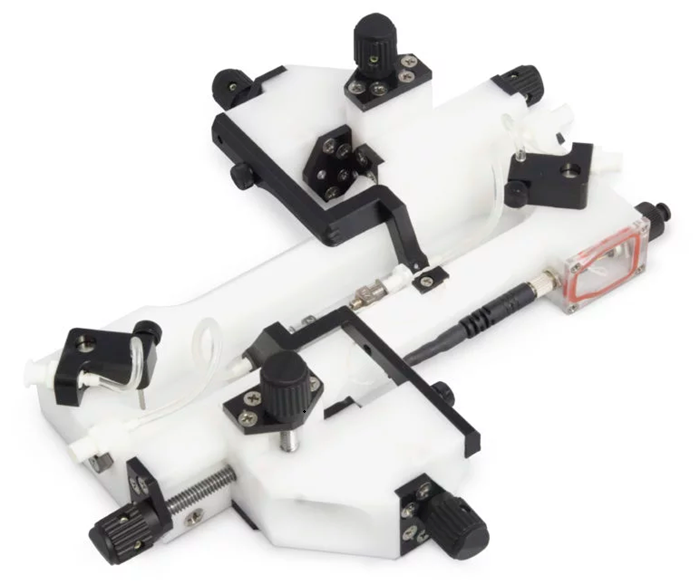
Image Credit: Scintica Instrumentation Inc.
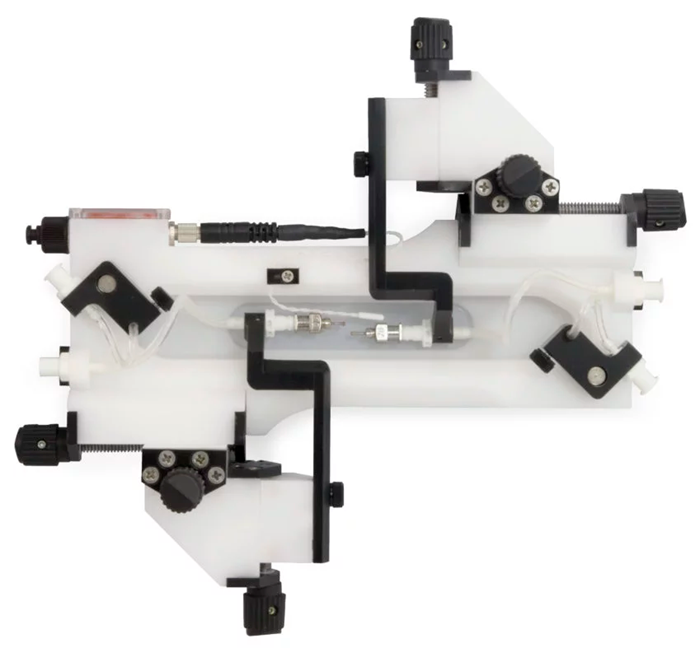
Image Credit: Scintica Instrumentation Inc.
Living Systems - Linear Alignment Large Vessel Chamber
Video Credit: Scintica Instrumentation Inc.
Suitable for cannulation and perfusion of large hollow organs such as blood vessels (e.g., aorta, carotid), intestine, airway, mid-gut, and colon. This chamber’s distinctive size makes it appropriate for a variety of applications, including insect midgut cannulation.
- New thermistor for monitoring bath temperature with an optional temperature controller (TC-09S, available separately)
- Optical viewing window for imaging research, perfect for backlighting and viewing via a stereoscope
- Both cannulae feature three axis (X-Y-Z) positioning for easy alignment and length adjustments
- Make changes in seconds using simple thumb screws, no additional equipment necessary
- Tubing barb allows thread ties to conveniently fasten the vessel attachment
- Can be used with 12, 14, 19, 22, and 25 gauge stainless steel canulae
- Waterproof connection port for the thermistor (IP67 rated)
- Rigid stainless steel cannulae are nearly indestructible
- Designed for superfusion applications
Notes
- Bath cannot be heated directly; heating of the superfusate line needs an external heat exchanger (BATH-HEAT-CIRC) (GHE) and a temperature controller (TC-09S)
- Chamber shown with 20 gauge cannulae, sold separately
Source: Scintica Instrumentation Inc.
Chamber
Material |
Mounting Type |
Vessel Size |
Dimensions |
Bath Volume |
| Delrin, stainless steel |
Stainless Steel Cannulae |
500 µ – 4 mm |
(overall): 8.22” L x 7.57” W x 2.39”
H (20.89 x 19.23 x 6.07 cm) |
50 ml |
Axially rotating single vessel chamber
Ideally suited for larger diameter vessels
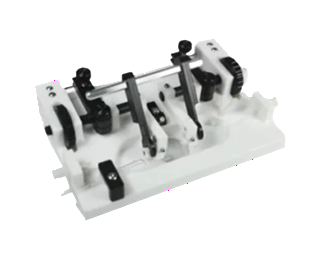
Image Credit: Scintica Instrumentation Inc.
Living Systems - Axially Rotating Single Vessel Chamber
Video Credit: Scintica Instrumentation Inc.
This axially rotating single vessel chamber spins the vessel to image nearby cell structures using confocal or Nomarski optics. This is handy for injecting caged agents and monitoring following inversion. The angled cannula holders bring the vessel close to the coverslip, allowing for simultaneous diameter and fluorescence measurements, while pressure and perfusion remain constant during rotation.
This chamber can accommodate optional standard cannula holders (RCH). It is best suited for bigger diameter vessels with longer lengths because of its longer bath.
Advantages
- Optional thermistor probe for bath temperature measuring (meter is needed)
- Chamber can be utilized for a variety of experimental purposes
- Cannulas rotate together to avoid vessel twist (tool included)
- Transmural electric field stimulation electrodes (optional)
- Vessel may be perfused and/or superfused
- Rotation angle continuously adjustable
Source: Scintica Instrumentation Inc.
| Bath Volume |
Dimensions |
| 6–10 ml |
13.08 cm W x 3.58 cm H x 9.0 cm D |
Quick transfer single vessel chamber
For rapid freezing or fixation of a cannulated and pressurized vessel
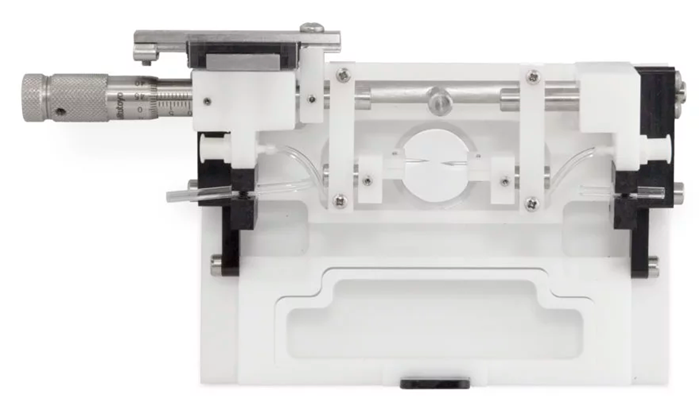
Image Credit: Scintica Instrumentation Inc.
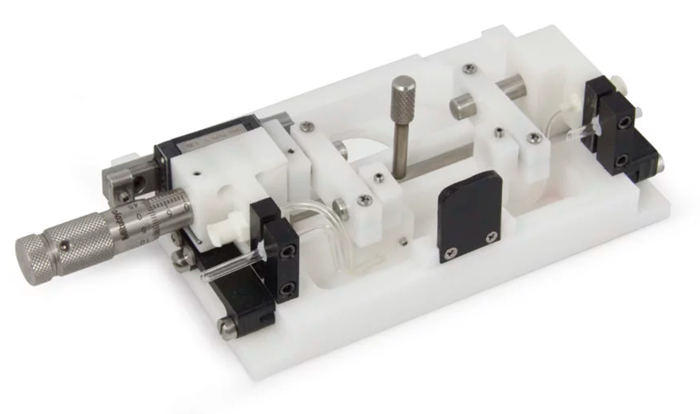
Image Credit: Scintica Instrumentation Inc.
Living Systems - Quick Transfer Single Vessel Chamber
Video Credit: Scintica Instrumentation Inc.
This chamber is intended for the quick freezing or fixation of a cannulated and pressurized vessel for biochemical or morphometric analysis.
A section of the CH-1-QT houses the experimental chamber, where a superfused vessel may be tested for diameter responses to pharmacological drugs, pressure, flow, and so forth.
Using the video dimension analyzer (VDA-10), a glass coverslip makes the vessel visible for lumen diameter and wall measurements. A detachable tray can be placed in the well in the opposite part.
The vessel and its tubing connections are swiftly (~1 sec) moved from the chamber to the tray using a lever arm. In this manner, the freezing or fixation procedure can preserve the vessel's physiological condition (pressure, myogenic tone, etc.). The CH-1-QT can easily withstand the low temperature of liquid nitrogen, several fixing solutions, or an acetone-dry ice freezing solution.
Source: Scintica Instrumentation Inc.
| Bath Volume |
Dimensions |
Working Distance |
| 6-10 ml |
13.08 cm W x 4.11 cm H x 9.0 cm D |
Requires minimum 1.8 mm WD objective lens |
Perfusion chamber with metal block for magnetic accessories
Ideal for cellular physiology studies: Requiring bath superfusion in a low volume.
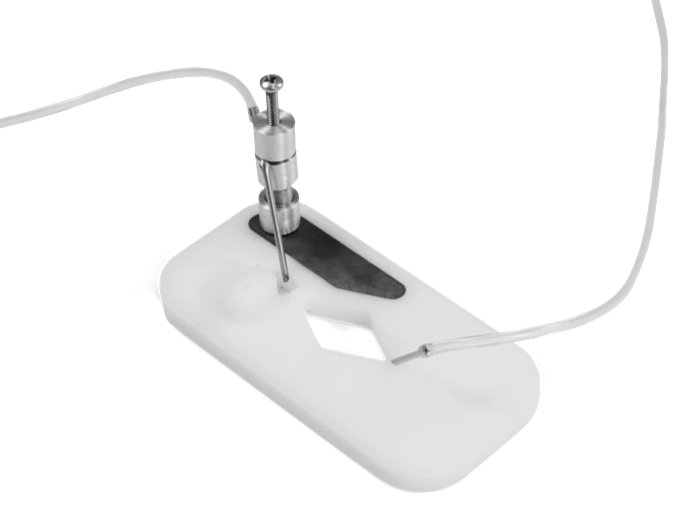
Image Credit: Scintica Instrumentation Inc.
For cellular physiology research needing low-volume bath superfusion, this tiny perfusion chamber is perfect.
The chamber fits onto the stage of an inverted microscope. Inflow and outflow tubes each include mounting holes. Additionally, users can utilize magnetic accessories by connecting them to the embedded metal block.
Does not contain the magnetic tube holder accessory.
Source: Scintica Instrumentation Inc.
| Base/Width |
Tube Pedestal: |
Metal Block: |
Bath Volume
(approximate): |
44.5 mm Length: 88.9 mm
Thickness: 6.4 mm |
5.8 mm Tall |
Width: 11.1 mm
Length: 43.3 mm |
0.5 to 0.8 ml |
Sealed single vessel chamber
Versatile sealed single vessel chamber
Living Systems - Sealed Vessel Chamber
Video Credit: Scintica Instrumentation Inc.
This multifunctional sealed single vessel chamber is suitable for long-term vessel perfusion, vessel culture, gene transfer, remodeling research, and extravascular compression.
Features
- Angled cannula holders for concurrent diameter and fluorescence (e.g., Ca2+) or confocal measurements
- Chamber can be utilized for a variety of experimental applications
- Steady or pulsatile pressures may be applied extravascularly
- Not compatible with platinum stimulation electrodes (stim-1. stim-2)
- Vessel may be perfused and/or superfused
- Also available in self-heating model
- Removable cover
Source: Scintica Instrumentation Inc.
| Bath Volume |
Dimensions |
| 3-8 ml |
13.08 cm W x 5.21 cm H x 11.1 cm D |
Sealed vessel self heated chamber
Self-heated package
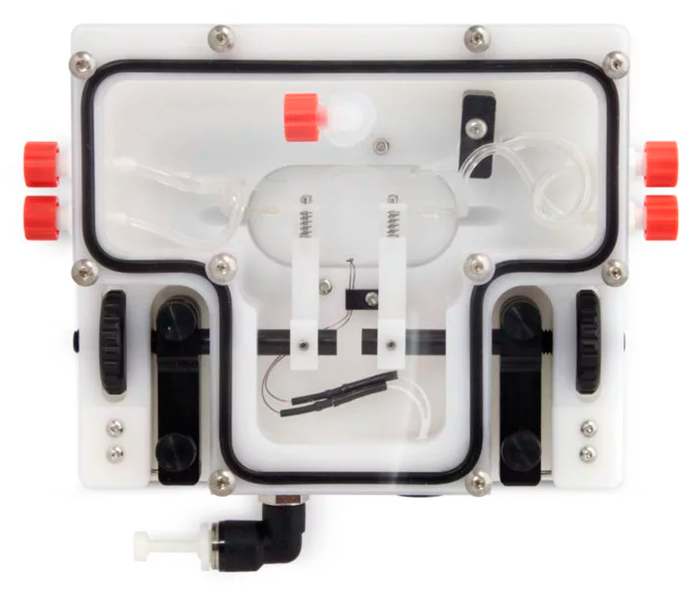
Image Credit: Scintica Instrumentation Inc.
This is the self-heated package that includes Living System's CH-1-AU Sealed Single Vessel Chamber.
Package includes
- Heater, signal output, and power cables
- CH-1-AU Sealed Vessel Chamber
- TC-09S Temperature Controller
- THRS Thermistor