From RevvityReviewed by Olivia Frost
This article and associated images are based on a poster originally authored by Johanna De Castro Arce, Andrew Riching, Emily Feldman, Allyson Malloy, Clarence Mills, and Josien Levenga and presented at ELRIG Drug Discovery 2026 in affiliation with Revvity, Inc.
This poster is being hosted on this website in its raw form, without modifications. It has not undergone peer review but has been reviewed to meet AZoNetwork's editorial quality standards. The information contained is for informational purposes only and should not be considered validated by independent peer assessment.

Abstract
The CRISPR-Cas system, originally an adaptive defense mechanism in bacteria and archaea, has been widely repurposed for genome editing and transcriptional regulation through dCas9 fusion proteins (CRISPRa and CRISPRi). All modalities rely on sgRNA-guided targeting for precise genome editing or gene-expression modulation.
Delivery of multiple synthetic sgRNAs targeting the same gene enhances CRISPRa- or CRISPRi-mediated activation or repression, while targeting different genes enables simultaneous gene knockouts or transcriptional modulation. Although delivery of two or more sgRNAs from a single vector via plasmid transfection, electroporation, or viral transduction has been widely demonstrated, achieving consistent editing or transcriptional modulation across multiple targets remains challenging.
In light of these challenges, researchers have recently described the Dharmacon DyadGuide™ dual-sgRNA expression system (patent pending), a single engineered bidirectional RNA polymerase III promoter that drives expression of two sgRNAs from one vector. This approach is compatible with multiple lentiviral delivery strategies, including "all-in-one" vectors containing both guides and Cas9/dCas9 fusion proteins.
Both sgRNAs expressed from the DyadGuide promoter showed comparable functionality regardless of whether they were expressed from the sense or antisense strand. Moreover, the platform outperformed all tested variants of the conventional sequential promoter approach, which uses two tandem U6 promoters to independently express each sgRNA.
The platform is also compatible with inducible Cas9/dCas9 systems, including Dharmacon's Strict-R™, enabling precise temporal and tunable control of multiple genes. Using Strict-R-inducible CRISPRa with the dual-sgRNA system, the researchers achieved efficient co-induction of two transcription factors in iPSCs, driving differentiation into astrocytes with cytokine release profiles comparable to primary astrocytes.
Using Strict-R-inducible Cas9, they also elucidated the mechanisms underlying the growth restriction observed following simultaneous MAP2K1 and MAP2K2 knockout in Hs936.T cells.
Collectively, these results establish the DyadGuide dual-sgRNA platform as a robust and versatile solution for uniform bidirectional expression of multiple sgRNAs, enabling precise, scalable, and multiplexed CRISPR-based genome engineering and transcriptional modulation.
Introducing DyadGuide: A bidirectional dual-sgRNA expression platform
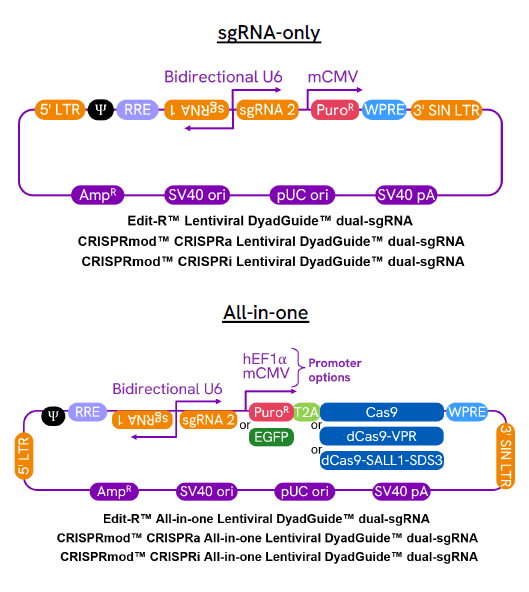
Figure 1. Schematic representation of bidirectional promoter vector maps containing either dual sgRNAs (top) or dual sgRNAs with Cas9/dCas9 effector proteins (bottom). Image Credit: Image courtesy of Johanna De Castro Arce et al., in partnership with ELRIG (UK) Ltd.
DyadGuide bidirectional promoter enables multiple CRISPR modalities
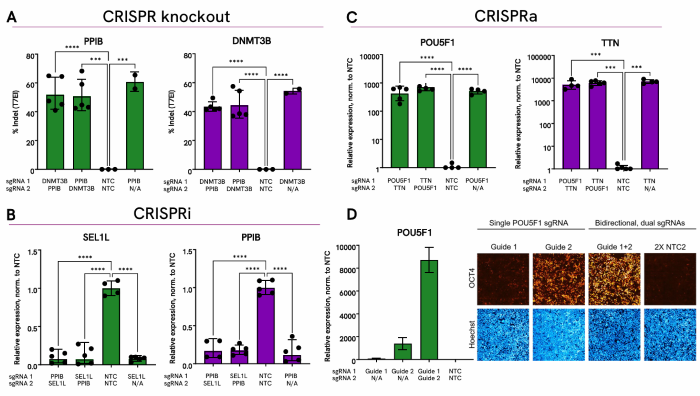
Figure 2. A–D) U2OS cells were transduced with bidirectional or single-sgRNA "all-in-one" lentiviral particles to evaluate dual-guide efficacy for CRISPR knockout (A, T7EI assay), CRISPRi (B, RT-qPCR), and CRISPRa (C–D, RT-qPCR and OCT4 immunofluorescence). In A–C, dual sgRNAs targeted two different genes, while in D, two sgRNAs targeted POU5F1, resulting in synergistic activation of OCT4 mRNA and protein expression. Image Credit: Image courtesy of Johanna De Castro Arce et al., in partnership with ELRIG (UK) Ltd.
Bidirectional promoter outperforms conventional sequential promoter strategies
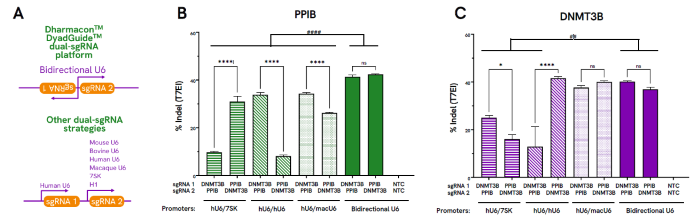
Figure 3. A) Schematic representation of sgRNA transcription from the bidirectional U6 promoter versus conventional dual promoter strategies. B–C) Indel formation at the PPIB (B) and DNMT3B (C) loci, measured by T7EI assay in U2OS cells eight days after transduction with "all-in-one" lentiviral particles expressing Cas9 and two sgRNAs from either the bidirectional promoter or various sequential Pol III promoter combinations. Image Credit: Image courtesy of Johanna De Castro Arce et al., in partnership with ELRIG (UK) Ltd.
Inducible double knockout of MAP2K1 and MAP2K2 impairs cell outgrowth through reduced proliferation
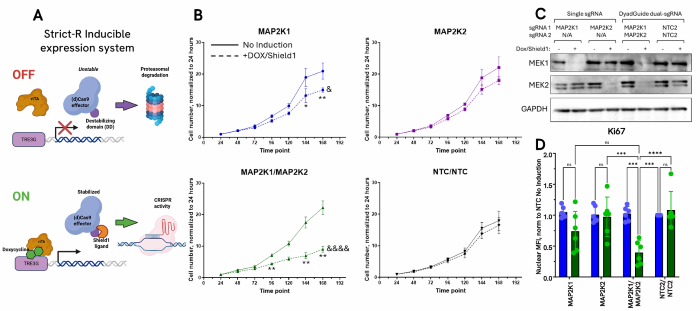
Figure 4. A) Schematic overview of the Strict-R inducible Cas9/dCas9 expression system. B) Growth kinetics of Hs936.T cells stably expressing Strict-R Cas9 and either a single sgRNA targeting the indicated gene or dual sgRNAs targeting both genes following induction with doxycycline and Shield1 (dashed lines) compared with uninduced controls (solid lines). C) Protein expression levels in transduced Hs936.T cells 96 hours after induction with doxycycline and Shield1 relative to uninduced controls. D) Ki-67 nuclear median fluorescence intensity in transduced Hs936.T cells nine days after induction with doxycycline and Shield1 compared with uninduced controls. Image Credit: Image courtesy of Johanna De Castro Arce et al., in partnership with ELRIG (UK) Ltd.
Inducible NFIA/SOX9 activation enhances astrocyte differentiation
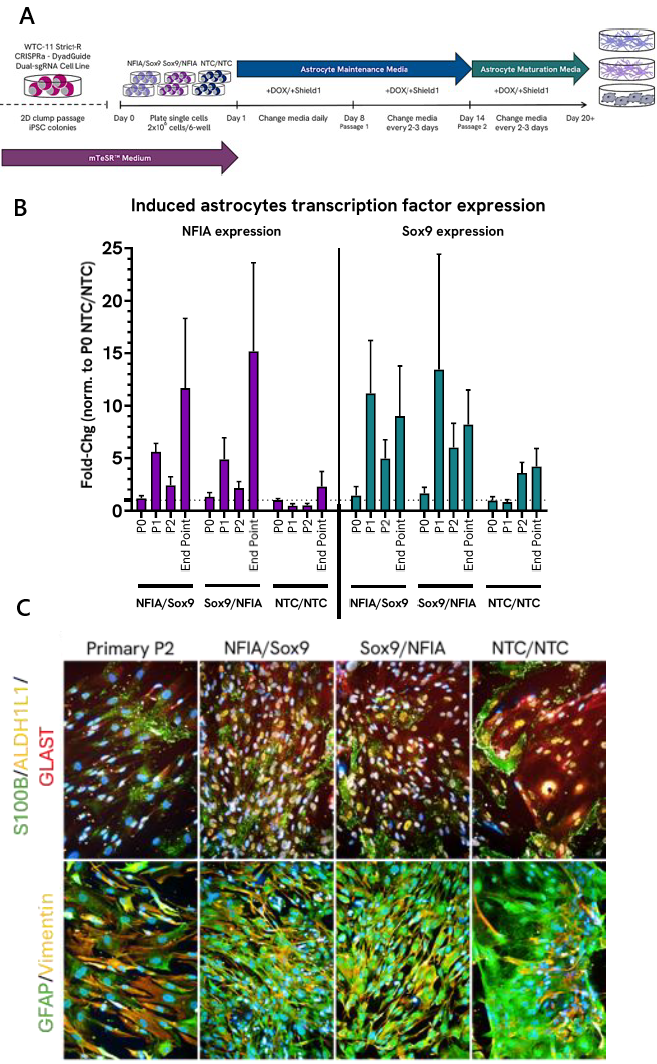
Figure 5. A) Schematic overview of induced astrocyte differentiation from WTC-11 iPSCs. B) Relative NFIA and SOX9 mRNA levels in undifferentiated WTC-11 iPSCs stably expressing Strict-R dCas9-VPR and a bidirectional dual-sgRNA construct (P0), and during astrocyte differentiation (P1, P2, and Endpoint). C) Immunofluorescence staining of astrocyte markers S100B, ALDH1L1, GLAST, GFAP, and Vimentin in day 20 WTC-11-derived induced astrocytes. Image Credit: Image courtesy of Johanna De Castro Arce et al., in partnership with ELRIG (UK) Ltd.
Conclusions
- Dual-gene targeting achieves mRNA activation and repression levels comparable to single-gene targeting using the bidirectional promoter.
- Two sgRNAs targeting the same gene can synergistically enhance CRISPRa-mediated gene activation.
- The bidirectional promoter delivers more uniform dual-sgRNA expression and more consistent gene knockout than sequential Pol III promoter strategies, with minimal impact from sgRNA orientation.
- Dual-gene targeting can generate stronger phenotypic effects than single-gene targeting.
About Revvity
Revvity provides health science solutions, technologies, expertise, and services that deliver complete workflows from discovery to development, and diagnosis to cure.
Revvity is pushing the limits of what’s possible in healthcare, with specialized focus areas in translational multi-omics technologies, biomarker identification, imaging, prediction, screening, detection and diagnosis, informatics and more.
About ELRIG (UK) Ltd.
The European Laboratory Research & Innovation Group (ELRIG) is a leading European not-for-profit organization that exists to provide outstanding scientific content to the life science community. The foundation of the organization is based on the use and application of automation, robotics and instrumentation in life science laboratories, but over time, we have evolved to respond to the needs of biopharma by developing scientific programmes that focus on cutting-edge research areas that have the potential to revolutionize drug discovery.
Comprised of a global community of over 12,000 life science professionals, participating in our events, whether it be at one of our scientific conferences or one of our networking meetings, will enable any of our community to exchange information, within disciplines and across academic and biopharmaceutical organizations, on an open access basis, as all our events are free-of-charge to attend!
Our values
Our values are to always ensure the highest quality of content and that content will be made readily accessible to all, and that we will always be an inclusive organization, serving a diverse scientific network. In addition, ELRIG will always be a volunteer led organization, run by and for the life sciences community, on a not-for-profit basis.
Our purpose
ELRIG is a company whose purpose is to bring the life science and drug discovery communities together to learn, share, connect, innovate and collaborate, on an open access basis. We achieve this through the provision of world class conferences, networking events, webinars and digital content.
Sponsored Content Policy: News-Medical.net publishes articles and related content that may be derived from sources where we have existing commercial relationships, provided such content adds value to the core editorial ethos of News-Medical.net, which is to educate and inform site visitors interested in medical research, science, medical devices and treatments.
Last Updated: Nov 3, 2026
 Launching Revvity: A Scientific Solutions Company Powering Innovation from Discovery to Cure