Introduction: What is food synergy?
Everyday examples of food synergy
From individual foods to dietary patterns: The power of combined behaviors
Complementary lifestyle changes: What the Evidence supports
Where supplements fit: Can pills replace food synergy?
References
Further reading
What happens when nutrients share a meal? From plant-based iron to dietary fats, food pairings offer clues to how the body uses what we eat.
 Image Credit: Lightspring / Shutterstock.com
Introduction: What is food synergy?
Nutrition research spent much of the 20th century focusing on single molecules like vitamin C, calcium, and beta-carotene, an approach that helped identify and treat nutrient deficiencies. Later research on chronic disease showed that isolated nutrients do not consistently reproduce the health effects associated with the foods that contain them.1,3
Whole foods consist of a complex matrix comprised of nutrients, water, and other constituents, including fiber and bioactive compounds in plant foods, that interact during digestion, absorption, and metabolism in ways a single supplement cannot fully replicate.1,2 This has given rise to the concept of food synergy, which describes additive or greater-than-additive effects of foods and their components on health. Food synergy provides a basis for studying whole foods and dietary patterns alongside individual nutrients, without assuming that every combination is superior to its separate components.2,3
Several mechanisms appear to drive food synergy. Some compounds increase another's absorption, while others affect digestion rates. Interactions with the gut microbiome can also modify how the colon metabolizes food compounds.
Overlapping effects on cellular signaling pathways may increase or reduce biological responses, depending on the compound and outcome.2 Evidence for these mechanisms varies, and a combined treatment producing a benefit does not by itself demonstrate a greater-than-additive effect. Thus, future trials need appropriate comparisons with the individual components to establish that distinction.2
The food matrix, which reflects the physical and chemical architecture in which nutrients exist within food, is central to food synergy. Nutrients are not evenly or freely distributed within plant or animal tissues; instead, they are embedded in cell walls, fat globules, or protein structures that affect how readily digestion releases them.4 Disrupting plant cell structures can improve the availability of some nutrients; therefore, an intact matrix does not invariably produce greater absorption.6
For example, within the beef matrix, muscle tissue contains saturated fat, protein, and micronutrients. Dairy foods show a comparable pattern, wherein the food's structure, fermentation, and accompanying nutrients can influence fat digestion and physiological responses across different dairy products.4 These matrix effects should be interpreted within the total dietary pattern; they do not establish that a food is beneficial regardless of its composition or the food it replaces.5,7
Food Synergy
Everyday examples of food synergy
Pairing vitamin C-rich foods with plant-based iron sources improves non-heme iron uptake. This combination is especially relevant for vegetarians and others who rely on legumes and vegetables as their primary iron source.3,6 The effect is best established for absorption from individual meals; its influence on long-term iron status also reflects the rest of the diet and the individual's requirements6
A similar principle applies to fat-soluble compounds, where carotenoids like beta-carotene are absorbed more efficiently when vegetables are consumed alongside a source of dietary fat, since the fat aids in forming the micelles needed for the intestinal uptake of carotenoids.6
Peptides released from casein and whey components can help keep calcium in solution during digestion, supporting absorption. Calcium and phosphorus also contribute to bone mineralization, though their ratio alone does not determine calcium uptake.
Vitamin D and physiological needs also regulate absorption, separate from calcium retention in bone. Oxalates and phytates in some plant foods can bind calcium in the gut and reduce absorption, even from foods with high total calcium content.6
Within plant-based foods, the fiber complex comprises fiber and a broad range of bioactive compounds that typically accompany it. Research on whole grains suggests that fiber alone may not explain all the health associations of these foods. This supports studying fiber alongside its accompanying compounds, while still allowing for the benefits of particular fiber supplements.3
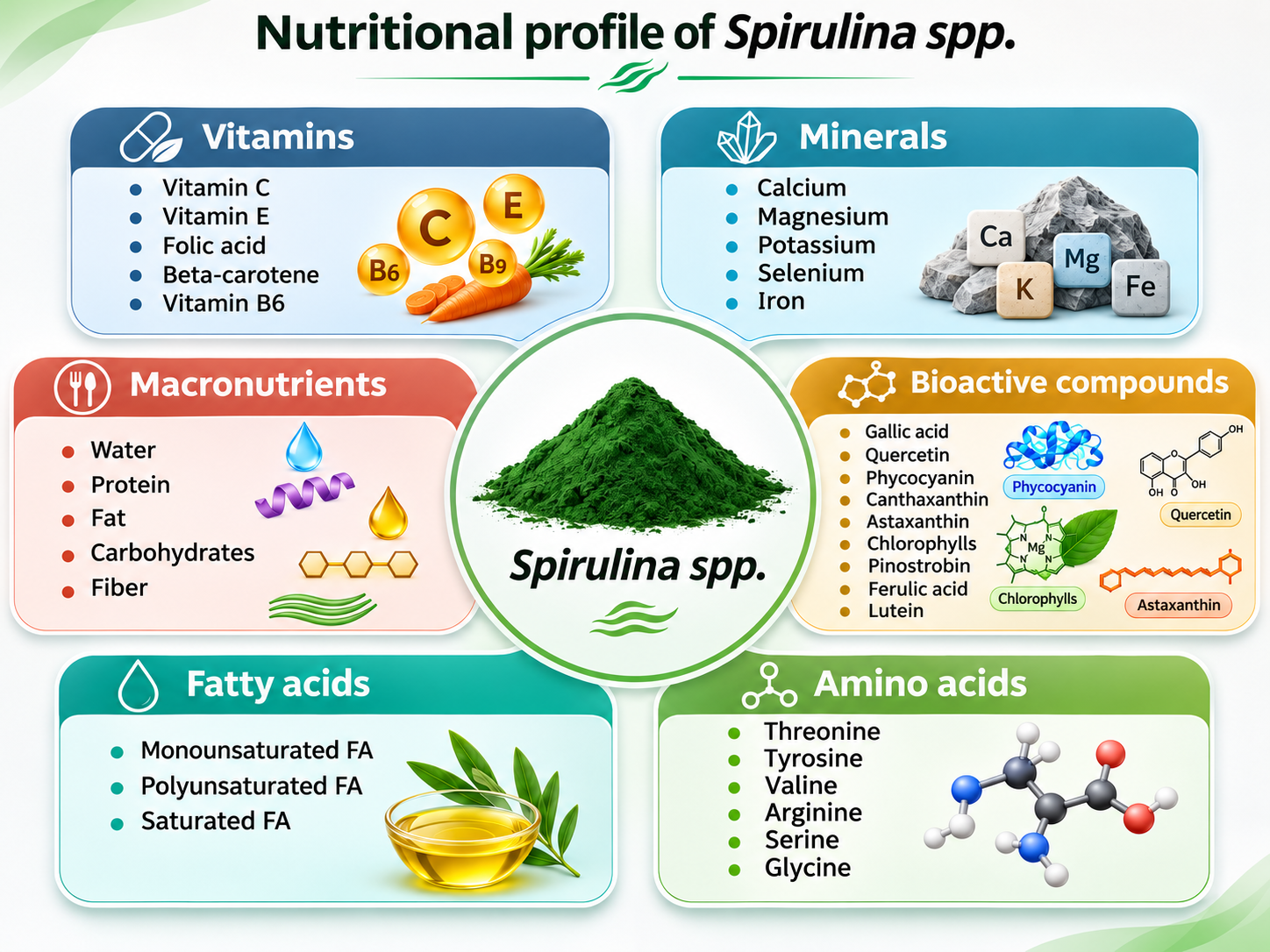
Example of Nutrient Synergy in foods (Spirulina spp.). This figure illustrates the diverse array of nutrients found in foods, highlighting their vital roles in supporting human health and well-being. In addition to macronutrients, foods provide an intricate blend of micronutrients, phytonutrients, and bioactive compounds, each contributing to various physiological functions. FA, fatty acid.2
From individual foods to dietary patterns: The power of combined behaviors
Food synergy isn't confined to nutrient pairs within a single meal; it also operates at the level of entire dietary patterns. The Mediterranean diet, which combines diverse plant foods, unsaturated fats from olive oil, regular seafood intake, and lower consumption of red and processed meats, refined grains, and sugary foods, is one of the most well-studied examples of food synergy.7,8
Evidence supports cardiovascular benefits from Mediterranean dietary patterns, but separating the contributions of individual foods and their interactions is difficult. These findings support evaluating the complete pattern, but do not prove it outperforms every component tested individually.7
Diet does not operate independently of other lifestyle behaviors. Studying diet and physical activity together extends the discussion to interactions between behaviors, a separate question from interactions within foods.8
 Image Credit: trirama17 / Shutterstock.com
Complementary lifestyle changes: What the Evidence supports
Research on dietary patterns supports considering complementary food choices together, but does not identify the smallest combination of dietary and activity changes needed to improve health.1,7,8 Adding a serving of legumes to an existing meal, pairing vegetables with a source of healthy fat, increasing the variety of plant foods eaten across a week, or replacing a highly processed snack with a minimally processed alternative are examples of changes consistent with these dietary principles. Their effects depend on the foods selected, the overall diet, and what they replace.6,7
The phrase “minimum combined lifestyle increment” describes an approach based on complementary changes, but the literature has no validated definition or established effective dose. Evidence for healthy dietary patterns and physical activity supports considering both behaviors, though the additional benefit attributable to their interaction remains uncertain.7,8
Where supplements fit: Can pills replace food synergy?
Supplements can correct diagnosed nutrient deficiencies. In some circumstances, such as certain medical conditions or restrictive diets, supplementation is appropriate and necessary.1
In general, isolated supplements do not reproduce the full composition and structure of whole foods. Once separated from the proteins, fats, and fibers that normally accompany them, isolated compounds may be absorbed differently, and their physiological effects can vary with dose, formulation, and interactions with other dietary components.1,2 Different absorption does not automatically mean poorer absorption: the food matrix can either promote or inhibit nutrient availability.6
A “food first” approach favors foods as the usual source of nutrients while retaining targeted supplementation where needed. Its rationale is that foods supply multiple nutrients and other compounds together, and the biological environment surrounding a nutrient can influence its effects.1
References
- Jacobs, D. R., Jr., Gross, M. D., & Tapsell, L. C. (2009). Food synergy: An operational concept for understanding nutrition. The American Journal of Clinical Nutrition, 89(5), 1543S- 1548S. DOI: 10.3945/ajcn.2009.26736B. https://www.sciencedirect.com/science/article/pii/S000291652323823X?via%3Dihub
- Townsend, J. R., Kirby, T. O., Sapp, P. A., et al. (2023) Nutrient synergy: Definition, Evidence, and future directions. Frontiers in Nutrition 10. DOI: 10.3389/fnut.2023.1279925. https://www.frontiersin.org/journals/nutrition/articles/10.3389/fnut.2023.1279925/full.
- Jacobs, D. R. & Steffen, L. M. (2003). Nutrients, foods, and dietary patterns as exposures in research: a framework for food synergy. The American Journal of Clinical Nutrition, 78(3 Suppl), 508S- 513S. DOI: 10.1093/ajcn/78.3.508S. https://www.sciencedirect.com/science/article/pii/S0002916522033482?via%3Dihub
- Cifel,li C. J. (2021). Looking beyond traditional nutrients: The role of bioactives and the food matrix on health. Nutrition Reviews 79(Suppl, 1- 31-3. DOI: 10.1093/nutrit/nuab100. https://academic.oup.com/nutritionreviews/article/79/Supplement_2/1/6457114
- Klurfeld D. M. (2024). The whole food beef matrix is more than the sum of its parts. Critical Reviews in Food Science and Nutritiont64, 4523- 4531. DOI: 10.1080/10408398.2022.2142931. https://www.tandfonline.com/doi/full/10.1080/10408398.2022.2142931.
- Melse-Boonstra A. (2020). Bioavailability of micronutrients from nutrient-dense whole foods: Zooming in on dairy, vegetables, and fruits. Frontiers in Nutrition 7; 101. DOI: 10.3389/fnut.2020.00101. https://www.frontiersin.org/journals/nutrition/articles/10.3389/fnut.2020.00101/full.
- Tapsell, L. C., Neale, E. P., Satija, A., & Hu, F. B. (2016). Foods, nutrients, and dietary patterns: Interconnections and implications for dietary guidelines. Advances in Nutrition 7(3); 445-454. DOI: 10.3945/an.115.011718. https://www.sciencedirect.com/science/article/pii/S2161831322007323?via%3Dihub
- Hershey, M. S., Martínez-González, M. Á., Álvarez-Álvarez, I., et al. (2022). The Mediterranean diet and physical activity: better together than apart for the prevention of premature mortality. The British Journal of Nutrition 128(7); 1413-1424. DOI: 10.1017/S0007114521002877. https://www.cambridge.org/core/journals/british-journal-of-nutrition/article/mediterranean-diet-and-physical-activity-better-together-than-apart-for-the-prevention-of-premature-mortality/B78B188D114FE7762330EB690E7DFEBA
Further Reading
Last Updated: Nov 2, 2026
 Can maternal diet prevent infant food allergy? A large trial puts eggs and peanuts to the test