A detailed analysis of thousands of products reveals striking differences between manufacturers and pinpoints where changes within existing portfolios could have the greatest impact.

Article: Large nutritional and environmental improvements can be achieved across the product portfolios of major UK food and beverage manufacturers. Image Credit: ultramansk / Shutterstock
In a recent study published in the journal Nature Food, researchers assessed the environmental and nutrition scores of food and beverage (F&B) manufacturers in the United Kingdom (UK).
The types of food produced and sold by F&B manufacturers must change to make food systems more environmentally sustainable and nutritious. While manufacturers have established targets for product quality and sustainability, voluntary reporting and pledges have largely failed to improve the environmental sustainability and nutritional value of food sales in the UK, with the government now planning to mandate reporting of healthy food sales for all large food companies as part of the 10 Year Health Plan for England.
The study and findings
In the present study, researchers evaluated the nutrition and environment scores of UK F&B manufacturers. First, they linked the Euromonitor and foodDB datasets to assess the environmental impact and nutritional quality of manufacturers that account for 51.5% of the UK F&B retail market. The Euromonitor dataset provided sales value data for manufacturers, brands, and categories in 2019.
The foodDB dataset provided quantitative information on the quality and impact of more than 57,000 food products in 2019. FoodDB products were first stratified into 31 categories based on Euromonitor sales categories. Individual products were then attributed to manufacturers, resulting in the linkage of 15,673 unique foodDB items to Euromonitor, spanning 396 brands and 44 manufacturers.
The team then estimated the average nutritional quality and environmental impact scores for all products within each brand by sales category and weighted the resulting category- and manufacturer-level metrics by Euromonitor sales value. For the nutritional quality score, they used the nutrient profiling model, which includes seven characteristics of a food item to estimate an overall nutrition score. For the environmental impact score, the team aggregated four indicators: eutrophication, water use, land use, and greenhouse gas emissions, into a composite indicator.
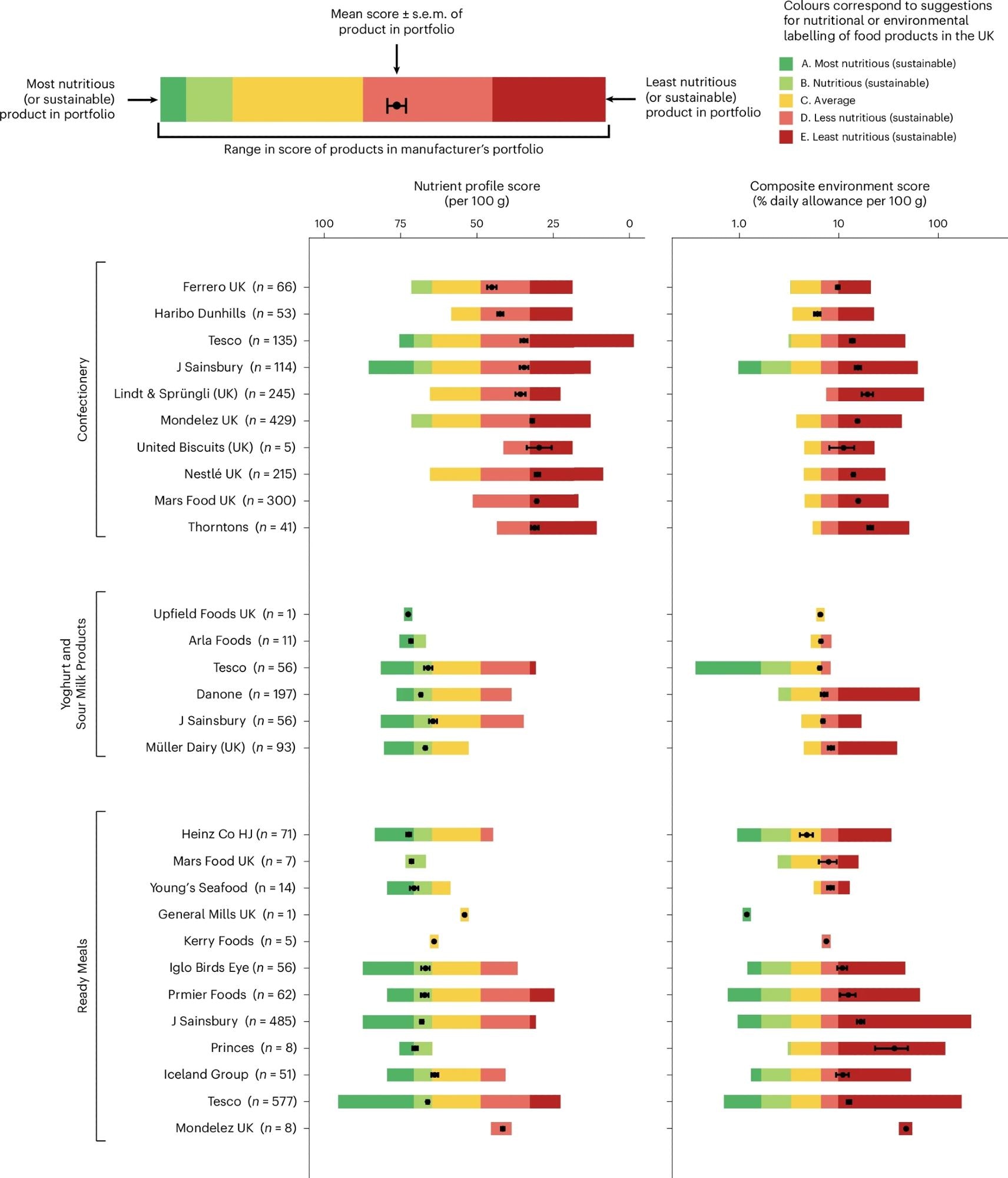
The colored bars indicate the range of nutrition or environmental scores in the product portfolio, from the most sustainable or nutritious product (left side of the bar) to the least sustainable or nutritious product (right side of the bar). The colors correspond to the A (dark green, best) to E (dark red, worst) letter bandings recommended for UK food-related nutritional or environmental labeling. Black points indicate the mean score of all products for that food category and manufacturer; error bars show one standard error around the mean. The food categories and manufacturers are ordered by overall sustainability, from top to bottom. The figure is limited to the Confectionery, Yogurt and Sour Milk Products, and Ready Meals food categories.
Numerical scores were transformed into a five-tier banding system (A to E), with A being the best and E reflecting the worst. Manufacturer scores varied widely for products in the same category. For nutrition, the widest difference between the best and worst manufacturers was three-letter bands in one category, while for environment, the widest difference was four-letter bands in two categories. Regarding the confectionery product category, the variation in the nutrition score was smaller than in the environment score.
Chocolate, fudge, and toffee were consistently the least nutritious products among confectionery products, while chocolates with high cocoa content had the highest environmental impact per 100 g under the study's composite metric. Meanwhile, jelly gums and other sugar confectionery had the lowest environmental impact. Further, portfolio-level scores of large and multinational corporations revealed no consistent trend across the categories examined that one manufacturer sold more sustainable or nutritious products than others.
Next, manufacturers' potential to improve their environment and nutrition scores was estimated by simulating the replacement of their worst products in 1% increments. The researchers identified the worst products based on their combined environment and nutrition score and replaced them in the model with products at the manufacturer's category median for both scores. The researchers found that manufacturers with the greatest potential for improvement were, in many cases, those with the highest sales.
By contrast, those with narrow product lines often had less scope to improve their environment and nutrition scores. Across manufacturers, 27 manufacturers had the potential to reduce environmental impact by more than 5%, and five by more than 20%. Twenty-five manufacturers had the potential to improve nutritional outcomes by more than 1%, and only two by more than 4%.
For some manufacturers, most portfolio-level benefits were possible with changes in small proportions of their product lines. For instance, improving ≤ 10% of the product lines would yield more than half of the potential environmental benefits for 12 manufacturers and at least half of the potential nutritional improvements for 17 manufacturers, if all worse-than-median products were improved. Nevertheless, some manufacturers would need to change more than 25% of their product lines to achieve ≥ 50% of the potential gains.
Conclusions
In summary, the study estimated the environment and nutrition scores for the product portfolios of UK F&B manufacturers. For some manufacturers, changing a small proportion of the product portfolio captured a large share of the modeled potential benefits, but the improvements were small compared to the changes needed to meet societal, corporate, and government targets for food-related environmental and nutritional outcomes. The environmental estimates were calculated per 100 g and excluded processing, transportation, and storage, while the analysis assumed that products within each manufacturer-category grouping were sold in equal quantities. As such, more systemic changes are needed to develop a food system that supports a healthy planet and population.
Journal reference:
- Hammond, E., Bandy, L., Milner-Gulland, E. J., Pechey, R., Rayner, M., Scarborough, P., Jain, S., & Clark, M. (2026). Large nutritional and environmental improvements can be achieved across the product portfolios of major UK food and beverage manufacturers. Nature Food, 7(9), 857-868. DOI: 10.1038/s43016-026-01420-2, https://www.nature.com/articles/s43016-026-01420-2
 Can maternal diet prevent infant food allergy? A large trial puts eggs and peanuts to the test