Beyond Sardinia’s famous longevity region, a small mountain village and its carefully preserved records are prompting researchers to reconsider where exceptional human survival might occur.
Study: A new blue zone? exceptional late-life survival in Bolotana, Sardinia. Image Credit: milart / Shutterstock
In a recent study published in the journal Frontiers in Aging, researchers investigated the demographic longevity profile of the inhabitants of Bolotana, a small mountain community in central Sardinia, to assess whether it warrants consideration as a new longevity “blue zone”.
The study used validated records to construct separate life tables for women and men during 2021–2025, focusing on individuals’ remaining life expectancy at age 70 and conditional survival from age 70 to 100.
The results indicated a pronounced late-life survival advantage among Bolotana’s women during 2021–2025, with estimated female survival from age 70 to 100 exceeding national and regional averages by more than threefold.
Yet concurrent temporal sensitivity analyses showed that the estimated advantage differed markedly between calendar periods, positioning Bolotana as a promising blue-zone candidate rather than an established longevity hotspot.
Background
Demographic “blue zones” are an umbrella term for geographically circumscribed regions with unusually favorable late-life survival and a high frequency of centenarians (individuals living to 100 or older).
Historically, extreme longevity in Sardinia has been documented across 14 mountain municipalities in the Nuoro and Ogliastra provinces. These regions are renowned for a relatively small gap between male and female longevity, with men reaching extreme old age at rates closer to those of women than is typical elsewhere.
While a growing body of biodemographic research aims to identify factors associated with longer survival in blue zones, recent reassessments suggest that historical advantages in regions such as Okinawa and Nicoya have weakened. Possible explanations include improving survival elsewhere, changes across birth cohorts, and slower mortality improvements at advanced ages.
Numerous other regions around the globe have been proposed as potential blue zones, but establishing genuine demographic hotspots requires rigorous archival validation to eliminate age misreporting. It remains uncertain whether further pockets of exceptional late-life survival exist outside previously mapped territories.
About the study
The present study aimed to address this knowledge gap and inform future biodemographic research by examining validated civil and parish records and estimating late-life survival in Bolotana, located approximately 110 kilometers from the original Sardinian Blue Zone.
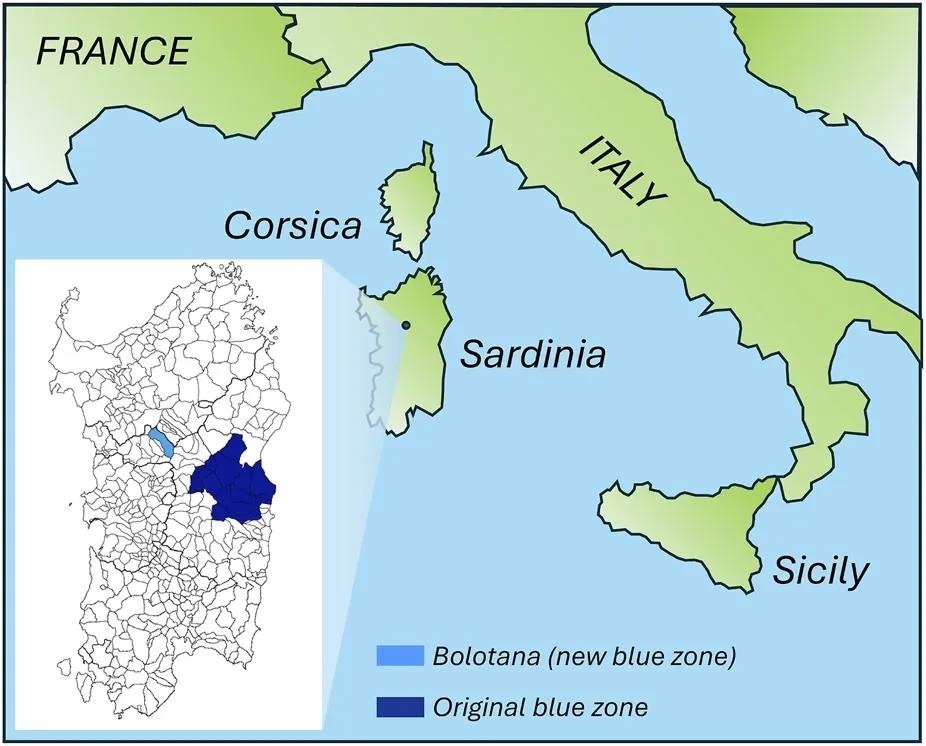
Geographic location of Bolotana and the original Sardinian Blue Zone. The main map situates Sardinia in the western Mediterranean, relative to Corsica, mainland Italy, Sicily, and southern France. The inset shows Sardinia's municipalities, with Bolotana highlighted in pale blue and the 14 municipalities that constituted the original Sardinian Blue Zone highlighted in deep blue.
The research team included scientists from the University of Sassari and other institutions in Sardinia, Italy, alongside US collaborators from the University of Alabama at Birmingham, the University of California, Los Angeles (UCLA), the University of Illinois Chicago, and Blue Zones in Minnesota. The authors disclosed that coauthor Dan Buettner owns Blue Zones, Inc., and S. Jay Olshansky received consulting compensation related to a proposed Blue Zone Research Institute.
The study cross-validated civil records against historical ecclesiastical parish baptismal and burial records to validate centenarian ages. Civil birth documentation was available for every identified centenarian, and the researchers independently checked 97% of recorded centenarian deaths against parish archives.
The resultant life-table analysis included 3,138 person-years of exposure (the combined time residents spent under observation) and 149 deaths occurring between 2021 and 2025 among residents aged 70 and older. Bolotana’s average total resident population was 2,266 during this period. Life-table indicators were compared descriptively with contemporary data from Nuoro Province, Sardinia, and Italy, published by the Italian National Institute of Statistics (ISTAT), as well as benchmarks from the Human Mortality Database (HMD). Earlier data for the original Sardinian Blue Zone provided a separate historical comparison. The authors did not conduct formal statistical tests of differences between populations.
The researchers assessed statistical uncertainty in the analytical dataset through computer simulations, supplemented by tests of different mortality assumptions and calendar periods, including 2020–2025 and 2015–2019.
Separately, the researchers calculated the cohort-based Extreme Longevity Index (ELI) for 3,060 people born in Bolotana between 1900 and 1925, including those who later moved away.
Study findings
Bolotana women had unusually favorable late-life survival estimates during the 2021–2025 study period. At age 70, remaining life expectancy was 20.85 years, substantially higher than contemporary averages in Nuoro Province (18.61 years), Sardinia (18.40 years), and Italy nationally (18.06 years).
Female conditional survival from age 70 to 100 reached 13.83%, more than triple the figures observed for Nuoro (4.33%), Sardinia (4.43%), and Italy (3.54%), and ranked behind only Hong Kong among the published international benchmarks examined, which covered an earlier period. These percentages estimate survival under the mortality conditions observed during the study period; the researchers did not follow a group of 70-year-olds until they reached 100.
Among men, remaining life expectancy was only modestly higher than regional and national averages, at 16.02 years from age 70, while estimated survival from age 70 to 100 was 4.92%. The latter estimate exceeded the comparison averages but remained highly uncertain.
A separate analysis of historical birth cohorts documented an ELI of 1,242 centenarians per 100,000 live births, compared with the Italian national average (793 per 100,000). Unlike the period estimates, the ELI measures survival from birth and reflects mortality throughout life. The researchers documented 38 centenarians among the 3,060 registered births. Some emigrants could not be traced, which may have led to a slight underestimate.
Sensitivity analyses revealed that survival advantages varied by calendar window: the period-matched 2015–2019 analysis yielded lower estimated survival from age 70 to 100 of 1.46% in women and 0.77% in men. Both figures were below those for the original Sardinian Blue Zone over the same period, though differences in life-table methods limit direct comparison. Including 2020 in the newer observation window produced a smaller difference: the female estimate was 12.48%, compared with 13.83% for 2021–2025.
Conclusions
The data suggest that Bolotana exhibits an unusual, predominantly female pattern of late-life survival, supporting its consideration as a candidate longevity blue zone.
This female-driven pattern differs from the relatively favorable male survival historically recorded in the original zone, illustrating that extreme longevity patterns may vary regionally and between calendar periods.
The authors caution that small population sizes generate considerable statistical uncertainty, and survival advantages differed across observation periods. The analysis could not establish whether genetics, lifestyle, social connections or health care explained the findings.
The researchers call for longer observation periods, continued demographic age validation and individual-level studies of biological, behavioral and social factors before Bolotana can be classified as an established longevity haven.
Source:
Journal reference:
 Beer, wine or spirits: A large study finds different mortality patterns for each