Introduction
How konjac influences appetite and metabolism
Can konjac support weight loss?
Additional health benefits of konjac
Food, supplement, and culinary uses
Potential side effects and safety risks
Limitations of evidence
References
Further reading
Konjac is a fiber-rich tuber whose primary compound, glucomannan, may support weight management, cholesterol reduction, glycemic control, and balance of the gut microbiota through its gel-forming and metabolic effects. Current evidence suggests konjac offers promising metabolic and gastrointestinal health benefits, though long-term clinical studies are still needed to confirm optimal dosing, safety, and therapeutic efficacy.
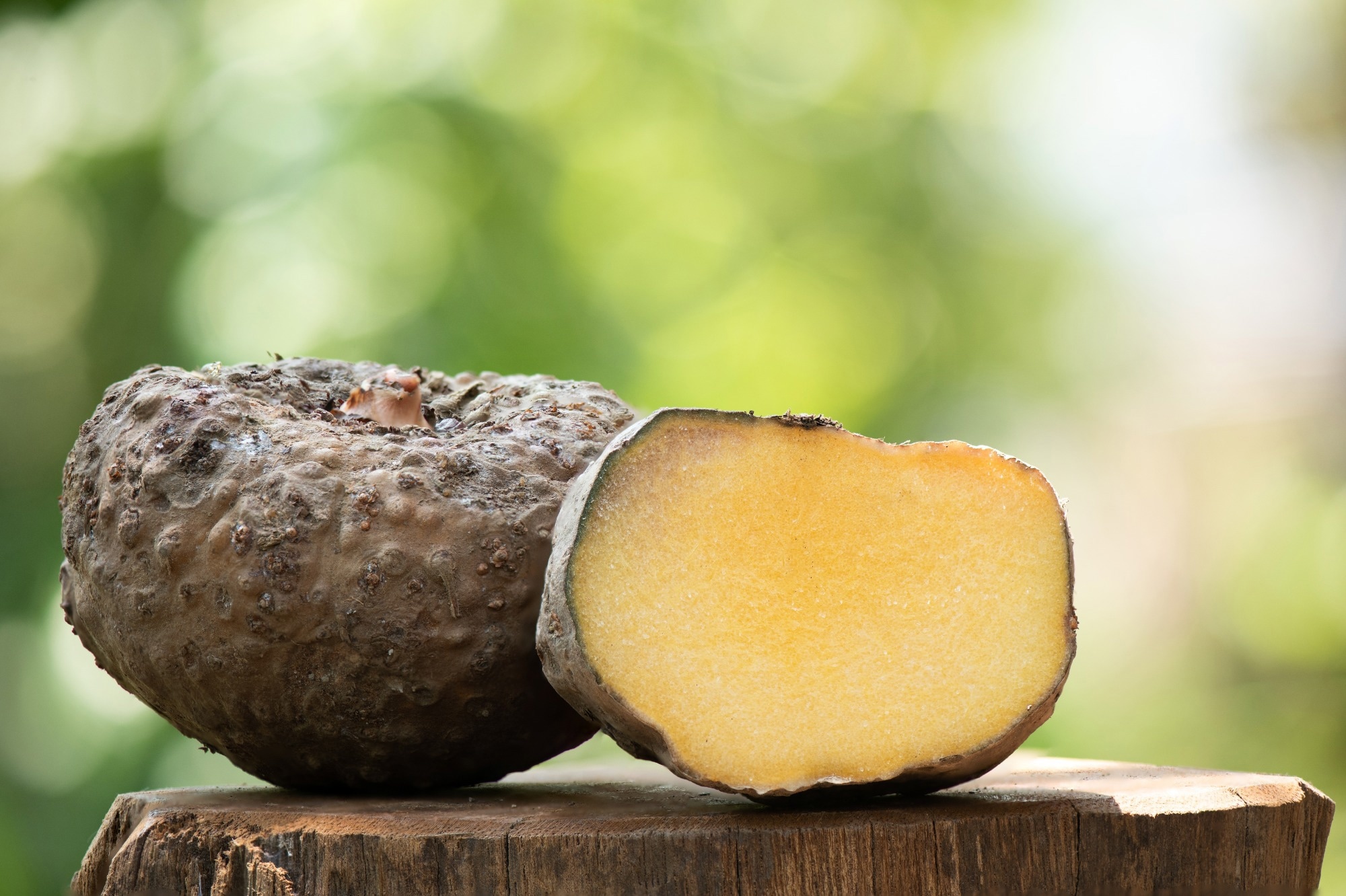 Image Credit: wasanaji / Shutterstock.com
Introduction
Konjac (Amorphophallus konjac) is a perennial tuberous plant that has been cultivated for centuries in Southeast Asia, particularly China and Japan. Historically, konjac has also been used in traditional Chinese medicine for digestive support, detoxification, and other therapeutic applications.3 Growing interest in konjac is attributed to its soluble fiber content that supports weight management, cholesterol reduction, and glycemic control.
The primary bioactive component of konjac is glucomannan, a polysaccharide that possesses distinctive physicochemical properties, including strong water absorption and gel-forming capacity. These physical characteristics confer nutritional and metabolic benefits that support weight management, metabolic regulation, and gastrointestinal health.
Glucomannan has an exceptional capacity to absorb water and expands significantly upon hydration, subsequently forming a viscous, gel-like matrix in the gastrointestinal tract.1,5 Once ingested, glucomannan delays gastric emptying and slows peristalsis, thereby reducing the rate of nutrient absorption and prolonging the sensation of fullness. The gel-like matrix also modulates the diffusion of glucose and lipids within the intestine and contributes to metabolic regulation.1,5
In addition to these mechanical effects, glucomannan is fermented by the intestinal microbiota to produce short-chain fatty acids (SCFAs) such as propionate and butyrate. These metabolites are essential for energy metabolism and the control of inflammation, in addition to their involvement in signaling pathways that regulate appetite and insulin sensitivity.5
Emerging evidence also suggests that konjac glucomannan may influence satiety-related hormones such as glucagon-like peptide-1 (GLP-1) and peptide YY (PYY), which are associated with appetite suppression and improved insulin sensitivity.1,5
Konjac glucomannan is primarily composed of glucose and mannose residues linked by β-1,4 glycosidic bonds, a structure that contributes to its high viscosity and fermentability by gut microbiota.2,5
Is Konjac the future of health food?
Can konjac support weight loss?
The role of konjac in weight management has been extensively studied, with current evidence suggesting modest but clinically relevant improvements in weight loss. The enhanced satiety from the expansion of glucomannan is likely the primary mechanism through which konjac aids in weight management. Furthermore, this increase in gastric volume does not increase caloric intake, which provides an effective way to reduce hunger while controlling energy intake.5
Previous randomized controlled trials and systematic analyses indicate that glucomannan supplementation leads to significant reductions in body weight, body mass index (BMI), and waist circumference.1 In one study, daily supplementation of five grams or more every day for a minimum of 12 weeks led to an average weight loss of 3.2 kg and BMI reduction of 1.5 kg/m2.5 These outcomes are more pronounced when supplementation is combined with calorie restriction or lifestyle interventions, such as regular exercise.5
In addition to regulating appetite, glucomannan slows carbohydrate absorption, thereby improving glycemic control. By reducing postprandial insulin surges, glucomannan may prevent rapid fat storage and subsequent hunger cycles that are often induced by high-glycemic meals.1
The high viscosity of glucomannan facilitates binding of this polysaccharide to bile acids in the small intestine, promoting their excretion and stimulating hepatic conversion of circulating cholesterol into new bile acids.5 As a result, glucomannan intake often correlates with lower total and low-density lipoprotein (LDL) cholesterol levels.3
Several studies also suggest that the metabolic benefits of konjac may partly arise from gut microbiota modulation, including increased abundance of beneficial bacteria such as Bacteroidetes, Bifidobacterium, and Akkermansia.1,3,5
Despite these observations, konjac supplementation alone is not sufficient to induce significant weight loss, as dietary patterns, gut microbiota composition, and adherence to supplementation protocols contribute to variable individual responses.1,5
Additional health benefits of konjac
Konjac offers several health benefits beyond weight management, particularly improvements in lipid profiles through reduced cholesterol absorption and lower LDL cholesterol levels.2 The viscous gel formed by glucomannan slows the digestion and absorption of carbohydrates, which stabilizes blood glucose levels, particularly for individuals with insulin resistance or type 2 diabetes.1
Emerging evidence highlights the role of konjac in supporting the proliferation of beneficial intestinal bacteria, such as Bacteroidetes and Akkermansia, which are associated with improved metabolic outcomes and negatively correlated with BMI.5 SCFAs produced by the fermentation of glucomannan also influence intestinal barrier function and immune responses, which may contribute to anti-inflammatory and metabolic effects.3,5
Additional preclinical and clinical research suggests that konjac glucomannan may support gastrointestinal regularity, improve constipation symptoms, and contribute to immune regulation through interactions with intestinal microbiota and inflammatory signaling pathways.3,5
 Image Credit: Utoimage / Shutterstock.com
Food, supplement, and culinary uses
Traditionally, konjac is used to make low-calorie foods such as shirataki noodles, rice substitutes, and jelly products. Konjac glucomannan is also widely used in the food industry as a thickener, stabilizer, gelling agent, and fat substitute because of its high viscosity and water-binding capacity.2,4
Konjac is also available as a dietary supplement in powder, capsule, and tablet forms. Due to its expansion capacity, glucomannan supplements are generally recommended to be consumed with adequate water intake.1,3
Potential side effects and safety risks
Konjac and glucomannan supplements are generally considered safe for most people when consumed appropriately. However, some individuals may experience bloating, flatulence, diarrhea, abdominal discomfort, or altered bowel habits, particularly during the early stages of supplementation.1,5
Because glucomannan rapidly expands after absorbing water, insufficient fluid intake may increase the risk of choking or esophageal and intestinal obstruction, particularly with tablet formulations.3,4
Individuals with swallowing disorders or gastrointestinal narrowing should use konjac-containing supplements cautiously and under medical supervision.3
Limitations of evidence
Although findings from clinical trials and review studies are promising, many studies evaluating konjac supplementation are relatively short-term and involve small sample sizes.1,5 Differences in dosage, formulation, dietary background, and gut microbiota composition may also contribute to inconsistent outcomes across studies.1,5
Additional long-term randomized controlled trials are needed to clarify optimal dosing strategies, long-term safety, and the extent to which gut microbiota alterations contribute to konjac's metabolic effects.1,3,5
References
- Jian, X., Jian, S., & Deng, B. (2024). Konjac Glucomannan: A functional food additive for preventing metabolic syndrome. Journal of Functional Foods 115; 106108. DOI: 10.1016/j.jff.2024.106108. https://www.sciencedirect.com/science/article/pii/S1756464624001105.
- Behera, S. S., & Ray, R. C. (2016). Nutritional and Potential Health Benefits of Konjac Glucomannan, a Promising Polysaccharide of Elephant Foot Yam, Amorphophallus konjac K. Koch: Review. Food Reviews International 32(2); 139-166. DOI: 10.1080/87559129.2015.1137310. https://www.tandfonline.com/doi/full/10.1080/87559129.2015.1137310.
- Jain, A., Sarsaiya, S., Gong, Q., et al. (2025). Amorphophallus konjac: traditional uses, bioactive potential, and emerging health applications. Frontiers in Plant Science 16; 1530814. DOI: 10.3389/fpls.2025.1530814. https://www.frontiersin.org/journals/plant-science/articles/10.3389/fpls.2025.1530814/full.
- Hu, Q., Huang, G., & Huang, H. (2025). Extraction, structure, activity, and application of konjac glucomannan. Ultrasonics Sonochemistry 116; 107315. DOI: 10.1016/j.ultsonch.2025.107315. https://www.sciencedirect.com/science/article/pii/S135041772500094X?via%3Dihub.
- Ghosh, A., Mohol, P., & Ghosh, S. (2025). Konjac glucomannan as an emerging nutritional strategy for obesity control via gut microbiota and metabolic regulation. Discover Food 5; 222. DOI: 10.1007/s44187-025-00533-0. https://link.springer.com/article/10.1007/s44187-025-00533-0.
Further Reading
Last Updated: May 24, 2026