Introduction
What is decision fatigue?
How too many choices strain the brain
Evidence from behavioral and neuroscience research
The role of environment and choice overload
Impacts on well-being and daily functioning
References
Further reading
Decision fatigue describes how repeated decision-making reduces cognitive efficiency, leading individuals to rely on simpler, less effortful choices over time. It arises from the interaction of cognitive, motivational, and neural processes and has measurable impacts on behavior, brain function, and real-world outcomes.
 Image Credit: PeopleImages / Shutterstock.com
Introduction
Decision fatigue refers to a decline in the quality of decisions after making several consecutive choices with sustained demands on cognitive and self-regulatory processes that reduce the ability to effectively evaluate options and control behavior. This decline is widely attributed to cumulative cognitive burden and shifts in motivation and attention that favor less effortful decision strategies over time, although definitions and measurement approaches vary across studies. Understanding the neural and behavioral mechanisms underlying decision fatigue is important, as modern environments require individuals to make numerous daily choices that influence their productivity, judgment, and overall well-being.1,2,3
This article explains the different factors that contribute to decision fatigue and its impact on decision-making, productivity, and well-being in everyday life.
What is decision fatigue?
As individuals repeatedly engage in decision-making, the cognitive demands of evaluating options, as well as controlling emotions and impulses, place greater strain on mental resources. Over time, this can impair judgment, making individuals more likely to avoid decisions, rely on default options, or choose impulsively rather than carefully evaluate alternative solutions.1,3
The concept of decision fatigue emerged from research in cognitive psychology and behavioral science examining how self-regulation and decision-making operate under conditions of limited mental resources. Early theoretical models suggest that self-control and decision-making activities draw on a common pool of cognitive resources that deplete with frequent use. However, this resource-based account has been challenged, and contemporary models emphasize motivational and attentional shifts as key mechanisms underlying reduced decision quality.3 As these resources diminish, individuals may experience a shift in motivation and attention that favors simpler or less effortful decisions. In professional settings, repeated decision-making may harm work performance by altering judgment through the accumulation of decisions over time.1,3
Decision fatigue is also conceptually distinct from general cognitive fatigue, which refers to a broader decline in mental performance due to sustained cognitive activity; decision fatigue specifically emphasizes changes in choice behavior and self-regulation following repeated decision-making.3,4
How too many choices strain the brain
Repeated decision-making places sustained demands on neural systems responsible for motivated control, particularly within the prefrontal cortex (PFC). Functional magnetic resonance imaging (fMRI) has led to the identification of a ‘fatigue network’ within the brain consisting of the dorsal anterior cingulate cortex (dACC), dorsolateral PFC (DLPFC), ventromedial PFC, and insula that considers the value of pursuing an option and whether to continue based on that perceived value. These regions are embedded within a broader cortico-striatal reward and interoceptive network that integrates effort, reward valuation, and internal bodily signals. Persistent fatigue leads to a gradual reduction in the perceived value of a reward, thereby necessitating additional forms of motivation, like money or verbal encouragement, to maintain task performance.4
Neuroimaging research further demonstrates that functional connectivity within this network dynamically changes as fatigue increases, including reduced connectivity in frontal control regions.4
Both chronic and acute fatigue have been implicated in altered signaling of neurotransmitters such as serotonin, noradrenaline, and dopamine. However, the direct neurochemical mechanisms underlying decision fatigue remain incompletely understood, and current explanations are largely theoretical. Scientists hypothesize that both low amounts and excess dopamine can increase the likelihood of fatigue emerging by disrupting the optimal balance of neural activity required for motivation and effort-based decision-making.
Whereas dopamine promotes reward-associated behaviors, serotonin inhibits actions that may lead to a negative outcome, suggesting that maintaining a balance between these neurotransmitters is crucial for overcoming the effects of chronic fatigue. These hypotheses complement, rather than replace, cognitive and motivational explanations of decision fatigue.
How to combat decision making fatigue. | Lenka Helena Koenigsmark | TEDxUNYP
Evidence from behavioral and neuroscience research
Decision quality often declines after individuals make many consecutive choices. Experimental studies demonstrate that repeatedly evaluating alternatives and making selections can gradually reduce an individual’s ability to assess relative advantages and disadvantages. Observational studies conducted in healthcare environments echo these results, as clinicians’ decisions about diagnoses, treatment options, and test ordering vary based on how long they have been working or how many cases they have already evaluated.2,3
Systematic evidence suggests that decision fatigue effects are observed in a substantial proportion of studies, although findings are heterogeneous due to inconsistent definitions, measurement approaches, and study designs.2
In many studies, proxies such as time-on-task, number of prior decisions, or time of day are used to infer decision fatigue, highlighting the absence of a standardized measurement framework.2
As mental effort accumulates, neural processes associated with attention and self-regulation may become less efficient, contributing to reduced engagement with executive functions. These changes explain why decision fatigue is often linked to behaviors such as impulsive choices, procrastination, reduced persistence, and lower self-control in both laboratory and real-life settings.2,3
The role of environment and choice overload
When people are exposed to many choices in quick succession, the effort required to compare options and determine the best outcome can gradually reduce the efficiency and quality of subsequent decisions. Compared with simpler environments that offer only a few alternatives, contemporary digital and organizational contexts often amplify this cognitive load.1,3
Most online platforms present users with hundreds of options that must be considered repeatedly throughout the day. These environmental demands reflect situational and organizational antecedents of decision fatigue, alongside individual factors such as cognitive capacity and emotional regulation.1 These environments increase the frequency and complexity of decision-making, making individuals more vulnerable to decision fatigue as cognitive resources become strained.1,3
To cope with excessive choices, people may rely on strategies that reduce mental effort, such as mental shortcuts, following routines, or accepting default options rather than carefully evaluating alternatives. These adaptive behaviors exemplify how people attempt to manage cognitive demands in environments filled with abundant choices.1,3
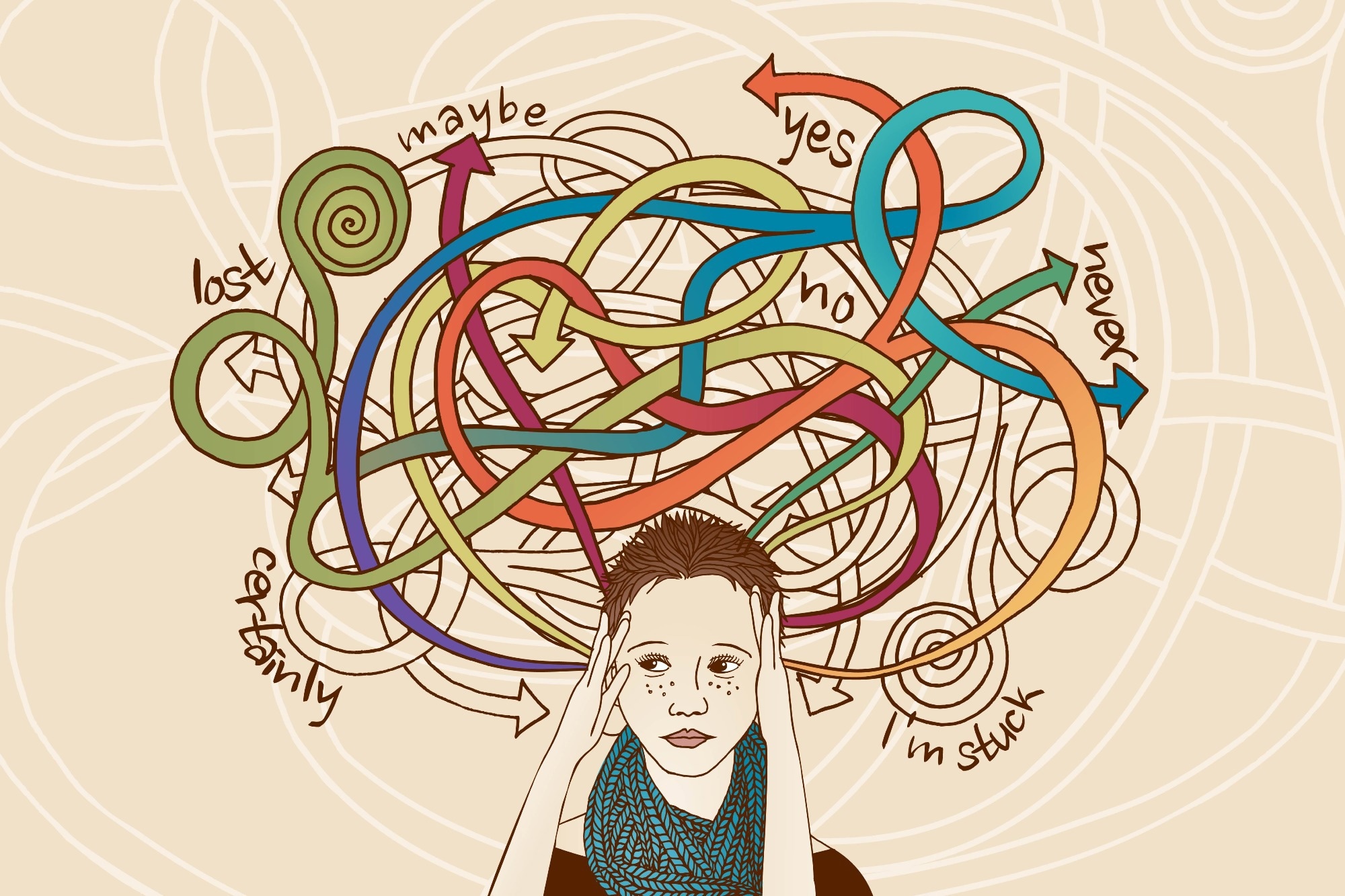 Image Credit: Franzi / Shutterstock.com
Impacts on well-being and daily functioning
Mental exhaustion can result from lengthy decision-making processes, which increase stress and irritability while lowering emotional control, especially for those who are continually making complex or stressful decisions.1,2 These effects are particularly evident among those working in high-pressure work environments characterized by continuous high-stakes decision making, often involving critical or life-threatening outcomes.
Decision fatigue has also been linked to shifts toward conservative, default, or less effortful decisions, as well as variability in professional judgment across time.2
Reduced motivation and difficulty maintaining self-control can emerge as people struggle to sustain attention and deliberate reasoning after extended decision-making.1,2 Decision fatigue also affects daily productivity and performance, as well as the ability to provide consistent judgment and remain efficient when completing tasks.1,2
References
- Choudhury, N. A. & Saravanan P. (2026). An integrative review on unveiling the causes and effects of decision fatigue to develop a multi-domain conceptual framework. Frontiers in Cognition 4. DOI: 10.3389/fcogn.2025.1719312. https://www.frontiersin.org/journals/cognition/articles/10.3389/fcogn.2025.1719312/full
- Maier, M., Powell, D., Murchie, P., & Allan, J. L. (2025). Systematic review of the effects of decision fatigue in healthcare professionals on medical decision-making. Health Psychology Review 19(4); 717-762. DOI: 10.1080/17437199.2025.2513916. https://www.tandfonline.com/doi/full/10.1080/17437199.2025.2513916
- Pignatiello, G. A., Martin, R. J., & Hickman Jr, R. L. (2020). Decision fatigue: A conceptual analysis. Journal of Health Psychology 25(1); 123-135. DOI: 10.1177/1359105318763510. https://pmc.ncbi.nlm.nih.gov/articles/PMC6119549/
- Wylie, G. R., Yao, B., Genova, H. M., et al. (2020). Using functional connectivity changes associated with cognitive fatigue to delineate a fatigue network. Scientific Reports 10. DOI: 10.1038/S41598-020-78768-3. https://www.nature.com/articles/s41598-020-78768-3.
Further Reading
Last Updated: Mar 23, 2026