Maternal blood cell-free DNA methylation may offer a minimally invasive research window into prenatal epigenetic signatures associated with later autism diagnosis, supporting future biomarker and early intervention studies.
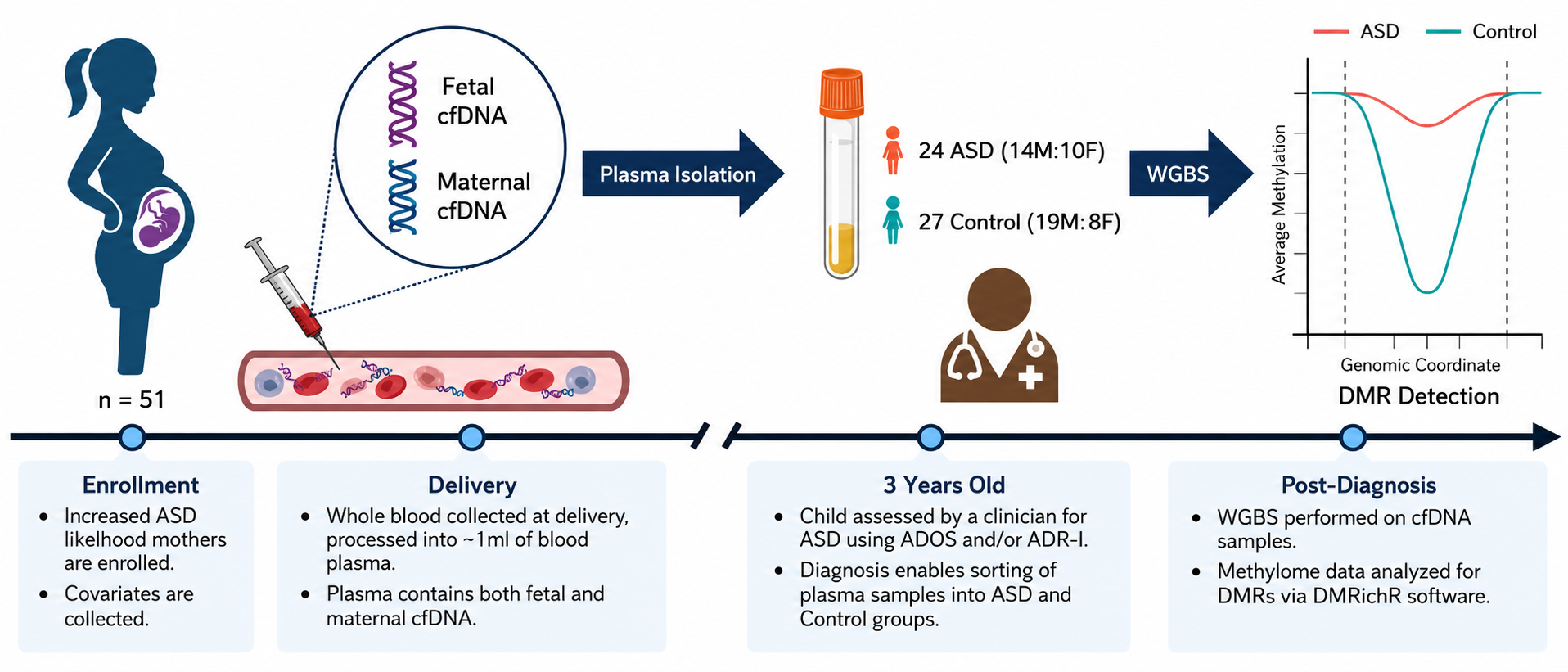
WGBS of cfDNA in a prospective autism cohort study enables prenatal detection of ASD-associated differentially methylated regions (DMRs). This experimental diagram details the process by which study participants were selected for cfDNA sampling, the subsequent diagnostic follow-up, and the computational method by which WGBS data was investigated for DMRs associated with ASD diagnosis. Williams, L. (2026)
A recent study in Communications Biology investigated whether cell-free DNA (cfDNA) methylation patterns in maternal blood could help identify prenatal epigenomic signatures associated with later autism spectrum disorder (ASD) diagnosis and maternal obesity.
The Role of Molecular and Epigenetic Markers in ASD
Autism spectrum disorder (ASD) is a prevalent neurodevelopmental disorder in American children, characterized by persistent deficits in social communication and restrictive, repetitive behaviors. Its clinical presentation and severity are highly variable. Children with ASD frequently experience co-occurring conditions such as attention deficit disorder, obesity, epilepsy, anxiety, depression, and intellectual disability. While early behavioral interventions can improve outcomes, progress is hindered by the lack of reliable early molecular markers to guide timely diagnosis and intervention.
ASD arises from both genetic and environmental factors. Although high concordance rates in monozygotic twins indicate a strong genetic component, ASD is polygenic, involving numerous rare and common variants. Environmental exposures, especially maternal obesity (MO), further modulate ASD risk through interaction with genetic susceptibility.
Epigenetic mechanisms, particularly DNA methylation, mediate the impact of environmental exposures, such as MO, on gene networks implicated in ASD. Methylation signatures associated with ASD have been identified in the human brain and placenta, while animal models show that MO-induced epigenetic alterations in the developing brain can disrupt neurodevelopment and social behaviors.
Human studies on early epigenetic markers of ASD remain limited by the inaccessibility of fetal tissue prior to clinical diagnosis. Recent advances in noninvasive prenatal testing now permit the analysis of cfDNA from maternal blood. cffDNA, derived from placental apoptosis, increases in maternal plasma as pregnancy progresses and retains a placental methylomic profile, offering a non-invasive window into the fetal epigenome. Despite these advances, research on the prenatal cfDNA methylome remains constrained by low-resolution methods and limited sample sizes.
Examining the Association Between Maternal Prenatal cfDNA Methylome, Autism Risk, and Maternal Obesity
The current study analyzed samples from the Markers of Autism Risk in Babies - Learning Early Signs (MARBLES) cohort, a prospective study enrolling women with an elevated risk of having children with autism spectrum disorder (ASD).
Eligibility criteria included women who were pregnant or planning a pregnancy and had a child previously diagnosed with ASD, as well as women who could potentially have half-siblings of a child with ASD. Participants also needed to be at least 18 years old, proficient in English, and reside within 2.5 hours of the Davis/Sacramento area.
Mothers provided demographic, dietary, and medical data before and throughout pregnancy. Offspring were evaluated for ASD symptoms at 6, 12, 24, and 36 months of age. Neurodevelopmental outcomes were determined using established algorithms based on scores from the Autism Diagnostic Observation Schedule (ADOS) and the Mullen Scales of Early Learning (MSEL).
Children classified as non-ASD included both typically developing and non-typically developing participants. For this analysis, only those with at least 1 ml of available blood plasma for cfDNA extraction were included.
Shared Epigenomic Alterations in ASD and Maternal Obesity
A total of 51 pregnancies were selected to capture variability in fetal sex, maternal BMI, and ASD diagnosis. Maternal plasma cfDNA, collected near delivery at 36 to 41 weeks’ gestation, was isolated and subjected to whole-genome bisulfite sequencing (WGBS) for single-base methylome analysis.
When examining cfDNA methylomes separately by fetal sex, the analysis identified differentially methylated regions (DMRs) associated with ASD that were particularly enriched in genes and pathways important for neurodevelopment. Notably, female pregnancies showed a greater number and greater magnitude of these DMRs than male pregnancies. Moreover, the direction of methylation changes often differed between the sexes, suggesting underlying sex-specific epigenetic responses.
The ASD-associated DMRs were predominantly found in genic regions and in regions of the genome rich in cytosine-phosphate-guanine (CpG) sites, which are known to be key regulatory elements. Genes mapped to these regions were heavily involved in synaptic signaling, calcium signaling, and circadian entrainment, processes essential for normal brain development. Both male and female DMR gene lists significantly overlapped with established autism risk genes, although some female fetal fraction-adjusted analyses showed weaker enrichment for these risk genes. Additionally, these DMRs were enriched at genomic loci that undergo dynamic methylation changes during pregnancy, highlighting their potential developmental relevance.
The methylation patterns observed in cfDNA showed substantial overlap with ASD-associated DMRs reported in matched term placenta samples and unrelated postmortem cortical tissue. There was substantial overlap at the gene level and convergence in the biological pathways affected across these different tissues and between the sexes, with synaptic signaling pathways being especially prominent. Importantly, a core set of genes was found to be differentially methylated across all tissues and sex groups, many of which play fundamental roles in neurodevelopment.
Certain DMRs were exclusive to female-specific lists and included known ASD risk genes. MO DMRs (maternal obesity) in cfDNA were also enriched in ASD-relevant gene pathways and significantly overlapped with ASD DMRs for both sexes, with shared enrichment in synaptic and neurodevelopmental pathways.
Pathway analysis using the Kyoto Encyclopedia of Genes and Genomes (KEGG) database demonstrated that both ASD- and MO-associated DMRs converged on several key pathways, including calcium signaling, circadian entrainment, and synaptic transmission. While genes uniquely associated with MO DMRs were involved in neuromodulatory signaling, those uniquely associated with ASD DMRs were more often linked to metabolic processes and motor protein function, suggesting both shared and distinct biological mechanisms.
Shared DMR genes across ASD and MO were concentrated in neurodevelopmentally critical pathways, highlighting convergent epigenetic mechanisms linking prenatal exposures and neurodevelopmental outcomes.
Conclusions
The current study provides evidence that maternal plasma cfDNA reflects both shared and distinct epigenomic signatures associated with ASD and maternal obesity. These findings support the possibility that shared epigenetic pathways may contribute to neurodevelopmental risk. Importantly, these results underscore the potential utility of cfDNA as a minimally invasive research tool for discovering early epigenetic changes linked to adverse neurodevelopmental outcomes, offering a framework for future studies of early detection and intervention.
However, the authors caution that the study was small, based on an enriched-risk cohort, and limited to late third-trimester maternal plasma samples. They also could not determine whether the methylation differences arose from fetal or maternal cfDNA, and cfDNA does not provide direct brain-specific resolution. Larger independent studies are therefore needed before these findings can be translated into clinical screening or diagnostic use.
Want to read later? Download your PDF copy by clicking here.
Journal reference:
- Williams, L. A., Habibi, E., Miller, M., Hertz-Picciotto, I., Walker, C. K., Schmidt, R. J., & LaSalle, J. M. (2026). Prenatal cell-free DNA methylome detects association with autism and maternal obesity. Communications Biology. Article in Press. DOI: 10.1038/s42003-026-10500-9, https://www.nature.com/articles/s42003-026-10500-9
 Cancer-related DNA changes may appear in blood years before diagnosis