From microbial diversity to gut barrier function, researchers are uncovering how individual fiber types may interact differently with the developing gut ecosystem during a critical stage of childhood.
Study: The impact of dietary fibres on gut microbiome of young children: insights from in vitro experiments and an observational cohort. Image Credit: Helena Nechaeva / Shutterstock
A recent study accepted for publication in the journal Scientific Reports suggests that different dietary fibers may influence the structure and function of the gut microbiota during early childhood. The researchers found that fibers such as xyloglucan, arabinoxylan, and pectin increased short-chain fatty acid (SCFA) production, whereas xyloglucan and arabinoxylan helped maintain gut barrier integrity following an inflammatory challenge. A combination of xyloglucan, pectin, and cellulose also dampened several LPS-induced cytokine responses in a cellular model. If confirmed in further studies, including diverse, fiber-rich foods in everyday meals may support a healthy gut microbiota in early life.
Around six months, infants begin adding complementary foods to their diet while breastfeeding continues. This transition also introduces new sources and types of dietary fiber, including those found in fruits, vegetables, and grains. Since the fibers vary in structure, they may perform different functions. A better understanding of how different fiber types affect gut microbes in early childhood could inform future dietary strategies to support healthy microbiome development.
About the study
In the present study, researchers conducted in vitro fecal fermentation studies, cellular co-culture experiments, and analyses of observational cohort data to investigate whether fibers such as cellulose, arabinoxylan, xyloglucan, and pectin altered gut microbiome composition and function. Caco-2 intestinal epithelial cells and THP-1 human monocyte cells, differentiated into macrophage-like cells, were co-cultured for analysis.
To assess the impact on function, the team assessed potential effects on metabolite production and epithelial barrier integrity. The researchers also included a no-substrate control (NSC) for comparison. They monitored trans-epithelial electrical resistance (TEER) across the Caco-2 cell layer to assess whether the fibers affected epithelial barrier integrity. To mimic an inflammatory response, fermentation samples were applied to the co-culture for 24 hours, followed by 6 hours of exposure to lipopolysaccharide (LPS). The LPS was added to the basal compartment containing THP-1 cells.
The team used 2.0 g/L of different fibers, with equal amounts of each in the fiber blends. To analyze the effects of dietary pectin intake, they obtained information from 256 children aged six to 36 months in the Baby Connectome Project enriched (BCP-e) study. Separately, the in vitro fermentation experiments used fecal samples from 12 infants: six aged about 6 months and six aged about 1 year. None of these infants used antibiotics in the previous 90 days and had no history of gut surgery or necrotizing enterocolitis (NEC).
The team used quantitative shallow metagenomic sequencing to characterize the microbiome, flow cytometry to obtain cell counts, and liquid chromatography-mass spectrometry (LC-MS) for metabolomic analysis. SCFAs were measured using gas chromatography with flame ionization detection. They examined the relationship between pectin intake and gut alpha diversity. In the in vitro analysis, species richness and evenness were determined using the Chao1, Shannon, and reciprocal Simpson diversity indices, while the cohort analysis focused primarily on the Shannon index.
Gas production and pH changes were recorded during fermentation. The researchers also calculated a community modulation score (CMS) based on changes in microbiome composition after incubation. For the cohort statistical analysis, they used linear mixed-effects models that accounted for age, energy intake, and soluble fiber intake.
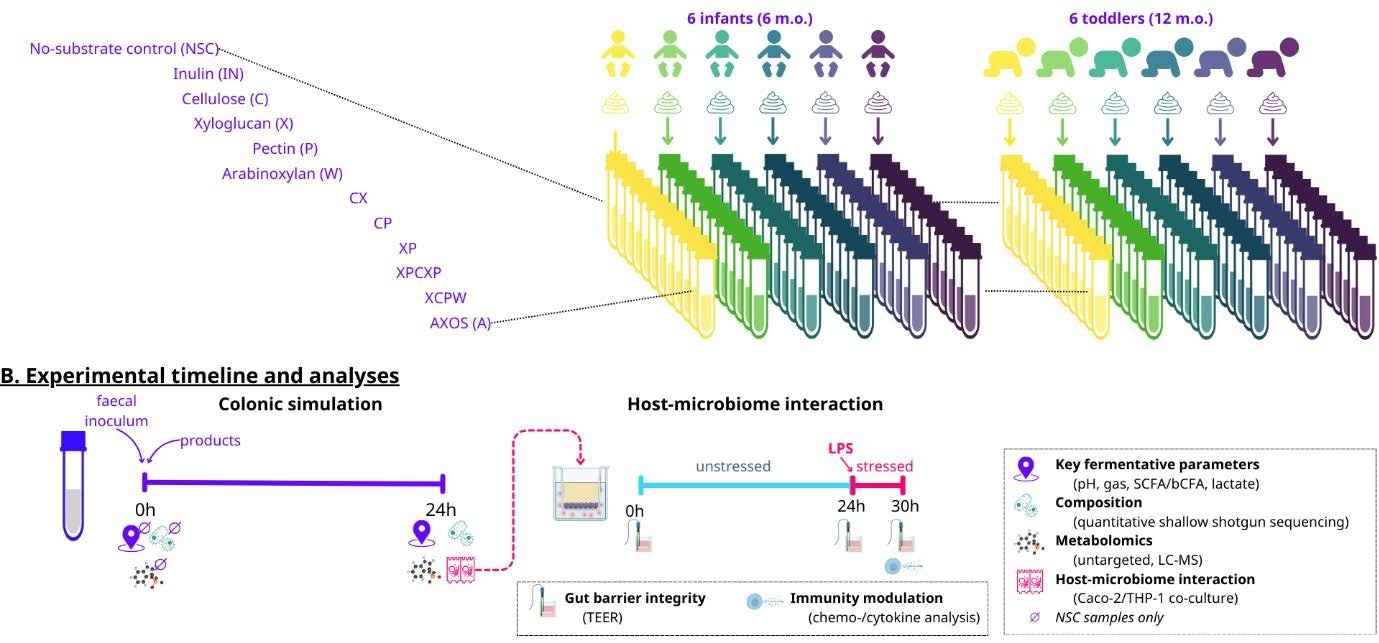
Schematic overview of the in vitro study design to assess the impact on the gut microbial activity and composition of 12 infants (6 months old (n= 6); 12 months old (n = 6)) of specific types of fibers and their combinations (C, X, P, W, CX, CP, XP, CXP, CXPW, A) compared to a no substrate control (NSC) and a reference
Results
Fermentation with xyloglucan, pectin, and arabinoxylan increased SCFA production, while different fiber treatments altered additional metabolites, including indole-3-lactic acid (ILA) and acetylated amino acids, especially at 12 months. During this period, several treatments also altered other amino acid-derived metabolites and B-vitamin-related compounds. Not all metabolite changes were necessarily beneficial. TMAO also increased with most tested fibers except cellulose, although the researchers noted that accumulation in the closed in vitro system may have contributed to this finding and that its health implications remain uncertain.
While xyloglucan and arabinoxylan helped preserve epithelial barrier function upon LPS challenge, the clearest significant effect was observed with arabinoxylan in samples from six-month-old donors. In particular, arabinoxylan treatment increased TEER upon LPS challenge. After 24-hour fiber incubation, TEER values correlated with SCFA production and with an increase in the abundance of acetate- and lactate-producing Bifidobacterium species.
Several gut microbes grew more readily in the presence of xyloglucan, pectin, and arabinoxylan in vitro. In the observational cohort, higher dietary pectin intake was positively associated with alpha diversity among children aged 6 to 36 months. Most treatments significantly increased microbial cell numbers, with the strongest increases seen for AXOS, the reference prebiotic inulin, and pectin. Post-incubation, xyloglucan and arabinoxylan increased the abundance of adult-type Bifidobacterium species, including B. pseudocatenulatum and B. catenulatum. Among one-year-olds, arabinoxylan increased the abundance of the infant-type species B. longum, while under pectin treatment, Faecalibacterium prausnitzii and Phocaeicola dorei showed the largest significant increases.
Conclusion
The findings provide valuable insights into the potential effects of different dietary fibers on the gut microbiome during early childhood. While fibers such as xyloglucan and arabinoxylan increased SCFA production and were associated with improved gut barrier measures in vitro, combinations of xyloglucan, pectin, and cellulose altered cytokine release, reducing levels of several pro- and anti-inflammatory cytokines in the cellular model. Pectin supported the growth of several bacterial species. In the observational cohort, greater pectin intake was also linked to higher alpha diversity.
Looking ahead, researchers could investigate the underlying mechanisms and causal relationships in naturally fiber-rich foods to determine whether the findings translate into real-world dietary patterns. The experimental work used purified fibers, a small number of fecal donors, and separate children in the six- and 12-month groups, while only one fiber dose was tested. More in vivo studies and randomized controlled trials with larger sample sizes are required to determine how different fibers and doses affect the developing gut microbiome and whether these findings hold true in children.
The research was supported by Nestlé Research. All three authors were employees of Société des Produits Nestlé SA, while the experimental work was conducted by Cryptobiotix in Belgium.
Journal reference:
- Dogra, S.K., Sprenger, N. & Wang, D. (2026). The impact of dietary fibres on gut microbiome of young children: insights from in vitro experiments and an observational cohort. Scientific Reports, DOI: 10.1038/s41598-026-68854-3, https://www.nature.com/articles/s41598-026-68854-3
 Scientists reviewed studies covering 1.17 million children and found a major research gap