From hidden vegetables to dinner-table rules, interviews with Swedish parents examine the everyday decisions that influence what children eat.
Study: Parents’ perspectives and roles in influencing 10–12-year-old children’s fruit and vegetable consumption: a qualitative study in Sweden. Image Credit: Rido / Shutterstock
In a recent study published in the journal BMC Public Health, researchers found that parents of children aged 10-12 years generally recognized the benefits of fruit and vegetables (F&V), yet often underestimated recommended daily intake and considered vegetables served at dinner sufficient.
Background
An earlier Swedish national dietary survey found that only 5% of children aged 10-12 years met the recommended daily intake of F&V, highlighting a considerable nutrition-related problem. Average daily consumption was 247 grams for girls and 200 grams for boys, below the Swedish recommendation of 500 grams for adults and children older than 10 years.
Parents play a crucial role in shaping their children’s eating behaviors by buying, preparing, and serving food, in addition to encouraging their kids and setting examples. Sufficient F&V consumption supports a child’s nutrition, while lower intake is associated with increased risks of cardiovascular disease, type 2 diabetes, and certain cancers.
About the study
The researchers conducted a qualitative study using semi-structured individual interviews with parents of children attending fifth grade, aged 10–12 years. The researchers purposively recruited 15 families through seven schools in two locations in southern Sweden: a larger multicultural city and a smaller, more ethnically homogeneous village. Recruitment aimed to capture variation in cultural background, socioeconomic circumstances, parental education, children’s gender, and perceived interest in F&V consumption.
The participants included 12 mothers and three fathers. Before the interviews, the parents completed questionnaires about family structure and living arrangements. The interviews were conducted from April 2018 to January 2019 and lasted 46 to 80 minutes. The interviews were digitally recorded and transcribed verbatim. Participants selected interview locations, including their homes, a local children’s hospital, or their children’s schools. An interview guide explored parents’ knowledge, beliefs, experiences, perceived barriers, and strategies concerning F&V. The interview included color photographs depicting 28 vegetables and 25 fruits and berries.
The researchers analyzed the transcripts using inductive thematic analysis adapted from Braun and Clarke. Initial coding was performed manually, while NVivo 14 supported data management. The team repeatedly reviewed transcripts, compared codes, refined themes, and discussed interpretations.
Study results
The analysis generated five themes: parental knowledge and beliefs, sources of information, family preferences and resources, parental agency, and parental intentions. After completing the thematic analysis, the researchers conceptualized four overlapping parental roles to describe parents’ intentions and feeding strategies.
Parents tended to recognize the health benefits of F&V, especially their vitamins and minerals, and associated them with immediate effects on child growth, energy, and immune system functioning. Parents rarely mentioned long-term benefits for children.
None of the respondents stated that they were familiar with the recommended daily intake for children, but four correctly estimated 500 grams. Most estimates were below this amount. Parents often considered dinner vegetables sufficient, with less attention to consumption throughout the day.
Concerns about fruit sugar sometimes led to unnecessary restrictions, while uncertainty about pesticides and organic produce complicated purchasing decisions.
Parents gathered dietary information from relatives, colleagues, friends, educational institutions, health professionals, television, Internet, podcasts, and social networks. Several parents recalled receiving dietary advice from child-health nurses when their children were younger, but said this guidance became less available as the children grew older.
Conflicting information about nutrition, sugar, and organic foods created uncertainty about credibility. Participants also perceived fruit and vegetables as receiving less promotional attention than processed foods.
The family’s preferences and resources shaped buying, cooking, and serving habits. Children’s preferences for flavor, texture, appearance, and preparation influenced what they were willing to eat. Parents described serving raw or cooked vegetables, cutting fruit into smaller pieces, presenting foods attractively, and offering alternatives.
Differences between siblings, parental preferences, cultural backgrounds, and shared-custody arrangements sometimes complicated meal planning. Financial constraints influenced the quantities and varieties purchased.
Some parents bought seasonal produce, selected discounted items, froze berries, or prioritized children’s consumption when budgets were limited.
Many parents felt responsible for their children’s diets, and most believed they could increase their children’s intake when necessary. Few expressed intentions to change their current practices.
Strategies included setting mealtime expectations, encouraging children to try unfamiliar foods, providing accessible snacks, and adapting preparation methods. Some concealed vegetables in other foods or pressured children to finish portions.
Others restricted certain fruits or limited portions because of worries about sugar, dental issues, overconsumption, or cost. Nearly all parents rated their satisfaction with their family's fruit and vegetable intake between 7 and 10 on a 10-point scale, often judging adequacy based on the presence of vegetables at dinner.
The study did not measure whether their children met daily intake recommendations.
The study identified four parental intentions: supplying nutrients, improving access, developing knowledge and skills, and demonstrating healthy eating habits. These intentions informed four overlapping roles. The Enforcer prioritized immediate consumption through rules, pressure, or concealed ingredients.
The Accommodator increased availability and adapted foods to children’s preferences.
The Teacher explained nutritional benefits, encouraged exploration, and involved children in food preparation.
The Role Model demonstrated desired behaviors through their own fruit and vegetable consumption and established family routines.
Individual parents could demonstrate several roles simultaneously. The roles represented reported practices and were not tested for their effectiveness in increasing children’s intake.
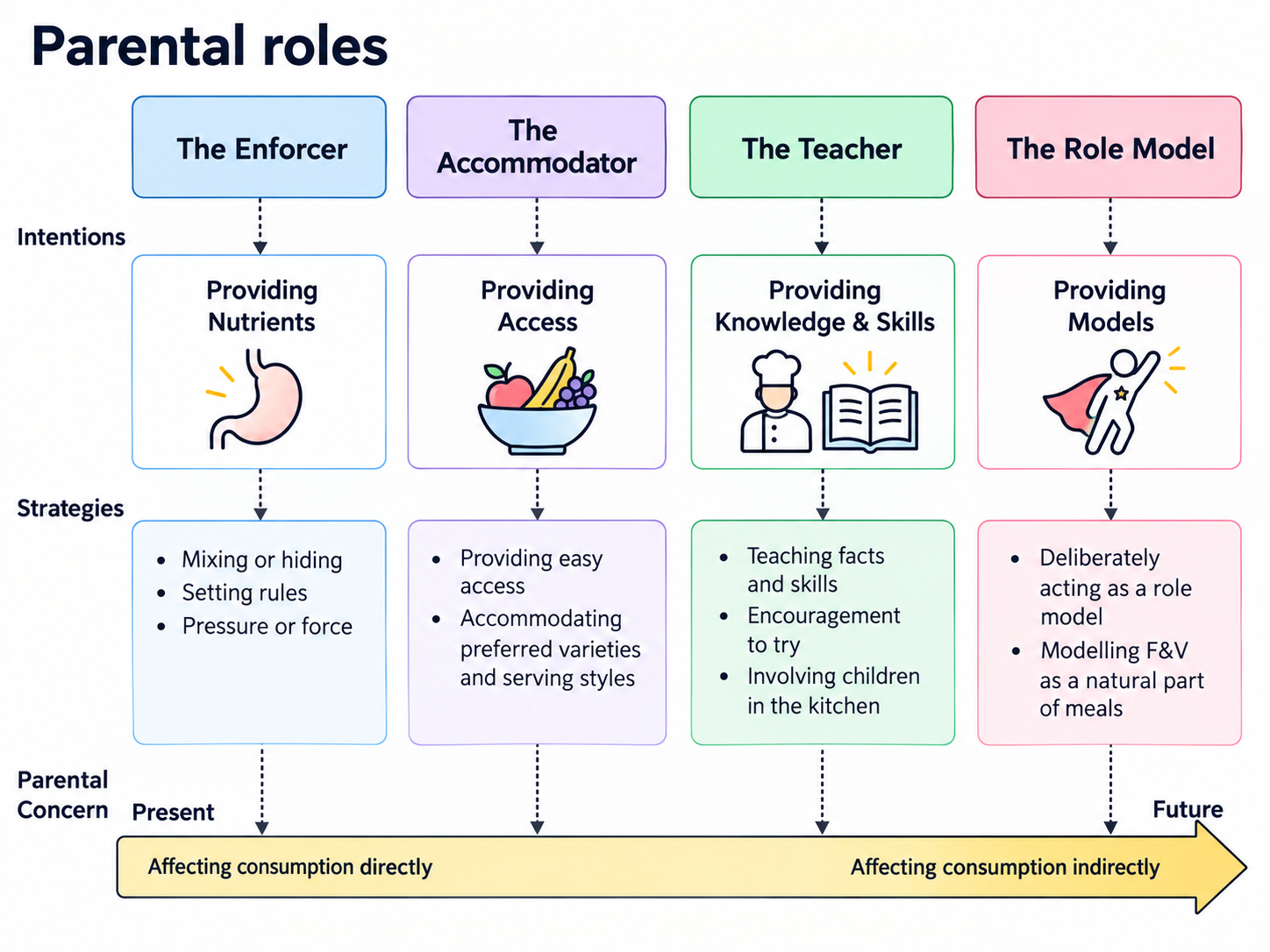
Conceptualized parental roles when influencing 10–12-year-old children’s fruit and vegetable (F&V) consumption. To illustrate patterns in the participating parents’ intentions and strategies related to influencing children’s F&V consumption, four parental roles were conceptualized. The roles are not mutually exclusive and individual parents’ intentions and actions could be described by several roles. The roles range from direct influence on consumption to more indirect and future-oriented approaches
Conclusions
The study results suggested gaps between the parents’ positive perceptions of F&V intake and their understanding of recommended quantities, health benefits, and practical feeding approaches. Limited nutritional knowledge, conflicting information, children’s preferences, cultural differences, and financial constraints influenced everyday practices.
The four conceptualized parental roles illustrated approaches ranging from direct control to improving accessibility, developing knowledge, and modeling behavior. More accessible guidance addressing why, how, how much, and how often to serve F&V may help parents support children’s intake.
With only 15 purposively selected parents, the study offers qualitative insights rather than statistically representative findings. The study relies on reported experiences, and the predominance of mothers and more highly educated parents limits how broadly the findings can be applied.
Source:
Journal reference:
- Helgegren, H., Winkvist, A., & Larsson, C. (2026). Parents’ perspectives and roles in influencing 10–12-year-old children’s fruit and vegetable consumption: A qualitative study in Sweden. BMC Public Health, 26, 2953. DOI: 10.1186/s12889-026-29852-2, https://link.springer.com/article/10.1186/s12889-026-29852-2
 Positive parenting in early childhood linked to stronger brain reward responses