Researchers followed nearly 2,000 children from infancy to preschool age to investigate whether an increasingly popular early-life aquatic activity might be connected to later cognitive development.
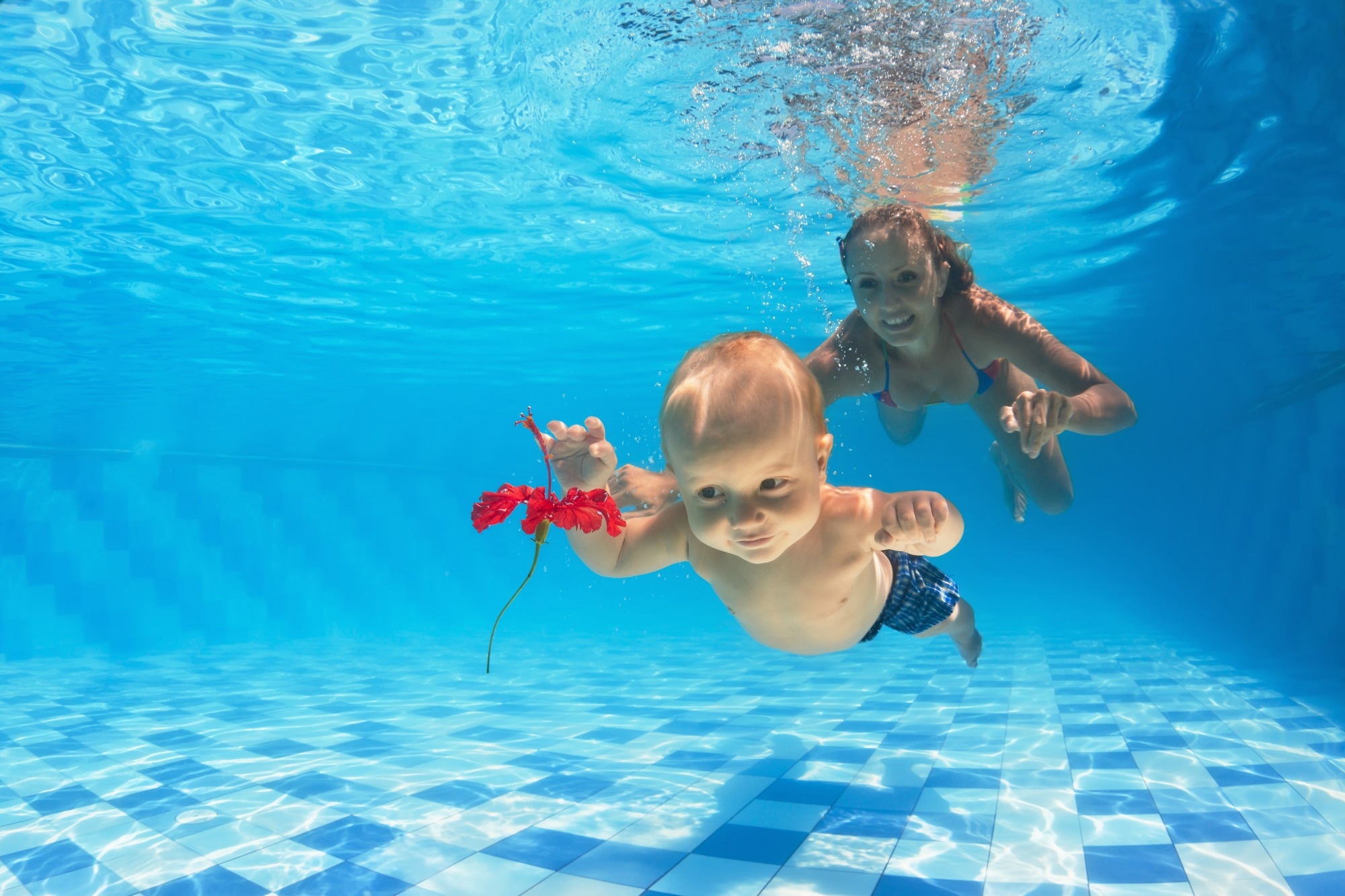
Study: Associations between baby swimming and preschooler child intelligence quotient: a cohort study. Image Credit: Denis Moskvinov / Shutterstock
In a recent study available online in the journal Scientific Reports, researchers examined whether baby swimming during the first 6 months of life is associated with intelligence quotient (IQ) at preschool age and whether maternal and infant-related factors modify this association.
Background
Physical activity has been positively associated with neurodevelopment, while current infant movement guidelines emphasize supervised floor-based play and limiting restrained sedentary time. However, structured aquatic activities for infants who cannot yet move independently are not specifically addressed. Baby swimming may provide multisensory experiences and enable self-generated movement under reduced gravitational constraints.
Previous small studies have mainly examined motor development, leaving its relationship with later intellectual development unclear.
About the study
The study used data from the prospective Wuhan Healthy Baby Cohort. Of 5,142 mother-infant pairs originally enrolled between March 2016 and November 2019, 1,935 had the required swimming, IQ, and covariate data for the final analysis.
Parents were asked whether their children had participated in baby swimming from birth to 1 month of age and from 1 to 6 months of age. At ages 4-6 years, the Chinese version of the Wechsler Preschool and Primary Scale of Intelligence, Fourth Edition (WPPSI-IV) was used to assess intelligence. The assessed domains included full-scale intelligence quotient (FSIQ), visual-spatial index (VSI), fluid reasoning index (FRI), verbal comprehension index (VCI), working memory index (WMI), and processing speed index (PSI).
Generalized linear models (GLMs) were used to examine associations between swimming and IQ after adjustment for socioeconomic status (SES), maternal and pregnancy characteristics, infant sex, birth weight, birth season, and primary caregiver. The researchers also corrected for multiple testing when comparing the six IQ measures to reduce the likelihood of chance findings.
Study results
The analysis included 1,935 mother-child pairs, of whom 1,272 (65.7%) had participated in baby swimming during the first 6 months of life. Participation occurred from birth to 1 month in 3.20% of children, from 1 to 6 months in 45.5%, and during both periods in 17.0%.
Before adjustment, children who participated in baby swimming scored modestly higher across most IQ measures, while processing speed was similar.
After adjustment for maternal, socioeconomic, pregnancy, and infant-related factors, baby swimming remained associated with higher scores in several domains. Compared with nonparticipation, swimming was associated with roughly 2 to 2.5 points higher scores in full-scale IQ, visual-spatial ability, and fluid reasoning, with somewhat smaller differences in verbal comprehension and working memory.
Children who swam from 1 to 6 months or during both age periods showed the clearest differences, with higher scores across several cognitive domains after correction for multiple comparisons. Swimming only during the first month showed less consistent associations.
Stratified analyses suggested numerically stronger associations among boys and children from higher-SES families, although formal interaction tests did not consistently support differences between groups. Because these analyses were exploratory, the subgroup findings should be interpreted cautiously.
Children from higher-SES households, those born to first-time mothers, those whose mothers took vitamin supplements during pregnancy, and those born in the fall were more likely to participate in baby swimming.
The researchers emphasized that these were associations rather than evidence of causation. Swimming exposure was measured only across broad periods and did not capture frequency, intensity, cumulative duration, or program characteristics. Residual confounding by parental investment, home environment, other enrichment activities, later physical activity, and sleep could not be ruled out.
Baby swimming was also strongly socially patterned, suggesting that participation may partly reflect broader family resources and enrichment rather than an independent effect of swimming itself. The subgroup and interaction analyses were exploratory and were not adjusted for multiple comparisons, increasing the possibility of chance findings. The findings also came from an urban Chinese cohort and may not generalize to rural or culturally different populations.
Conclusions
Participation in baby swimming during the first 6 months of life was associated with modestly higher intellectual development scores at preschool age, particularly among children who swam from 1 to 6 months or during both age periods. However, the observational study cannot establish that swimming caused the differences, and further research with more detailed exposure measures and stronger control for family-level confounding is needed.
Journal reference:
- Cao, S., Xiong, Z., Ma, B., Zuo, J., Gang, H., Li, M., Yang, F., Li, Y., Xu, S., Liu, J., & Xia, W. (2026). Associations between baby swimming and preschooler child intelligence quotient: A cohort study. Scientific Reports. DOI: 10.1038/s41598-026-68032-5, https://www.nature.com/articles/s41598-026-68032-5
 Epilepsy drugs may reduce effectiveness of hormonal contraceptives