Kerecis, the company pioneering the use of sustainably sourced fish‑skin grafts in cellular therapy and tissue regeneration, has significantly expanded U.S. insurance coverage, adding more than 40 million covered lives through recent policy updates across multiple large national and regional insurers, as well as state Medicaid programs.
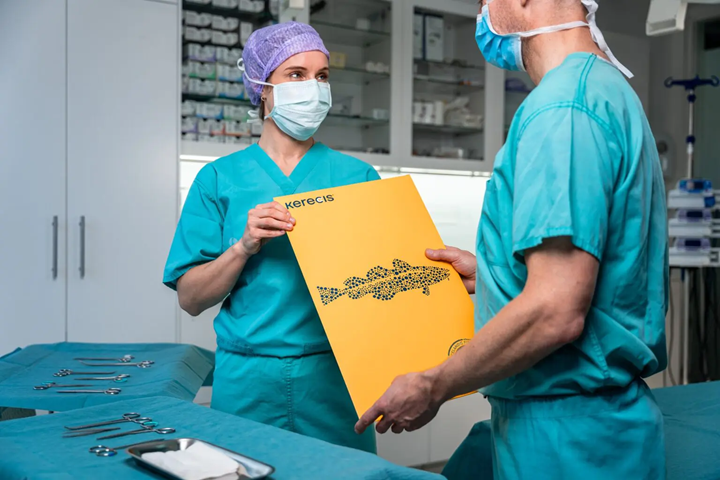 Image Credit: Kerecis
This important news comes as new data showing that intact fish‑skin grafts significantly reduce hospital length of stay for severely burned patients requiring skin grafting.
These milestones further strengthen Kerecis’ position in the U.S. and reflect a broader trend toward evidence‑driven reimbursement for biologic solutions that combine clinical outcomes with operational simplicity.
Kerecis’ intact fish‑skin grafts are designed to preserve the natural structure of the tissue, supporting cellular ingrowth and tissue regeneration. Unlike heavily processed or synthetic materials, fish skin maintains structural and biochemical components that enable efficient wound‑bed preparation and reliable progression toward closure. In addition to burns, Kerecis ranks in the top two widest covered skin substitute for diabetic foot ulcers.
Insurance expansion is leading to mainstream fish-skin graft adoption
Kerecis is now included in policy frameworks formed by Blue Cross Blue Shield Association, a national umbrella organization representing more than 30 independent health plans, with more plans to follow.
“We are seeing a clear shift in how payors evaluate biologic solutions,” said Kerecis Founder and CEO Fertram Sigurjonsson. “Coverage decisions are increasingly grounded in clinical outcomes, practical applicability, and the ability to reduce downstream burden on the healthcare system. That is where fish‑skin grafts are resonating.”
Securing these policy inclusions is a direct reflection of our targeted clinical trial strategy and the undeniable biological advantages of intact fish skin. Major payors demand definitive evidence that a biologic solution reliably advances tissue regeneration. Our data establishing efficacy in the most severe ulcers sets a new clinical benchmark, and that clear differentiation is driving these coverage decisions.”
Gunnar Johannsson, MD, Senior Vice President and Medical Director, Kerecis
“Coverage determines whether innovation is actually used,” Sigurjonsson added. “What we are seeing now is access catching up with clinical experience. That is when adoption accelerates.”
Kerecis also recently expanded access through Medicaid programs across multiple states, broadening availability of fish-skin grafts to nearly all state Medicaid plans.
Kerecis is now one of a limited number of biologic graft solutions included in these policies, reflecting increased payor confidence in both the clinical performance and practical value of intact fish skin in tissue regeneration.
Study shows intact fish-skin grafts can shorten hospital stays
A new study analyzing outcomes across 61 U.S. burn centers, revealed that intact fish‑skin grafts significantly reduce hospital length of stay for severely burned patients requiring skin grafting.
The retrospective, propensity-matched, cohort study drew on data from the American Burn Association’s Burn Care Quality Platform database. It compared clinical results for 465 patients who were either treated with Kerecis intact fish-skin grafts or products made from reconstituted cross-linked collagen and synthetic polyurethane.
After adjusting for age, gender, total body surface area burned, burn severity, inhalation injury and trauma diagnosis using generalized linear mixed models, the study found:
- Hospital length of stay was significantly shorter for patients treated with the intact fish-skin (24.2 days versus 33.5 days).
- Sepsis, graft loss, venous thromboembolism and hospital-acquired pressure injury were all numerically lower in the intact fish-skin group.
- Graft loss occurred in 3.2% of patients treated with the intact fish-skin versus 8.3% of those treated with synthetic materials.
“The real-world comparative data shows that hospital stays are shorter for burn patients treated with intact fish-skin grafts than for those treated with products that do not replicate the structure of native human tissue and are made from reconstituted cross-linked collagen and synthetic polyurethane,” said Sigurjonsson.
 Researchers followed glucose monitor users for three years and found a possible kidney benefit