From brain scans and blood markers to sleep watches and weekly surveys, the Sussex 4-Day Week study is taking an unusually deep look at what happens when employees spend less time at work.

Study: Assessing health, wellbeing, and working life impacts of a 4-day week: a multimodal protocol. Image Credit: Andrzej Rostek / Shutterstock
In a recent study published in the journal Frontiers in Psychology, researchers described a protocol to examine the relationship between reduced working time and physical and mental health, well-being, and workplace performance, while investigating potential psychological and biological mechanisms that may explain these effects.
Background
Long working hours can adversely affect health, well-being, sleep, and work performance. However, much of the existing evidence relies on self-reported outcomes, leaving the biological and psychological mechanisms underlying the reported benefits of reduced working time insufficiently understood. Important questions remain about whether reducing working hours influences brain function, immune activity, sleep, interoception, lifestyle, and workplace performance. The Sussex 4-Day Week study was designed to address these gaps by combining subjective assessments with objective physiological, behavioral, and neuroimaging measures.
Study design and participants
Researchers developed a 14-week multi-modal study protocol that aims to involve at least 150 working-age adults in the United Kingdom. Participants are recruited into two groups: a working-time-reduction group and a control group that maintains its usual working schedule. The sample size was informed by a power calculation based on pilot questionnaire data. Participation in some components, including magnetic resonance imaging (MRI), blood sampling, interoception testing, sleep monitoring, and time-use diaries, is voluntary; therefore, sample sizes may differ across individual outcome domains.
Most participants in the working-time-reduction group have adopted a 4-day workweek, generally reducing one full working day each week while maintaining their original pay. However, the protocol does not require a specific schedule. Some employers use a 9-day fortnight, two half-days, or shorter working days. This flexibility reflects differences in organizational needs. Control participants continue their existing working hours and pay, helping researchers distinguish changes associated with reduced working time from those caused by repeated testing or other factors.
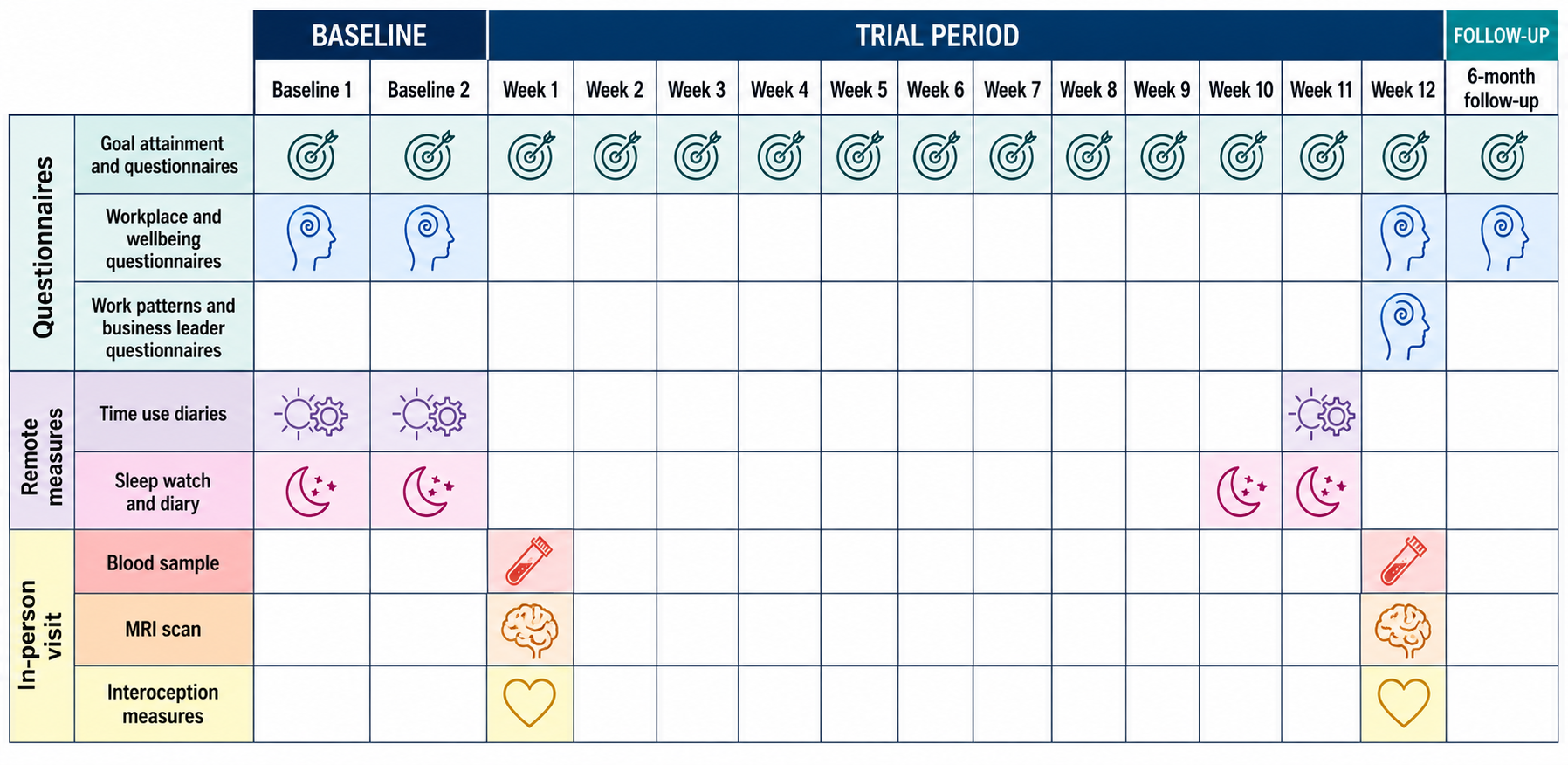
The full protocol timeline for both the working time reduction intervention and control groups.
Study procedures
The study was approved by the Brighton and Sussex Medical School Research Governance and Ethics Committee and is being conducted in accordance with the British Psychological Society ethical standards and the Declaration of Helsinki. The protocol includes a 2-week baseline period followed by 12 weeks of reduced working time, with weekly questionnaires completed throughout the study. During baseline, participants maintain their existing work patterns. The working-time-reduction group then implements the planned reduction, whereas the control group does not change its schedule. Assessments conducted at the beginning and end of the trial are supplemented by an optional 6-month follow-up using questionnaires.
Participants are also offered time-management training before the intervention. The training focuses on task prioritization, meeting practices, messaging habits, and the identification of inefficient work activities. It is provided to both groups, helping researchers distinguish the effects of time-management advice from those of reduced working hours.
Measures and outcomes
The study uses a broad range of measures covering health, well-being, work, behavior, and biological function. Weekly questionnaires assess positive and negative affect, burnout, psychological detachment from work, work engagement, task performance, and sleep quality. Additional baseline and end-of-trial questionnaires assess depression, anxiety, stress, mental wellbeing, physical activity, diet, sleep, job control, job support, job satisfaction, life satisfaction, organizational commitment, and intention to quit.
Time-use diaries are used to examine how participants redistribute their time when working hours are reduced, including time spent on travel, household activities, and leisure. Sleep is assessed using both self-reported diaries and wrist-worn actigraphy. Participants who opt in wear a MotionWatch 8 device during the 2-week baseline and 2-week end-of-trial periods. The device records movement and provides estimates of sleep onset, sleep latency, wake periods, total sleep time, and sleep efficiency.
The biological component includes blood sampling to assess inflammatory markers. A 10-mL peripheral blood sample is collected at baseline and at the end of the trial to measure serum concentrations of C-reactive protein and pro-inflammatory cytokines, including interleukin-1 beta, interleukin-6, and tumor necrosis factor alpha (TNF-α).
The study also investigates interoception, or the sensing and interpretation of signals originating within the body. Participants complete heartbeat-tracking, time-tracking, and heartbeat-discrimination tasks.
MRI assessments provide another objective component. The protocol includes functional MRI tasks examining response inhibition and interoceptive attention, resting-state functional MRI to assess connectivity between brain regions and networks, and diffusion-weighted and structural MRI sequences to examine brain organization and white matter.
Primary and secondary outcomes
The primary outcome is the difference in physical and mental health from baseline to the end of the trial among participants undergoing working-time reduction, compared with controls. Secondary outcomes include weekly changes in self-reported well-being and assessment of whether these changes are maintained at the 6-month follow-up.
Significance of the study
Data collection for the protocol is currently underway, with completion anticipated in 2027. Therefore, the paper does not present findings from the trial. Instead, it establishes the methodological framework for investigating the effects of reduced working time. Its major strength is the integration of subjective and objective measures. By combining questionnaires with actigraphy, blood-based inflammatory markers, interoception tasks, and MRI, the researchers aim to reduce reliance on self-report measures and explore potential mechanisms linking working-time reduction with health and workplace outcomes.
However, the researchers acknowledge several limitations. Organizations are not randomly assigned to reduced working time or the control condition, and participating employers are primarily small and medium-sized organizations located near the research site. This may introduce selection bias and limit generalizability to larger or more geographically diverse workplaces, while expectancy effects cannot be completely ruled out.
Conclusion
The Sussex 4-Day Week study provides a comprehensive framework for examining how reduced working hours may influence health, wellbeing, sleep, brain function, immune activity, and work performance. Its multi-modal design and control group are intended to strengthen the investigation of the effects and potential mechanisms of working-time reduction. The future trial results will be needed to determine whether the expected improvements occur and how changes across different health and workplace domains are interconnected.
Journal reference:
- Armitage, R. M., Souter, N. E., Graftdijk, T. J., McLaren, J., Moore, S. A., Kampoureli, C., Racey, C., Campbell-Meiklejohn, D., Garfinkel, S. N., Mullen, L., Russell, E., & Rae, C. L. (2026). Assessing health, wellbeing, and working life impacts of a 4-day week: A multimodal protocol. Frontiers in Psychology. 17. DOI: 10.3389/fpsyg.2026.1894642, https://www.frontiersin.org/journals/psychology/articles/10.3389/fpsyg.2026.1894642/full
 A protective brain enzyme may counteract aging-associated cognitive decline