Two siblings buried 725 km apart offer an intriguing clue in an ancient DNA investigation spanning centuries of Roman rule, political upheaval, and migration across Iberia.
Study: Contrasting demographic impacts of Roman colonization and early medieval migrations in the Iberian Peninsula
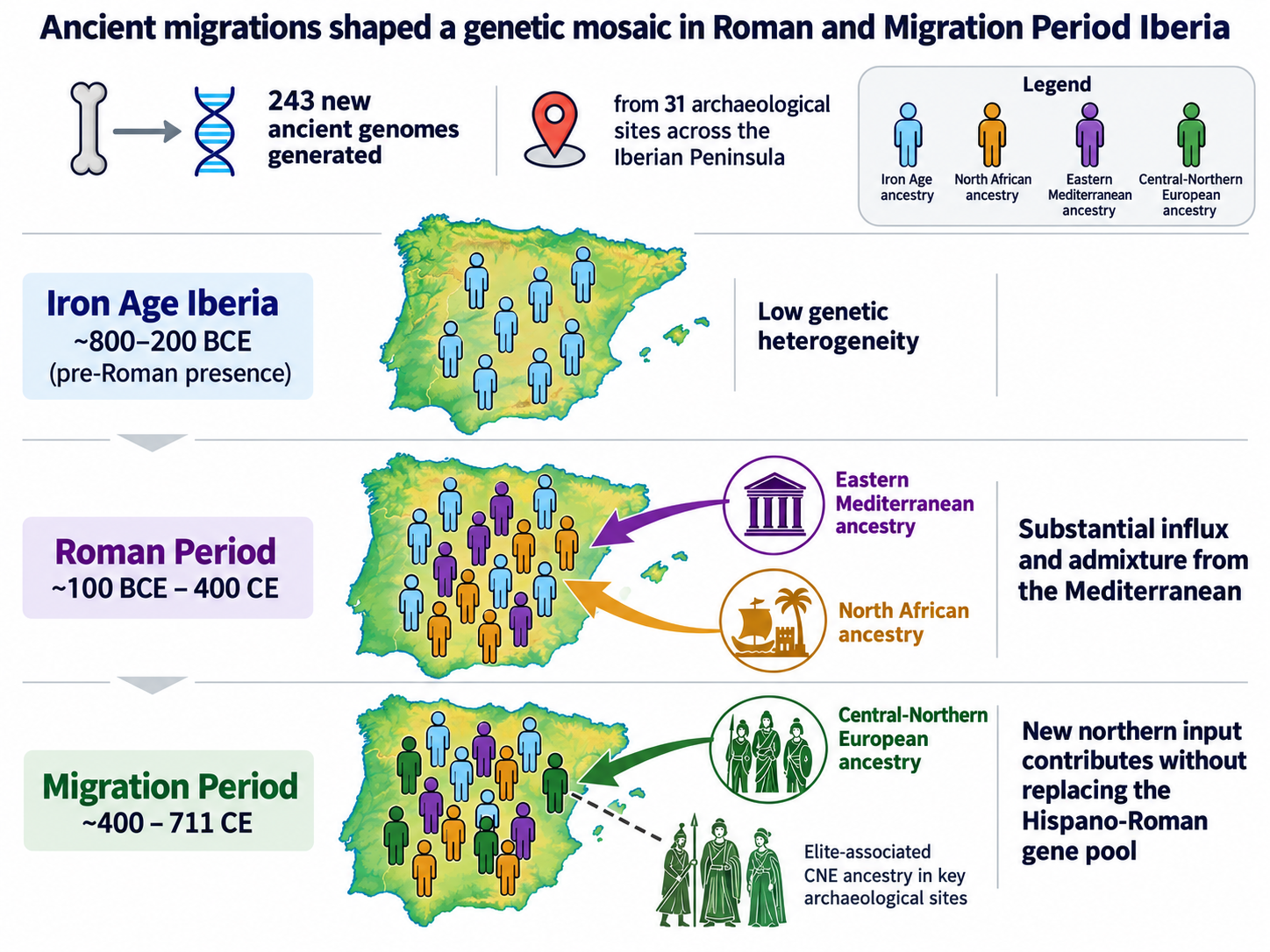
In a recent study published in the journal Cell, researchers investigated how Roman expansion and early medieval migrations influenced Iberia’s genetic makeup. Roman rule was associated with the arrival of ancestry from the eastern Mediterranean and North Africa, while later migrations introduced Central-Northern European (CNE)-related ancestry without widespread replacement of the Hispano-Roman population. The study also identified siblings buried approximately 725 km apart, highlighting long-distance movement among migrant groups. Overall, the findings point to more pronounced demographic changes in Roman Iberia than during the later migration period, contrasting with population shifts documented in post-Roman Britain and the central Mediterranean.
Rome entered Iberia during the Second Punic War in the late 3rd century BCE, drawn by its strategic location and resources. Roman rule changed the region’s language, culture, religion, and legal systems. Yet control weakened during the 5th-century CE migration period as Germanic and Alan groups gained political influence. It remains unclear whether these transitions caused major population shifts and how Iberia’s demographic changes compared with those elsewhere in Europe.
About the study
In this study, researchers analyzed deoxyribonucleic acid (DNA) from 243 people who lived in Iberia between 100 and 800 CE, covering four areas, and incorporated findings from 58 people examined in previous research. The samples underwent enrichment using panels targeting approximately 1.2 million or 1.4 million single-nucleotide polymorphisms (SNPs). The newly examined remains were collected at 31 archaeological locations, representing diverse settings and cultural contexts, including Hispano-Roman and Germanic-associated communities. Notable groups included individuals from Augusta Emerita, a former Roman provincial capital, and sites with evidence of Germanic cultural influences.
After applying sequencing coverage and contamination filters, the researchers included 212 newly analyzed individuals in the genetic comparisons. They obtained 35 additional radiocarbon measurements and drew on 32 dates reported in earlier research. Principal component analysis (PCA) was used to compare the genetic profiles of people from the Roman era and late antiquity.
Ancestry modeling assessed whether the Hispano-Roman population continued through the period of Germanic migrations. The researchers also investigated how CNE-related ancestry varied by burial setting and estimated social standing. Additional analyses excluded cemeteries associated with Germanic material culture to assess whether these findings reflected broader demographic patterns or specific burial groups.
The team compared genetic variation between ancient and present-day Iberians and analyzed regional populations from the 1000 Genomes Project to investigate whether genetic contributions from Central and Northern Europe remained detectable in modern Iberians. The analyses distinguished population continuity from migration-related demographic changes.
Results
The analysis revealed major demographic changes associated with Roman rule, with increased variation in ancestry composition across three of the four regions studied when Iron Age populations were compared with Roman and late antique samples. Eastern Mediterranean-related ancestry was detected in 55 of 66 Roman-period individuals (83%), with average proportions ranging from 4.1% in Augusta Emerita to 34.6% in southeastern Iberia. By contrast, clear ancestry linked to the Italian Peninsula was uncommon, suggesting that migrants from the eastern Mediterranean contributed more substantially to Iberia’s changing genetic profile. The genetic evidence could not establish whether this ancestry arrived directly from the eastern Mediterranean or through other imperial regions, including Italy.
North African ancestry was also widespread in Iberia during the Roman and late antique periods. In southeastern Iberia, 33 of 34 Roman-period individuals showed a North African ancestry component, averaging 26.9%. The signal extended to northeastern Iberia during Roman times and central Iberia during late antiquity, including provincial capitals and inland settlements. Genetic evidence of African maternal and paternal lineages further supported this admixture. At the Christian basilica of Cortijo Coracho, 29 of 30 individuals carried North African ancestry, generally alongside local Iberian and Eastern Mediterranean ancestry, suggesting extensive admixture within the community. The researchers also identified a four-generation family network linking 16 individuals.
CNE-related ancestry appeared more frequently among people from the migration period. This pattern was found in 53 of 164 individuals (32%), compared with six of 66 people who lived during Roman times.
At Germanic-associated cemeteries, 29 of 52 individuals carried CNE-related ancestry, including some high-status burials. After excluding these cemeteries, 23 of 114 individuals still carried this ancestry, which averaged 12.1% across the subset. These samples were not necessarily representative of Iberia’s wider population. The newcomers did not replace the existing population on a large scale. At sites with Germanic-associated burial practices, individuals with predominantly CNE ancestry lived alongside people retaining Hispano-Roman ancestry, with evidence of admixture between the groups.
One particularly notable finding involved two siblings with entirely CNE-related ancestry who were buried approximately 725 km apart along the Roman road network. Their locations suggest considerable mobility among migrant groups and connections maintained through Roman-era infrastructure, but their precise movements remain uncertain. CNE-related ancestry later declined, but traces persisted into the medieval period. Comparisons with present-day Iberians showed less variation in ancestry composition among sampled modern populations, but none of the ancestry models achieved a statistically acceptable fit. Later population movements and resettlement may partly explain the differences.
Conclusion
Based on the findings, Roman rule substantially changed Iberia’s genetic composition through sustained migration introducing Eastern Mediterranean-related and North African ancestry. Later Germanic migrations introduced new ancestry, but the existing population largely persisted. North African ancestry in a late antique Christian community also highlights strong historical connections across the Strait of Gibraltar.
Sparse Iron Age and early Roman sampling, partly linked to cremation practices, limits the conclusions. Migrant routes and two-way movement between Iberia and North Africa remain unclear. Future studies combining ancient DNA with mobility-related isotope measurements could help trace these movements. Broader genomic sampling across pre-Roman Iberia, northern Iberia, North Africa, and medieval and post-medieval populations is also needed to explain how later historical events shaped the genetic differences between ancient and present-day Iberians.
Source:
Journal reference:
 Scientists reviewed studies covering 1.17 million children and found a major research gap