An analysis of more than 13,000 elite running performances spanning 25 years challenges decades of assumptions about the limits of female athletic performance and raises new questions about what is driving the changes.

Study: The gap between elite female and male runners continues to shrink in the 21st century. Image Credit: boonchoke / Shutterstock
In a recent study published in the journal Scientific Reports, Tommaso Jucker of the School of Biological Sciences, University of Bristol, UK, examined changes in the performance gap between elite male and female athletes across 11 running disciplines from 2001 to 2025.
Background
Can female athletes eventually match or surpass male runners in competitive athletics? Early studies predicted that women could eventually outperform men in some running disciplines. Yet later research suggested that the performance gap had stabilized at around 10% since the 1980s. Possible explanations include aerobic, biomechanical, musculoskeletal, and hormonal differences between men and women. Recent gains in women’s middle- and long-distance running world records have called this assumption into question. Jucker examined whether the gap had continued to narrow across running events, beyond the changes recorded in world records.
About the study
The study used officially ratified running race results recorded between 2001 and 2025, obtained from the World Athletics website on December 21, 2025. Eleven running disciplines, ranging from 60 meters to the marathon, were included. They were categorized as sprint events (60m, 100m, 200m and 400m), middle distance events (800m, 1500m and 3000m) and long distance events (5 and 10 km, half marathon and marathon). The analysis included outdoor races, except for the indoor 60-meter event. The mile, hurdle races, barrier events, and competitions held in 2020 were excluded because of pandemic-related cancellations, leaving 24 racing seasons of results.
For each event and year, the initial dataset included the 100 best performances of male and female athletes. Only each athlete's fastest annual performance was retained to prevent frequently competing individuals from disproportionately influencing the findings. The 25 highest-performing athletes of each sex were then selected annually. The final dataset contained 13,094 performances of 3611 elite athletes (1966 men and 1645 women) and was collected from 971 sporting events.
Jucker calculated annual mean completion times and compared male and female performance differences using pace (seconds per kilometer) and percentages. Statistical models were used to compare performance gaps between events and examine changes over time, allowing trends to differ by running discipline. Repeating the analysis using the top 10 and top 50 athletes per event and year produced similar findings.
Study results
Across the 25-year observation period, elite female runners were, on average, 12.6% slower than male runners across all disciplines. The performance difference varied considerably according to running distance. The gap was narrowest in sprint events, measuring 9.2% in the 60-meter race, and generally widened with distance, reaching 14.2% in the 10-kilometer event, before narrowing again in the half marathon and marathon.
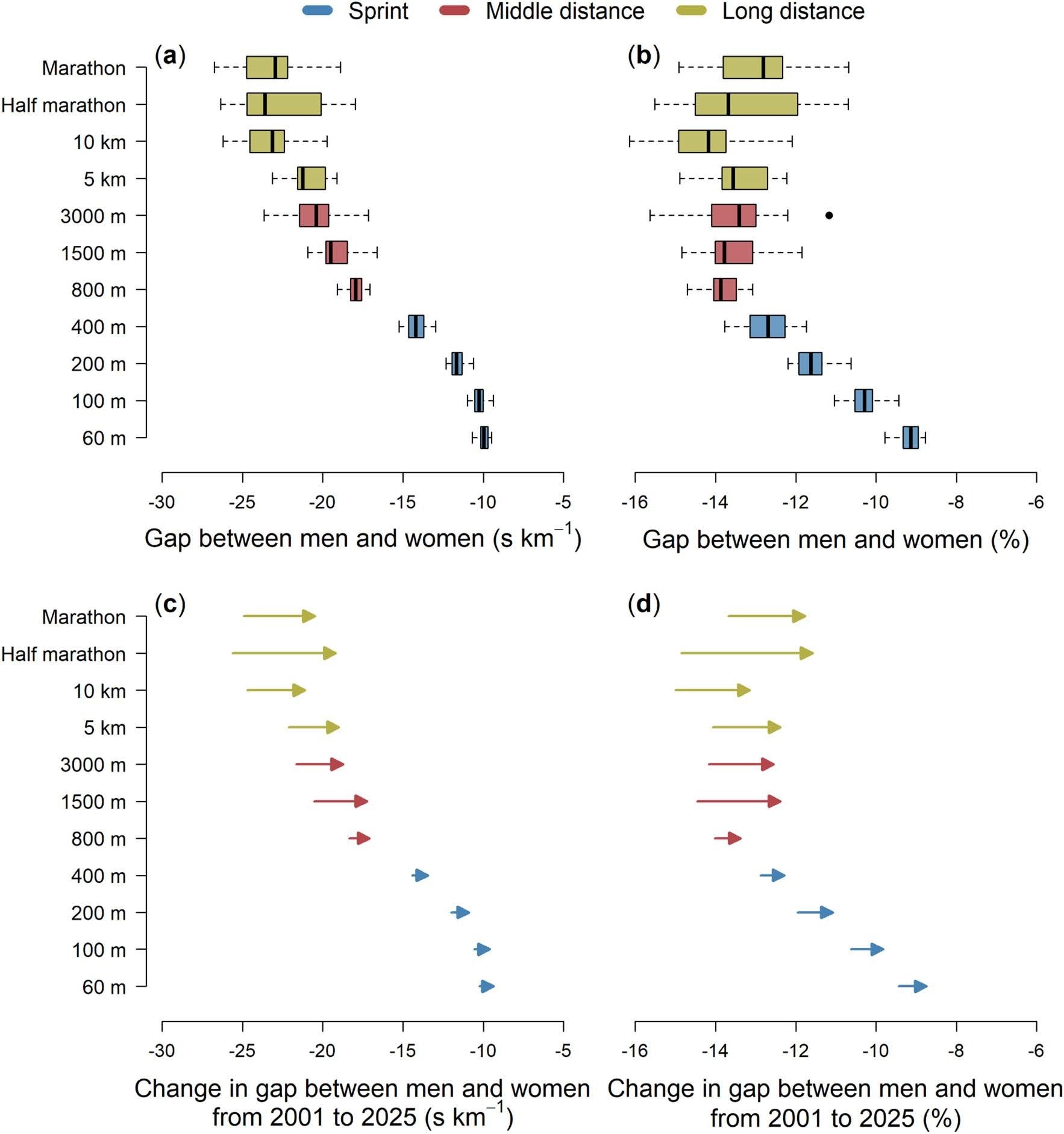
Shrinking gap among elite male and female runners during the 21st century. Top panels depict variation in the gap, expressed as both a difference in pace between men and women (a) and as a % (b), across the 11 events considered in this analysis for the period between 2001 and 2025. The more negative the values, the greater the gap between male and female runners. Bottom panels (c–d) show changes in the gap between 2001 (start of the arrow) and 2025 (arrow head) for each running event, as estimated from linear mixed effects models. Arrows pointing to the right indicate a shrinking gap over time, with the length of the arrow reflecting the magnitude of this change. Running events are color-coded into sprint (blue), middle-distance (red) and long-distance races (yellow).
The overall performance gap narrowed steadily. Between 2001 and 2025, the difference decreased by an average of 1.3 percentage points, declining from 13.2% to 11.9%. The greatest relative gains occurred in middle- and long-distance competitions exceeding 800 meters. Across these disciplines, women gained an average of 3.6 seconds per kilometer relative to men’s performances, corresponding to a 1.9-percentage-point reduction in the performance gap.
Performance gaps also became more consistent across events. The range between the smallest and largest gaps narrowed from 5.6 percentage points in 2001 to 4.6 percentage points in 2025. The widest gap shifted from the 10-kilometer event to the 800-meter event over this period.
Women gained ground while male athletes continued to improve. From 2001 to 2025, men improved in all 11 running disciplines, reducing their average time per kilometer by 2.2 seconds, with the largest gains in the half marathon and marathon, where times fell by 6.0 to 6.2 seconds per kilometer.
Average times among the leading female runners improved approximately twice as much, falling by 4.5 seconds per kilometer over the study period. Their greatest improvements occurred in long-distance road races, where average times fell by 10.3 to 12.6 seconds per kilometer in the half marathon and marathon, representing improvements of 5.0–6.3%.
The analysis showed broadly linear improvements for both sexes across most disciplines, including long-distance road races, with no clear performance plateaus or major turning points. These findings indicated that women’s faster rate of improvement, rather than stagnation among men, primarily explained the narrowing performance difference.
Conclusions
The findings challenge the longstanding assumption that differences between elite male and female running performances have stabilized. Between 2001 and 2025, women improved faster than men across all 11 disciplines, with the greatest relative gains occurring in middle- and long-distance races. Advanced footwear technology may have contributed to these improvements, but the gains generally followed steady trajectories that began before the introduction of advanced shoes in road races around 2016 and track events around 2021. This suggests that footwear technology alone cannot explain women’s greater gains relative to men.
Increasing opportunities for women’s participation in competitive running may also have influenced performance progression. As the study analyzed historical race results, it could not establish the causes of these trends. The findings describe elite athletes rather than runners generally.
Further controlled investigations into footwear technology, biomechanics, and running economy are necessary to clarify these trends. Continued improvements may reshape the future boundaries of elite athletic performance.
Source:
Journal reference:
 Essential marathon training tips to prevent injuries and boost recovery