Could trace amounts of naturally occurring lithium in water supplies influence how a baby's heart develops? Researchers investigated a possible connection using millions of children's healthcare records.
Study: Elevated lithium levels in drinking water are associated with a higher prevalence of Wolff-Parkinson-White diagnoses. Image Credit: vchal / Shutterstock
In a recent study published in The Journal of Clinical Investigation, researchers found that higher county-level lithium concentrations in water sources were associated with greater odds of Wolff-Parkinson-White (WPW) diagnoses among children in California. They also examined whether exposure during fetal development could contribute to abnormal electrical pathways in the heart.
Supraventricular tachycardia (SVT) is the most common form of arrhythmia in children and young adults. Atrioventricular reciprocating tachycardia using an accessory pathway is one of the most common mechanisms. An atrioventricular accessory pathway is an abnormal electrical connection between the heart's upper and lower chambers. Because accessory pathways are congenital, environmental exposures in utero could influence their development.
Lithium is among the substances linked to cardiac malformations. Children born to mothers with therapeutic lithium use during pregnancy have an increased cardiac malformation risk that can include Ebstein's anomaly. Ebstein's anomaly is a rare congenital abnormality affecting the tricuspid valve, and 10%–30% of affected patients have at least one accessory pathway. Drinking water often contains variable levels of lithium, which may have health effects.
Sustained low-level exposure to lithium during fetal development could raise the risk of accessory pathways, the researchers hypothesized. The WPW pattern on an electrocardiogram (ECG) is the most clinically obvious manifestation of an accessory pathway. WPW syndrome occurs when this pattern is accompanied by symptoms of an abnormally rapid heartbeat and is associated with SVT, atrial fibrillation, and an increased, though rare, risk of sudden death.
About the study
In the present study, the researchers examined the associations between lithium levels in drinking water and WPW diagnoses in children using a county-level observational design. The study included patients younger than 18 years whose first hospital, emergency department, or ambulatory surgery encounter was recorded in California's Department of Health Care Access and Information database between 2016 and 2020. Data on lithium concentrations in raw groundwater and surface-water sources from 1998 to 2020 were obtained from public datasets and averaged by county. The primary outcome was WPW diagnosis determined using diagnostic codes.
Logistic regression was performed to investigate the association between lithium levels and WPW diagnoses. Analyses were adjusted for age, sex, ethnicity, race, insurance, and income. Separate logistic regression analyses explored associations between lithium levels and SVT, fainting (syncope), palpitations, and a composite of these three outcomes. External validity was tested using a New York dataset including patients from 2010 to 2012.
An exploratory analysis evaluated associations between lithium levels and Ebstein's anomaly and congenital heart disease (CHD). Because data linking children to their mothers were unavailable, primary analyses were restricted to children, assuming they would remain in their county of birth. To account for possible discordance between county of birth and residence, a sensitivity analysis restricted to patients under one or two years was performed. Another analysis excluded wells designated for monitoring.
Findings
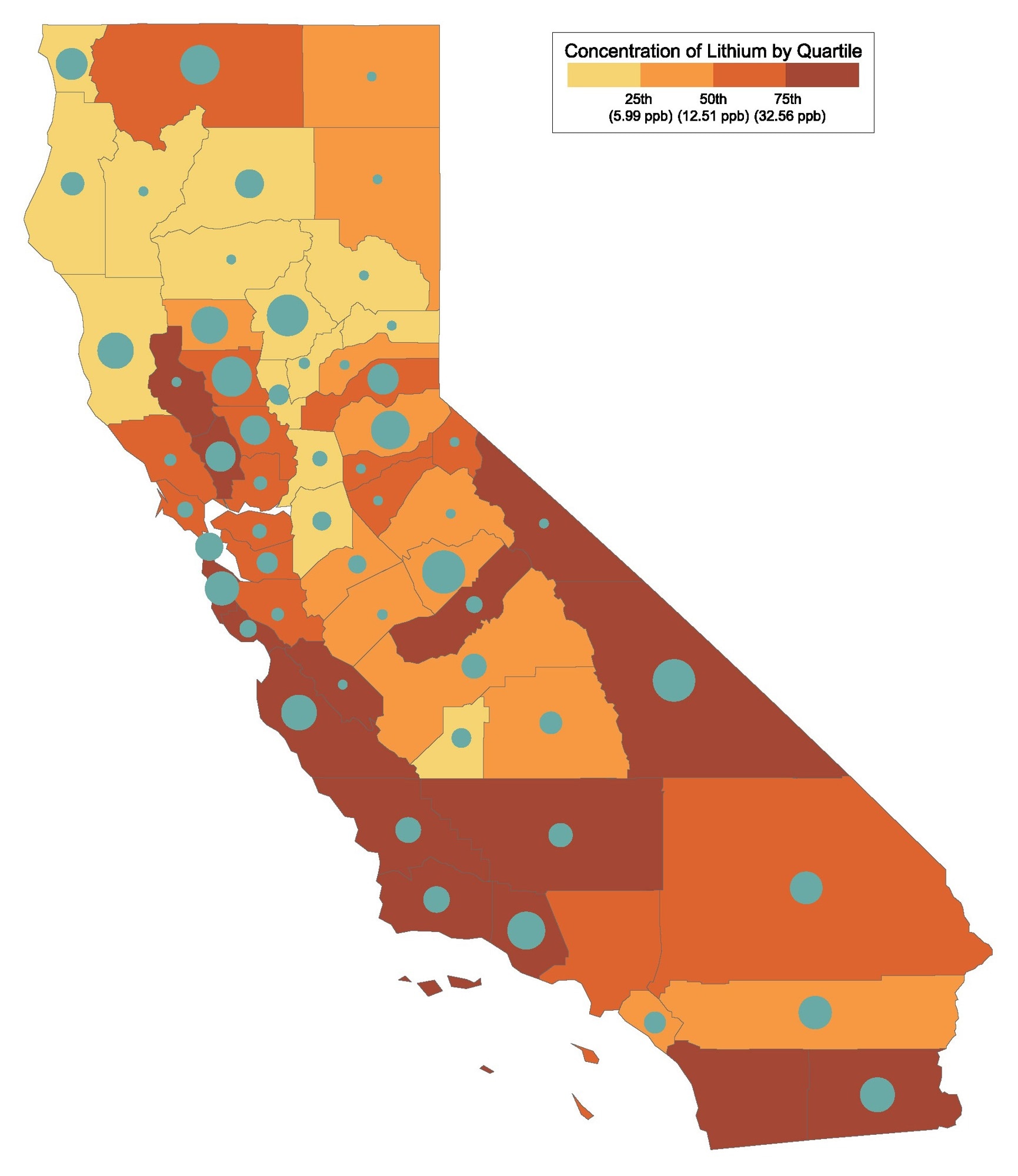
California county-level estimates of Wolff-Parkinson-White diagnoses per 1000 acute care visits in percentiles (circles), compared to quartiles of lithium concentration levels in raw water sources. Darker shades designate higher quartiles of lithium concentrations.
The study included more than 2.3 million patients, with a mean age of 8.2 years at first encounter. The county-level average lithium concentrations across water sources ranged between 1.49 parts per billion (ppb) and 213 ppb (median: 12.5 ppb). Patients from areas with higher lithium levels were more likely to be Hispanic and had lower income. In total, 686 WPW diagnoses (0.03%) were recorded. In unadjusted analyses, each 50% increase in county-level lithium concentrations was associated with 8% higher odds of WPW diagnosis.
Children in counties with lithium concentrations at or above the 75th percentile (32.6 ppb) had 71% higher odds of WPW diagnosis before adjustment and 60% higher odds after adjustment. At or above the 10 ppb health-based screening level, adjusted odds of WPW were 33% higher. This screening level is not an enforceable drinking-water limit. SVT, syncope, and palpitations were observed in 2,260, 44,276, and 13,317 patients, respectively. Adjusted analyses indicated that children in counties above the 75th-percentile lithium threshold had greater odds of these diagnoses.
These outcomes are not specific to accessory pathways. In separate checks, lithium concentrations were not significantly associated with hypertrophic cardiomyopathy or selective IgA deficiency. Air pollution was not significantly associated with WPW.
In the external dataset of over 1.9 million patients from New York, living in areas with lithium levels > 10 ppb was associated with 22% higher adjusted odds of WPW diagnosis, but the association above 32.6 ppb was not statistically significant.
Exploratory analyses revealed significantly higher odds of a CHD diagnosis among those from areas with lithium levels ≥ 75th percentile. No statistically significant association was found for Ebstein's anomaly. Sensitivity analysis revealed that the odds of receiving diagnoses for symptoms potentially associated with accessory pathways were higher for patients under one or two years living in areas with lithium levels ≥ 75th percentile. The association with WPW also persisted after excluding monitoring wells, though the upper-quartile threshold fell to 11.8 ppb.
Conclusions
Taken together, higher levels of lithium in drinking water sources were associated with increased odds of WPW diagnoses among children in California. Non-specific symptoms and diagnoses that can accompany accessory pathways (SVT, syncope, or palpitations) were also more common in children from counties with higher lithium levels. In New York, the association was observed at the 10 ppb threshold but not at 32.6 ppb. Individual lithium intake and maternal exposure during pregnancy were not measured. Outpatient diagnoses were unavailable, and other environmental factors may have contributed to the associations. The observational study cannot establish causation. Overall, these results suggest a potential modifiable factor that warrants further investigation.
Source:
Journal reference:
- Teraoka JT, Agarwal A, Tang JJ, Dewland TA, Marcus GM (2026). Elevated lithium levels in drinking water are associated with higher prevalence of Wolff-Parkinson-White diagnoses. The Journal of Clinical Investigation. DOI: 10.1172/JCI205020, https://www.jci.org/articles/view/205020
 Metformin in pregnancy does not raise developmental risk in children