Lentinan is a bioactive polysaccharide extracted from shiitake mushrooms and renowned for its immunomodulatory effects. It is often used as an adjuvant in cancer therapy to ease potential complications following chemo- and radiotherapy.
Beyond oncology, lentinan has shown antioxidant and antiviral activity and is commonly incorporated in health supplements to slow aging and enhance immunity. In food applications, it can improve stability and texture and add nutritional benefits.
Molecular weight is an essential component of lentinan’s functionality. Higher-molecular-weight molecules often bind more effectively to immune cell receptors and adopt more ordered structures, yielding more potent immunomodulatory effects.
Lower-molecular-weight molecules dissolve and absorb more easily, but their biological activity is sometimes shorter-lived. Using the best molecular weight is crucial for optimizing performance in specific applications.
Experimental section
This study employed a Size Exclusion Chromatography (SEC) system that was equipped with refractive index (RI) and light-scattering (LS) detectors.
The light-scattering detector used was the BeSEC LS2 from Bettersize Instruments, with detection angles at 90 ° and 7 °.
The BeSEC workstation uses light scattering, along with UV or RI signals, to calculate molecular-weight averages (Mn, Mw, and Mz) and distributions.
System configuration:
- Detectors: Refractive Index (RI) and Light Scattering (LS)
- Column: Shodex Ohpak LB-806M
- Mobile phase: 0.05 M NaNO3 aqueous solution
- Flow rate: 0.7 mL/min
- Injection volume: 100 μL
- Column temperature: 40 ℃
- dn/dc: 0.129 mL/g
Sample preparation:
Five different lentinan samples were analyzed. Each powder was accurately weighed and dispersed in 0.05 M sodium nitrate (NaNO3) and stirred until clear (1 to 3 mg/mL). Following stirring, the samples were filtered through a 0.22 μm PES syringe filter, transferred to vials, and placed in the autosampler for measurement.
Results and discussion
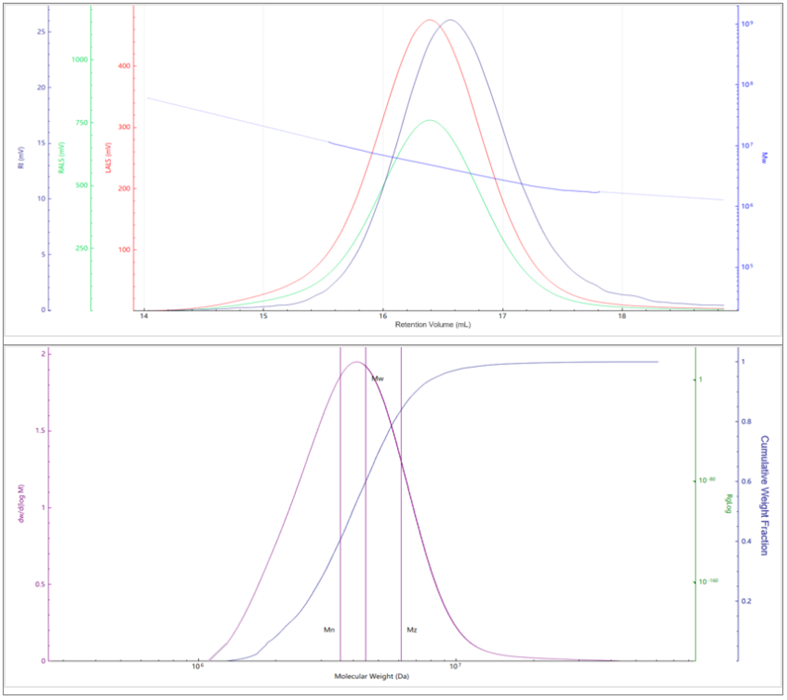
Figure 1. Elution profiles of the multi-detector signals (top) and molecular weight distribution (bottom) for Sample A. Image Credit: Bettersize Instruments
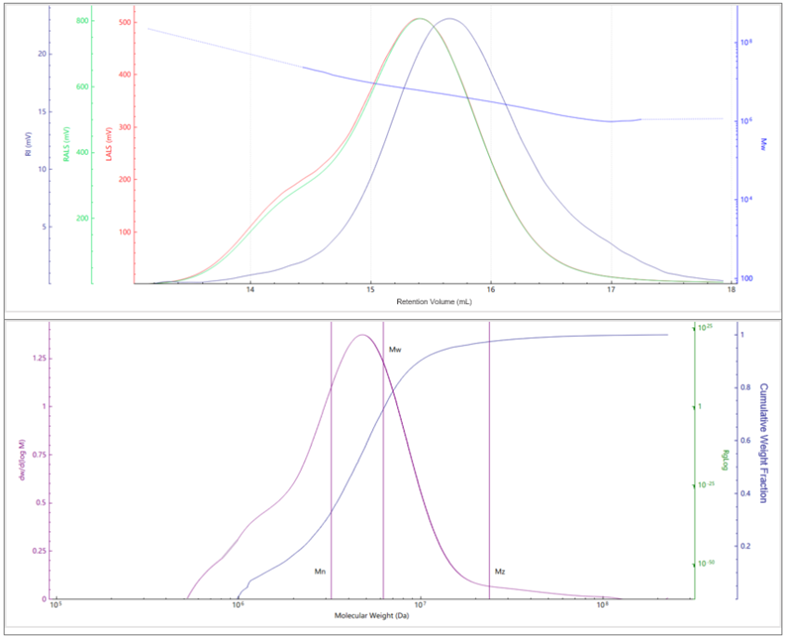
Figure 2. Elution profiles of the multi-detector signals (top) and molecular weight distribution (bottom) for Sample B. Image Credit: Bettersize Instruments
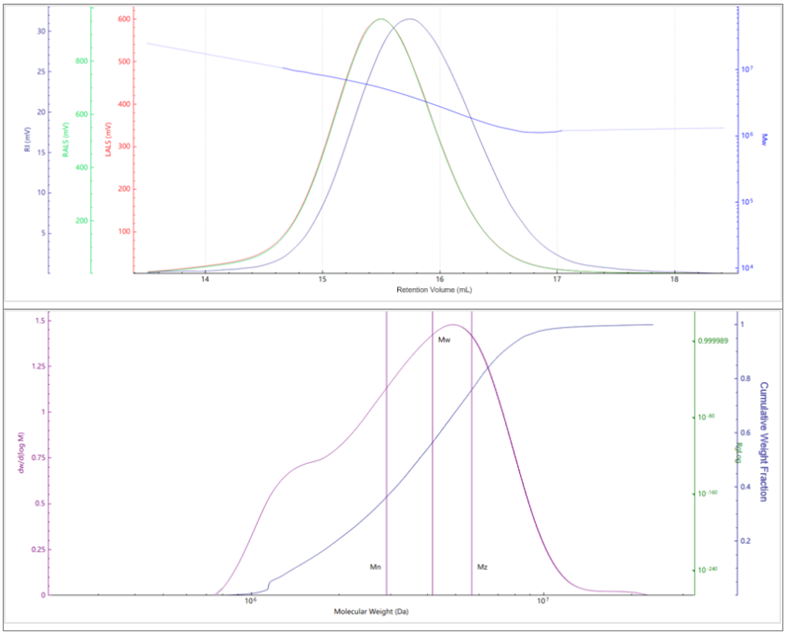
Figure 3. Elution profiles of the multi-detector signals (top) and molecular weight distribution (bottom) for Sample C. Image Credit: Bettersize Instruments
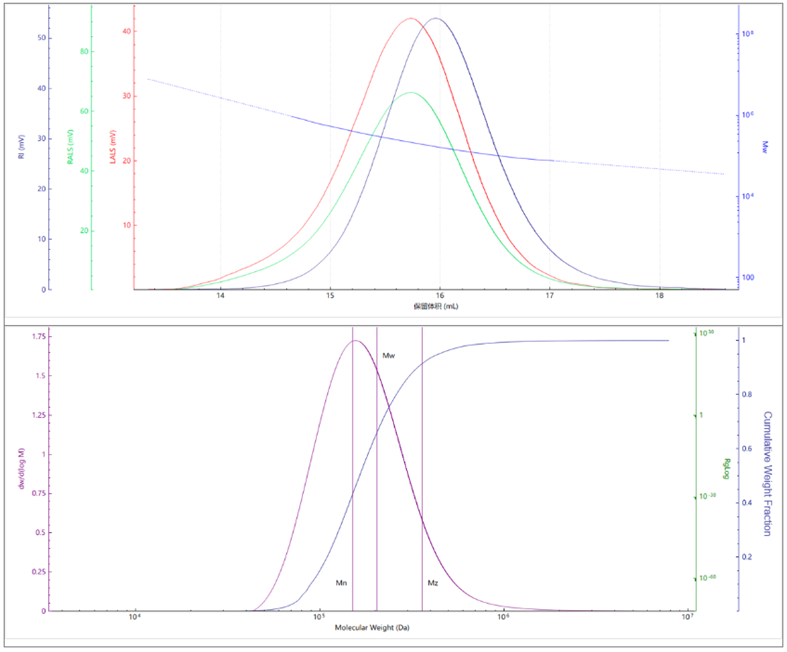
Figure 4. Elution profiles of the multi-detector signals (top) and molecular weight distribution (bottom) for Sample D. Image Credit: Bettersize Instruments
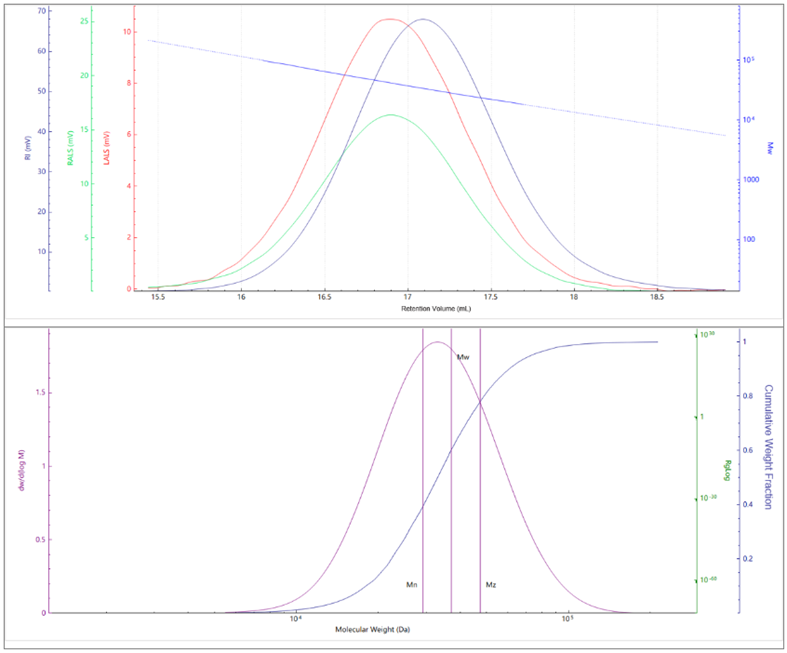
Figure 5. Elution profiles of the multi-detector signals (top) and molecular weight distribution (bottom) for Sample E. Image Credit: Bettersize Instruments
Figures 1 to 5 show chromatograms of the five samples. The right-angle light scattering (RALS) signal is shown in green, the low-angle light scattering (LALS) signal in red, and the refractive index (RI) signal in blue.
The purple line indicates the molecular weight distribution, which represents molecular weight as a function of elution time.
Across all samples, the signals are clean, with minimal noise, high signal-to-noise ratios, and flat baselines.
In Figure 1, the molecular weight profile steadily decreases with increasing elution volume, consistent with SEC principles: larger species elute first, followed by smaller ones.
Scattering peaks exhibit no tailing, and the molecular weight curve stays stable at the end, suggesting effective size-based separation.
Table 1. Molecular weight results of lentinan samples. Source: Bettersize Instruments
| No. |
Mn (kDa) |
Mw (kDa) |
Mz (kDa) |
Mw/Mn |
| Sample A |
3559 |
4465 |
6128 |
1.25 |
| Sample B |
3218 |
6222 |
23741 |
1.37 |
| Sample C |
2903 |
4168 |
5676 |
1.13 |
| Sample D |
150.8 |
204.5 |
360.45 |
1.3 |
| Sample E |
29.2 |
37.1 |
47.5 |
1.27 |
The molecular weight results for all five samples are summarized in Table 1. Substantial differences in molecular weight can be seen, which directly affect viscosity, formulation behavior, solubility, and biological activity.
Accordingly, each sample may be more suited to different applications.
Conclusion
This study demonstrated the use of the BeSEC LS2 with light scattering detection to characterize the molecular weights of lentinan samples.
The results revealed significant variation in the molecular weights of the five samples, providing crucial information for selecting the appropriate grade for pharmaceutical, nutraceutical, or food applications.
Acknowledgments
Produced using materials originally created by Zhibin Guo, from Bettersize Instruments
About Bettersize Instruments 
With over 29 years of experience, Bettersize Instruments has established itself as a leading global manufacturer of analytical instruments for particle analysis. Quality is core to our business - we carry out 95 % in-house production for strict quality control.
Our mission is to empower our customers worldwide with best-in-class instruments, comprehensive solutions, and exceptional customer service. We are dedicated to helping scientists, researchers, and engineers gain deeper insights into material properties to facilitate R&D and improve production efficiency.
We are proud to have 95 patents and serve over 17,000 organizations across 92 countries and industries, including pharmaceuticals, battery materials, chemicals, coatings, mining, and more. We invest 15 % of annual revenue in R&D to continuously improve the performance of existing instruments while driving relentless innovation to ensure precise measurement results.
In 2023, we opened a new facility in Costa Mesa, California, to provide real-time support and improve product delivery for our North American customers. This facility allows us to work more closely with local material scientists, researchers, and engineers to optimize their materials analysis.
Our Main Product Series:
- BeNano Series: Nanoparticle size and zeta potential analysis by three light scattering techniques;
- Bettersizer Series: Particle sizing by laser diffraction technology with built-in dry/wet dispersion systems;
- BeVision Series: Particle size and shape analysis by dynamic/static image analysis technologies;
- BeDensi Series: Tapped and bulk density, flowability, and angle of repose measurement;
- PowderPro Series: 14-in-1 automatic powder characteristics tester;
- BetterPyc 380: Automatic gas pycnometer for volume, true density, solid content, and open cell content measurement.
International qualifications:
All Bettersize instruments have passed ISO9001 international quality management system certification and the European CE certification. Laser particle analyzers obtained the approval of 21 CFR Chapter I Subchapter J, Part 1040.10 and 1040.11.
The software complies with 21 CFR Part 11 of the FDA, ensuring the validity and reliability of results and regulatory compliance.
Services and support:
1. Online Store: Hassle-free ordering of our BeDensi Series.
2. Free Sample Testing: Up to 3 free sample tests for particle size, particle shape, zeta potential, molecular weight, and powder characteristics.
3. Complete Pre-sale and After-sales Service System: Timely response to product inquiries, 2-3 years warranty, free installation and debugging, free software upgrade, spare parts supply, and more;
4. Knowledge Hub: Get free product brochures, application notes, industry solutions, guidebook whitepaper, and more;
5. Training Conference: Expert-led sessions for product training and sales strategy.
Sponsored Content Policy: News-Medical.net publishes articles and related content that may be derived from sources where we have existing commercial relationships, provided such content adds value to the core editorial ethos of News-Medical.net, which is to educate and inform site visitors interested in medical research, science, medical devices, and treatments.