Sponsored Content by AbselionReviewed by Olivia FrostApr 2 2026
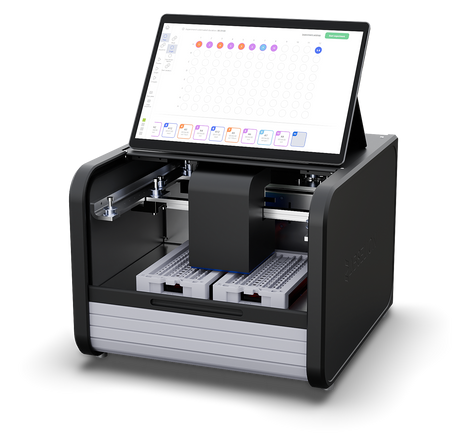
Amperia™ is a compact benchtop platform designed for rapid, reproducible measurement of viral vectors and proteins, even when working with crude or complex samples.
The platform has been developed for bench use, operating without fluid or optical components, and delivers consistent results across assay formats, users, and sample types.
Amperia™ is powered by Redox Electrochemical Detection (RED), enabling faster decisions in both research and development settings through streamlined, reproducible workflows enabled by its straightforward setup and guided touchscreen interface.
The science behind Amperia™
RED is at the core of Amperia™. This proprietary sensing technology measures the electrical signal generated by enzyme-substrate reactions at the sensor tip, which accurately reflects the amount of bound analyte.
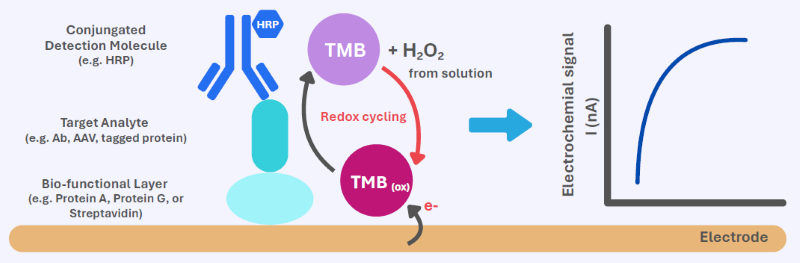
Redox Electrochemical Detection (RED) principle. RED measures enzyme-driven electron transfer at the sensor surface. HRP-labeled detection reagents catalyze the redox cycling of TMB, and the resulting electron transfer produces a current proportional to the amount of target bound. This enables quantitative detection
without optics or active fluidics. Image Credit: Abselion
This innovative approach enables quantitative readouts without the need for fluidics or optics. RED can operate reliably in colored, turbid, or unpurified samples, which makes it well suited for viral vectors, crude lysates, and complex matrices.
Amperia™ brings consistency and clarity to every run, even without optical alignment or fluid handling.
What Amperia™ can be used to measure
Amperia™ supports rapid quantification across an increasingly wide range of biologics, including viral vectors, monoclonal antibodies, and tagged proteins.
The platform has been designed to accommodate both purified and complex samples, with short hands-on time and flexible throughput options.
The platform continues to evolve to meet the needs of modern biologics workflows, with expanded use cases in development and broader molecular targets in progress.
Source: Abselion
| Target |
Example Use |
Throughput
(per run) |
Run
Time
(min) |
Hands-on
Time (min/
per run) |
Detection
Range |
Antibodies
(e.g., mAbs) |
Clone screening and
culture profiling |
Up to 64 |
∼75 - 200 |
∼15 - 30 |
μg/mL‑scale |
AAV
capsids |
Serotype analysis and
process tracking |
Up to 40 |
∼120 |
∼15 - 30 |
0.78e9 - 1e11
vp/ml |
Tagged Proteins
(e.g. His-tag) |
Expression monitoring
and lysate analysis |
Up to 40 |
∼65 |
∼20 - 30 |
nM‑scale |
Note: Values shown are typical ranges based on internal testing. Actual throughput and hands-on time may vary depending on assay format, sample type, and workflow configuration. Detection range may vary depending on analyte affinity and assay conditions.
Assay format compatibility
Amperia™ supports three different assay formats, each suited to specific modes of interaction between the analyte and detection reagents.
All three formats use dip-style sensors with a functionalized capture surface but differ in terms of the introduction of the detection component:
- Premix Competition involves the analyte and detection analog competing for the same site, generating an inverse signal. This flexibility allows reliable quantification across a wide range of biologic targets.
- Inverse Occupancy sees the signal decrease as the analyte blocks detection binding
- The sandwich format produces a direct signal via sequential capture and detection
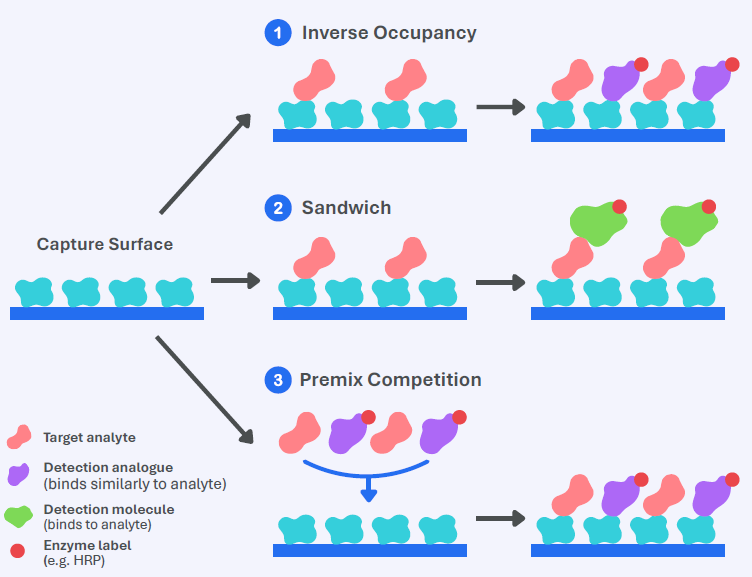
Assay formats supported on the Amperia™ platform. Each format uses dip-style sensors with a capture surface but differs in binding order and signal behavior: (1) Inverse Occupancy; (2) Sandwich; (3) Premix Competition. Image Credit: Abselion
Each assay format is ideally suited to a specific target type, supporting reliable assay performance and signal behavior.
Inverse Occupancy is employed in antibody quantification, Sandwich in investigations into viral vectors, and Premix Competition in the analysis of tagged proteins.
This assay design ensures consistency across applications, with wider target coverage continually expanding.
Source: Abselion
| Format |
Used For |
Signal Type |
| Inverse Occupancy |
Antibody quantification (e.g., mAbs) |
Inversely proportional |
| Sandwich |
AAV capsids |
Directly proportional |
| Premix Competition |
Tagged proteins (e.g., His-tag) |
Inversely proportional |
Running an Amperia™ assay
Amperia™ has been developed to enable straightforward benchtop use. Its touchscreen-guided workflow standardizes each run across assay formats, with its five-step process enabling reproducible results from plate setup to data output without specialized instrumentation.
Built-in analysis tools streamline the workflow yet further, making it easier than ever to generate consistent, actionable data.
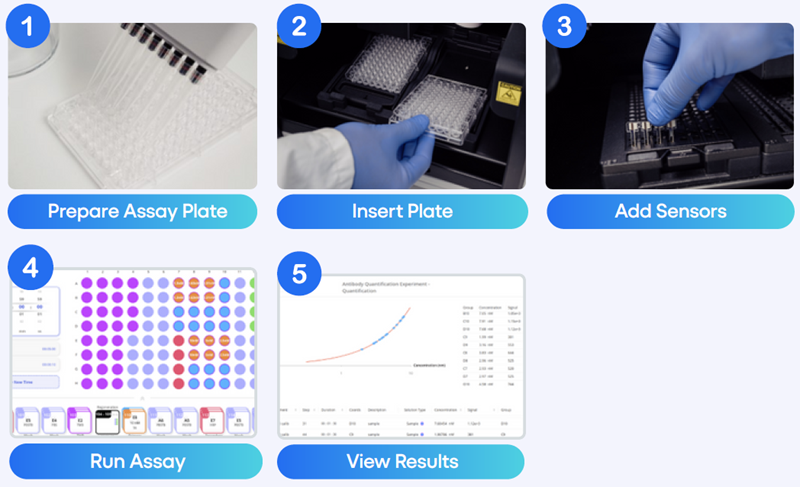
Touchscreen-Guided 5-Step Workflow on the Amperia™ Platform. From plate setup to final data export, Amperia™ guides users through a consistent, step-by-step process - no external software or specialist training required. The built-in interface streamlines assay setup, run execution, and result analysis across all supported formats. Image Credit: Abselion
Amperia™ assays are:
- Reliable, designed to offer consistent, trustworthy performance, even with complex samples
- Accessible, built for ease of use - no specialist required
- Rapid, designed to ensure speed from sample to result
Data highlights
Amperia™ delivers reproducible, quantitative data across a range of key biologic targets, including AAV capsids, monoclonal antibodies, and tagged proteins.
These examples highlight Amperia™’s capacity to deliver reliable standard curves in both buffer and complex media, showcasing its flexibility across workflows and sample types.
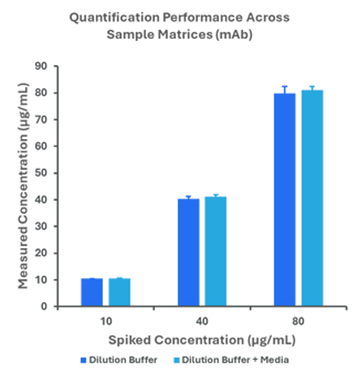
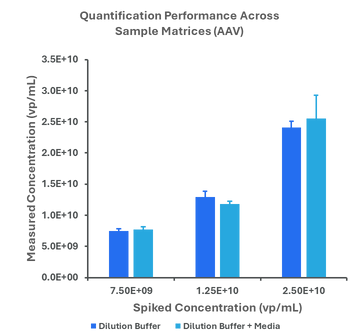
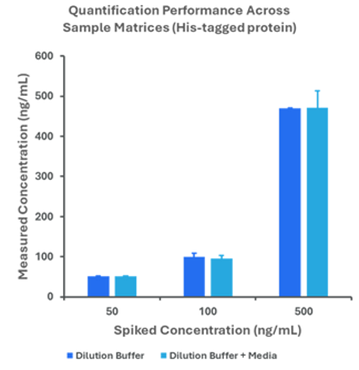
Representative bar charts generated using Amperia™. Demonstrating consistent quantification across targets and matrices. For more details, please see the corresponding application notes. Image Credit: Abselion
Instrument specifications
The compact, bench-ready Amperia™ system integrates sensor-based detection, intuitive software, and onboard control into a single platform. Technical specifications have been carefully implemented to support planning and deployment in lab environments.
Source: Abselion
| Specification |
Details |
| Dimensions (W × D × H) |
Approx. 35 × 33 × 26 cm |
| Weight |
∼ 18 kg |
| Sample types |
Crude lysate, purified protein |
| Temperature control |
15 - 40 °C |
| Agitation function |
500 - 1000 rpm |
| Interface |
Built-in touchscreen |
| Connectivity |
USB, Wi-Fi |
| Data export format |
.csv, .xlsx, PDF |
| Software features |
Built-in analysis, guided setup |
| Power supply |
100 - 240 V AC |
Note: Cooling to 15 °C or 5 °C below ambient, whichever is higher.
Acknowledgments
Produced from materials originally authored by Abselion.
About Abselion
Abselion started in 2018, at that time under the name HexagonFab, in a small corner of a laboratory at the University of Cambridge.
It set out with the humble goal to make protein research simpler. Scientists should be able to pursue their passion for discovery and innovation, rather than spend their valuable time on tedious, manual tasks. With RED, Abselion had access to the ideal technology to create this product. A product that is so compact that it could fit on every bench, and so affordable that it is accessible to everyone. Over the years, Abselion has designed, built, and tested its first product, Amperia™, and is proud to introduce it to the world.
Sponsored Content Policy: News-Medical.net publishes articles and related content that may be derived from sources where we have existing commercial relationships, provided such content adds value to the core editorial ethos of News-Medical.net, which is to educate and inform site visitors interested in medical research, science, medical devices, and treatments.