Renal dialysis water treatment systems are designed to generate highly purified water for hemodialysis. During treatment, this water comes into contact with a patient’s bloodstream across a semi-permeable membrane. Since patients may be exposed to substantial volumes of water during each session, regular water quality monitoring is a vital part of safe system operation.
Dialysis water treatment facilities in the UK generally consist of several stages, including filtration, carbon adsorption, and reverse osmosis. Monitoring these stages helps confirm that each part of the system is functioning properly and that the treated water remains suitable for dialysis applications.
Pi has supported installations in UK hospitals by providing and installing instruments that monitor treated water quality before it reaches the dialysis equipment.
Which water quality parameters are commonly monitored in dialysis water systems?
Monitoring dialysis water systems helps verify that unwanted substances are being removed and that the treatment process continues to operate effectively. Commonly measured parameters include chlorine, nitrate, and conductivity, with each measurement offering different information about system condition.
Taken together, these parameters help demonstrate that disinfectants have been eliminated, dissolved contaminants remain under control, and treatment stages such as reverse osmosis are working as expected.
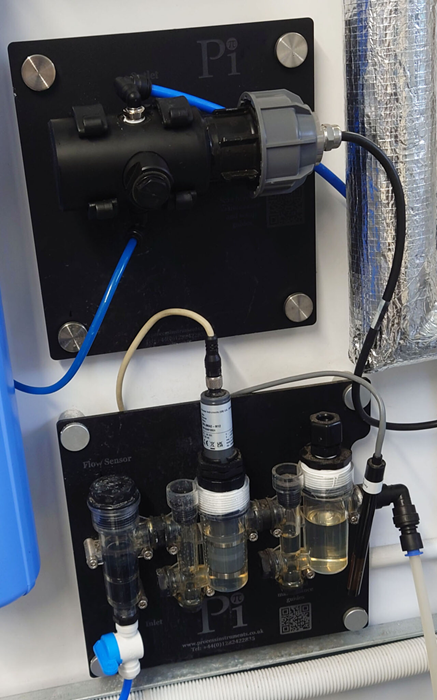
Image Credit: Process Instruments (UK)
Why is chlorine monitoring critical in dialysis water treatment?
Public drinking water is commonly disinfected with chlorine or chloramine. These substances must be removed before the water can be used for hemodialysis.
If chlorine or chloramine remains in the treated water, it may damage dialysis membranes and contribute to hemolysis, creating a serious risk to patients. Chlorine monitoring is therefore carried out downstream of the carbon filtration stage to confirm that disinfectant removal is effective.
To combat this risk, Pi’s HaloSense chlorine analyzer measures residual chlorine levels. The sensor is designed to deliver stable readings while being less affected by changes in pH, helping operators detect variations in chlorine concentration reliably during normal operation.
What role does nitrate monitoring play in dialysis water quality control?
Nitrate may be present in the incoming water supply or may occur when treatment performance changes. Because dialysis exposes patients to treated water for extended periods, nitrate monitoring helps confirm that dissolved contaminants continue to be removed effectively.
Nitrate measurement also provides further assurance that treatment stages, including reverse osmosis, are performing correctly and that dissolved impurities are not entering the dialysis system.
At this facility, Pi’s NitraSense analyzer is used to measure nitrate and verify its concentration within the treated water stream.
What does conductivity monitoring indicate in dialysis water systems?
Conductivity is a widely used indicator in dialysis water treatment. Unexpected conductivity changes can signal problems such as membrane damage, incorrect system operation, or filter breakthrough.
Treated water conductivity is monitored with Pi’s ConductiSense conductivity sensor. The sensor is intended for continuous use in high-purity water systems, where corrosion or fouling may otherwise reduce measurement reliability. Consistent conductivity readings allow operators to recognize changes in treatment performance at an early stage.
What are the risks of relying only on periodic testing?
When water quality is assessed primarily through occasional sampling and laboratory analysis, changes between tests may not be identified promptly. In dialysis applications, this can allow disinfectants, dissolved contaminants, or insufficiently treated water to reach the dialysis equipment.
Continuous measurement of chlorine, nitrate, and conductivity enables operators to detect treatment deviations as they occur and intervene before the water is supplied to the dialysis equipment.
How does monitoring support patient safety in dialysis applications?
In renal dialysis, water quality monitoring is an important component of patient protection. Monitoring data helps confirm that the treatment plant is operating correctly and provides assurance that treated water quality remains stable throughout use.
Facilities reviewing dialysis water monitoring procedures or considering improvements to an existing system can receive support from Pi with application assessment and instrumentation selection based on the requirements of healthcare water treatment.
 About Process Instruments (UK)
Process Instruments (UK) Ltd. (Pi) is a global supplier, providing water analyzer instrument solutions since 1998. With offices, a laboratory and new manufacturing facilities in Burnley (UK), with subsidiaries in Ireland and France and a company representative in China, Pi has a growing reputation for innovation with customers in over 50 countries, across 6 continents. A major part of Pi’s business is through Private Label/OEM agreements, so the name ‘Process Instruments’ is not as widely known as many of our competitors. Instead of focusing on building a brand name, we aim to provide our customers with the most reliable, flexible, and arguably the best water quality analyzers on the market.
Sponsored Content Policy: News-Medical.net publishes articles and related content that may be derived from sources where we have existing commercial relationships, provided such content adds value to the core editorial ethos of News-Medical.net, which is to educate and inform site visitors interested in medical research, science, medical devices and treatments.