From resistant starch to plant cell walls, scientists examine the hidden competition and cooperation among gut bacteria, raising intriguing questions about what happens to different fibers after they reach the colon.
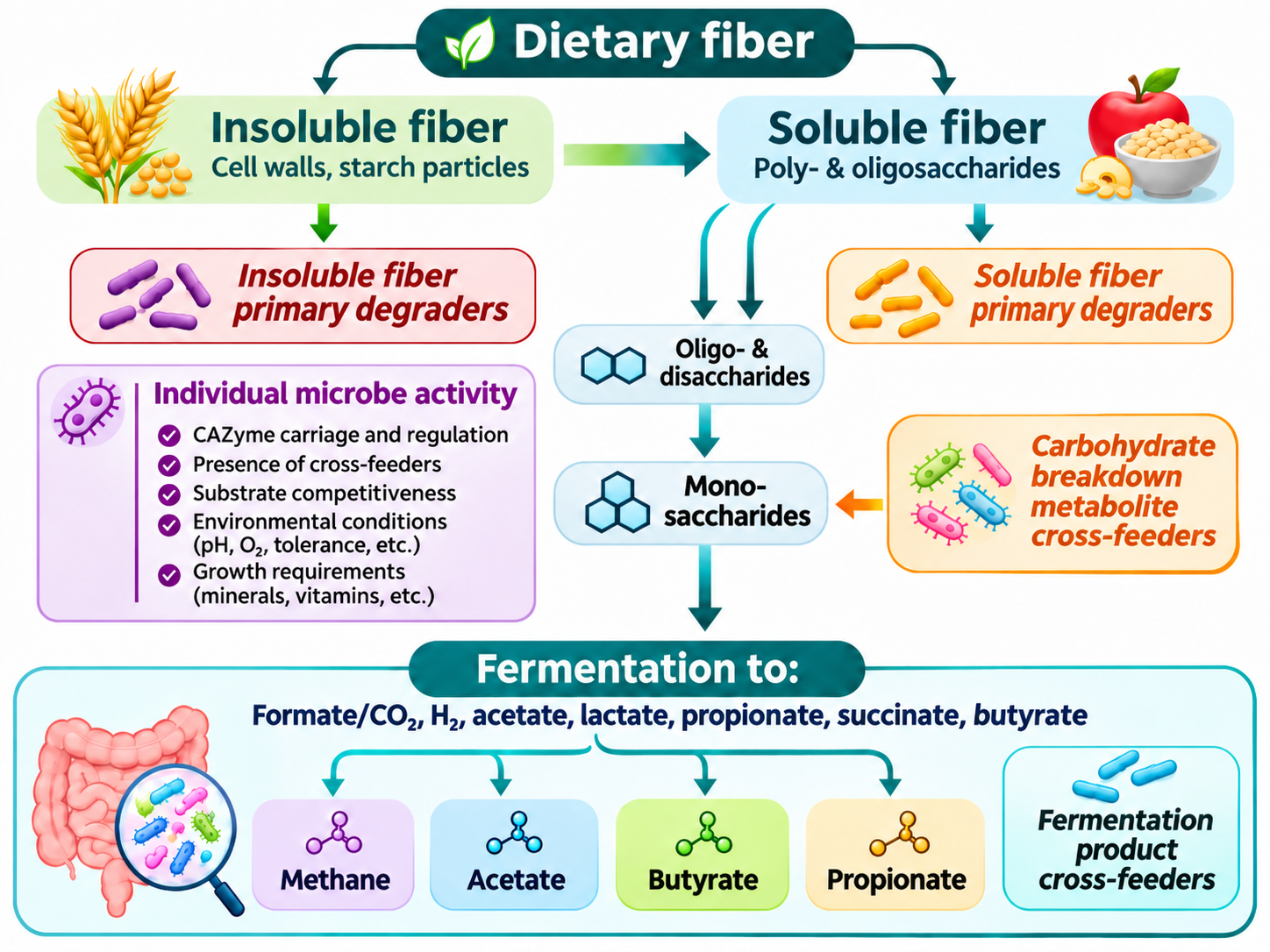
Main routes of metabolic cross-feeding of dietary fibre by the human gut microbiota and major factors affecting the activity of individual microbes. CAZyme: carbohydrate-active enzyme. Study: Dietary fibre complexity and its influence on functional groups of the human gut microbiota
In a 2021 narrative review published in Proceedings of the Nutrition Society, researchers synthesized existing biochemical, microbiological, and genomic literature to examine how dietary fiber complexity influences the resident human gut microbiota.
The authors examined how differences in dietary carbohydrate structure influence which gut bacteria can break down fiber and how other microorganisms use the resulting nutrients and fermentation products. Together, these microbes produce short-chain fatty acids (SCFAs; predominantly acetate, propionate, and butyrate), which can influence host energy metabolism and inflammatory processes. Butyrate also provides energy to colon lining cells.
Background
Advances in sequencing, imaging, and computational methods have enabled scientists to characterize the complex microbial community (‘microbiota’) in the human large intestine, which contributes to the maintenance of physiological health and the pathogenesis of disease.
Microbiological and nutritional research has shown that dietary interventions and habitual dietary patterns can alter the gut microbiota's composition and function, highlighting the importance of dietary fiber in supporting microbial fermentation.
Studies of Western diets indicate that roughly one-third to one-half of total dietary fiber comes from grain products, followed by vegetables, fruits, potatoes, and legumes.
Traditionally, nutritional descriptions have treated dietary fiber, which consists mainly of carbohydrates that escape digestion in the upper gastrointestinal tract, as a homogeneous bulk nutrient.
Research shows that dietary carbohydrates vary substantially in biochemical and physical properties, ranging from insoluble, crystalline cellulose microfibrils that provide plant structural scaffolding to pectins of varying solubility and resistant starch (RS; starch fractions that resist breakdown by pancreatic amylase or remain physically inaccessible to digestive enzymes). Fiber within intact plant cells or insoluble food particles may be less accessible to microbial enzymes than purified carbohydrates, potentially affecting which bacterial species can use it.
While the potential benefits of microbial fermentation are widely recognized, how carbohydrate structure shapes bacterial competition and cooperation remains incompletely understood, particularly within intact food matrices.
About the review
This review aimed to address these mechanistic knowledge gaps by examining how complex carbohydrates are enzymatically deconstructed across distinct gut bacterial functional groups and the possible implications for dietary advice.
The authors described dietary substrates in two broad architectural classes: plant cell wall carbohydrates, contrasting Type I cell walls in dicotyledons (rich in pectins and xyloglucans) with Type II cell walls in cereals (rich in arabinoxylans and mixed-linkage β-glucans), and plant storage carbohydrates, including resistant starch types 1 through 5, with RS5 representing a more recently proposed category, inulin-type fructans, and raffinose-family oligosaccharides.
They also examined the genomic organization of carbohydrate-active enzymes (CAZymes), including glycoside hydrolases (GH), polysaccharide lyases (PL), and carbohydrate esterases (CE), and compared the distinct foraging strategies of metabolic generalists and specialists.
Review findings
The reviewed studies described highly divergent physiological strategies used by gut bacteria to access recalcitrant carbohydrates. Certain Bacteroides species within the phylum Bacteroidetes possess more than 100 discrete polysaccharide utilization loci (PULs; gene clusters encoding carbohydrate-degrading enzymes, substrate-binding and transport systems, and regulatory functions), allowing them to recognize and prioritize different carbohydrates.
Species within the phylum Firmicutes, on average, harbor fewer CAZymes than members of Bacteroidetes, with substantial variation between species, but some deploy specialized extracellular machinery for targeted carbohydrate acquisition.
Ruminococcus champanellensis uses multienzyme cellulosomes (large protein complexes tethered to the cell surface via cohesin and dockerin-binding domains) to degrade crystalline cellulose.
Another species, Ruminococcus bromii, produces surface-anchored amylosomes, multienzyme complexes that target starch and may explain its keystone role in resistant starch degradation.
Laboratory studies showed that it releases glucose and maltose that other gut bacteria can use. During a controlled high-resistant-starch dietary intervention, two participants with very low or undetectable levels of this bacterium excreted a large fraction of the resistant starch they consumed.
The authors also examined the limitations of predicting microbial functions from genetic information. They described Coprococcus eutactus, whose genome contains enzyme genes associated with cellulose breakdown, but which failed to grow on cellulose in laboratory tests. This demonstrates why bacterial functions cannot always be inferred from DNA sequences alone.
Other evidence describes metabolic cross-feeding pathways in which bacteria use fermentation products released by other species. Certain lactate-utilizing bacteria convert accumulated lactate into butyrate or propionate, helping limit concentrations that could lower intestinal pH and disrupt microbial communities. Coprococcus catus produces mainly butyrate from fructose but mainly propionate when it uses lactate.
The extent of cooperation also varies. Some primary degraders release carbohydrates for neighboring bacteria, while others retain greater access to their own breakdown products.
Dietary substrate availability and environmental factors can also influence microbial competition. Continuous-culture studies of human fecal communities found higher relative levels of Bacteroidetes at pH 6.5 and Firmicutes at pH 5.5. Acid tolerance varied among species: Eubacterium rectale grew well at an initial pH of 5.1, while Roseburia inulinivorans growth was severely restricted below pH 5.5.
Conclusions
The present review indicates that carbohydrate structure, physical accessibility, and competition and cooperation between gut bacteria shape microbial fermentation of dietary fiber.
Better knowledge of these microbial food webs may help guide the development of targeted prebiotics (substrates selectively used by host microorganisms that confer a health benefit) and microbiota-targeted functional foods, but clinical benefits require further investigation.
The authors acknowledge that current experimental evidence relies heavily on purified carbohydrates, leaving the degradation of complex insoluble plant matrices and the roles of microbial biofilms on fiber particles and bacteriophages understudied. Further research involving intact whole foods and more complete microbial communities could improve dietary recommendations and clarify whether the proposed mechanisms produce measurable health benefits in humans.
Source:
Journal reference:
- Louis, P., Solvang, M., Duncan, S. H., Walker, A. W., & Mukhopadhya, I. (2021). Dietary fibre complexity and its influence on functional groups of the human gut microbiota. Proceedings of the Nutrition Society, 80(4), 386–397. DOI: 10.1017/S0029665121003694. https://www.cambridge.org/core/journals/proceedings-of-the-nutrition-society/article/dietary-fibre-complexity-and-its-influence-on-functional-groups-of-the-human-gut-microbiota/FB50596C3824817F30073EB517391CF9
 Gut bacteria may help explain why endometriosis pain varies