Researchers tracked more than 285,000 adults across Finland and the UK to investigate how chronic disease and socioeconomic disadvantage influence the health risks of extreme temperatures, with implications for protecting vulnerable populations as the climate warms.
Study: Health risks of hot and cold temperatures in people with pre-existing conditions and social disadvantage. Image Credit: Quality Stock Arts / Shutterstock
People with both clinical and socioeconomic vulnerabilities experienced more than tenfold higher excess mortality associated with extreme heat or cold than those with neither or only one vulnerability, according to a new study published in the journal Nature Communications.
Background
Global warming has increased extreme heat events worldwide, while extreme cold events have generally become less frequent, raising concerns about their public health effects. During heat and cold exposures, the human body maintains core temperature through sweating and vasodilation (widening of blood vessels) and through vasoconstriction (narrowing of blood vessels) and thermogenesis, respectively.
These regulatory processes can be impaired by preexisting health conditions, further increasing the risk of temperature exposure-related morbidity and mortality in affected people. Similar to preexisting health conditions, socioeconomic vulnerabilities, such as living in households with poor insulation or ventilation, are known to influence the health impact of temperature exposure. However, direct individual-level evidence on how clinical and socioeconomic vulnerabilities affect temperature exposure-related morbidity and mortality remains limited in the literature.
The current study aimed to assess health risks during extreme heat and cold exposures among people with clinical and socioeconomic vulnerabilities.
Key findings
The researchers analyzed individual-level data from 275,763 Finnish adults and 9,681 UK adults. They compared mortality rates in both cohorts and emergency hospital visit rates in Finland during extreme heat, cold, and moderate-temperature periods. Clinical vulnerability was defined using 17 chronic diseases or disease groups, including diabetes, cancer, and cardiovascular and kidney conditions. Social vulnerability was determined from neighborhood-level deprivation scores rather than individuals' incomes or housing conditions.
Extreme temperatures were defined as the hottest and coldest 2.5% of seven-day periods in each cohort. Finnish data showed that seven-day average ambient temperatures above 20.4 °C or below –11.4 °C were associated with 1.4-fold and 1.1-fold higher mortality rates, respectively, than moderate temperature exposure (–11.4 to 20.4 °C). The estimated increase in cold-related mortality in Finland was not statistically significant in the main analysis. The UK cohort showed similar patterns.
In both Finnish and UK datasets, excess mortality associated with hot and cold periods combined was more than tenfold higher among individuals with both clinical and social vulnerability than among those with neither or only one vulnerability. This subgroup included 15,326 Finnish and 354 UK participants, leaving some subgroup estimates imprecise.
Excess temperature-associated mortality differed little between individuals with neither vulnerability and those with only one vulnerability.
Climate modeling of the potential effects of future global warming suggested that an increase from approximately 1°C to 4°C could raise the proportion of deaths attributable to extreme temperatures from about 1% to more than 5%, roughly a fivefold increase in both Finland and the UK.
In the Finnish cohort, data on non-fatal outcomes showed that compared to moderate temperature exposure, cold periods were associated with a 9% lower rate of emergency hospital visits, whereas hot periods were associated with a 5% higher rate of such visits. The observed associations were stronger among individuals with both clinical and social vulnerability than those with neither vulnerability or only one vulnerability. Cold weather may also restrict access to emergency care, potentially contributing to fewer recorded visits.
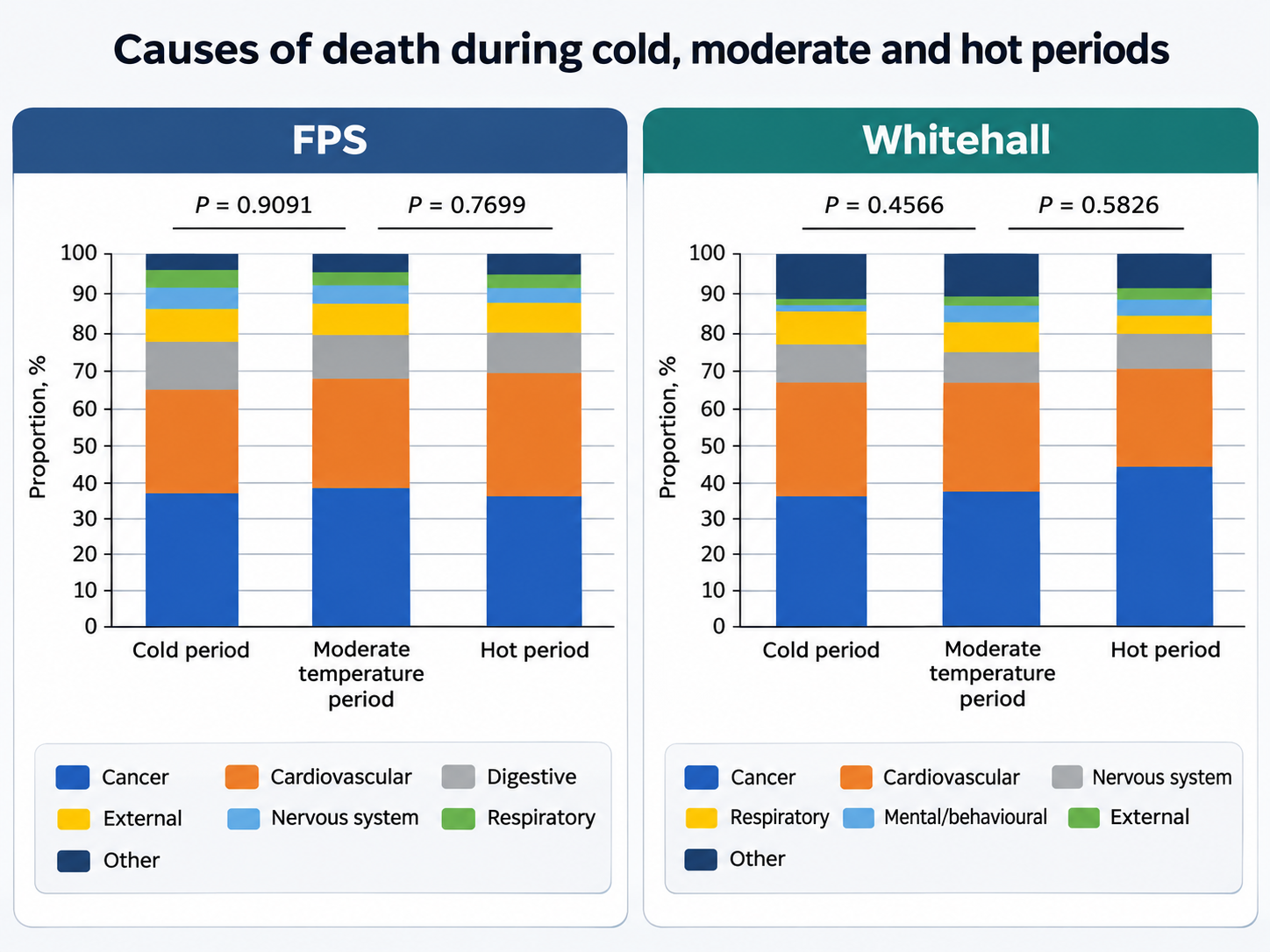
Bars show the proportions of primary causes of death among participants who died during cold, moderate, and hot periods in FPS and the Whitehall study. Differences in these proportions between periods were tested using two-sided chi-squared tests. No differences in cause-specific mortality were observed across temperature periods in either study. Supplementary Table 2 presents data for all underlying and contributing causes of death and largely replicates these findings, with one exception: respiratory and genitourinary deaths were more common during cold periods in FPS but not Whitehall.
Study significance
The study reveals that people with both clinical and socioeconomic vulnerabilities experienced substantially greater excess mortality associated with extreme temperatures. Climate projections suggest that as warming progresses, increases in heat-related mortality could outweigh reductions in cold-related mortality.
Overall, the findings suggest that exposure to extreme temperatures may accelerate deaths among highly vulnerable individuals who already have a high short-term mortality risk. Heat and cold may act as acute stressors that worsen pre-existing or subclinical illnesses in vulnerable populations. The researchers also acknowledged that temperature extremes may cause premature deaths among people without either identified vulnerability.
The observed association between social vulnerability and extreme temperature-related mortality may reflect differences in the ability to avoid temperature-related physiological stress. Socioeconomically deprived people may be more likely to live in households with poor insulation and ventilation and have limited access to heating, cooling, and safer environments. These housing-related explanations were proposed by the researchers, but individual household conditions were not directly measured.
The study associated higher temperatures with increased rates of emergency hospital visits for infectious and digestive diseases. Warmer conditions may promote pathogen survival and replication, but the researchers did not directly test this mechanism.
Emergency hospital visits for skin, neurological, and mental disorders, and for external causes, also increased with higher temperatures, while respiratory-related visits were less frequent. These findings are biologically plausible. Extreme hot and humid conditions increase sweating and dehydration and promote bacterial and fungal skin infections. The researchers suggested that heat-related aggression, impulsivity, and frustration may contribute to self-harm, violence, and accidents, without establishing the mechanisms behind psychiatric visits.
These findings highlight the need for developing public health strategies to protect vulnerable people from adverse health outcomes during extreme weather conditions.
The results reflect climatic and socioeconomic conditions in Finland and the UK. Further research is needed to validate these findings in populations living in markedly different climatic, geographic, or socioeconomic conditions.
The analyzed datasets include occupational cohorts and are not fully representative of the general populations of the UK and Finland. Because unemployed people and those with work disabilities were excluded at baseline, the participants are generally healthier than the overall population. These factors may have led to an underestimation of the adverse health effects of extreme temperatures. The climate modeling also did not account for future demographic changes, shifts in environmental conditions, or protective adaptations that might alter temperature-related health risks. As the study was observational, the reported associations cannot establish that temperature exposure directly caused the estimated excess deaths.
Source:
Journal reference:
- Kivimäki, M., Pentti, J., Frank, P. et al. Health risks of hot and cold temperatures in people with pre-existing conditions and social disadvantage. Nat Commun (2026). DOI: 10.1038/s41467-026-79203-3, https://www.nature.com/articles/s41467-026-79203-3
 Worried nuts will cause weight gain? A large review puts that concern in perspective