Researchers compared trials of nuts with different fat profiles to examine what changes beyond the number on the scales.
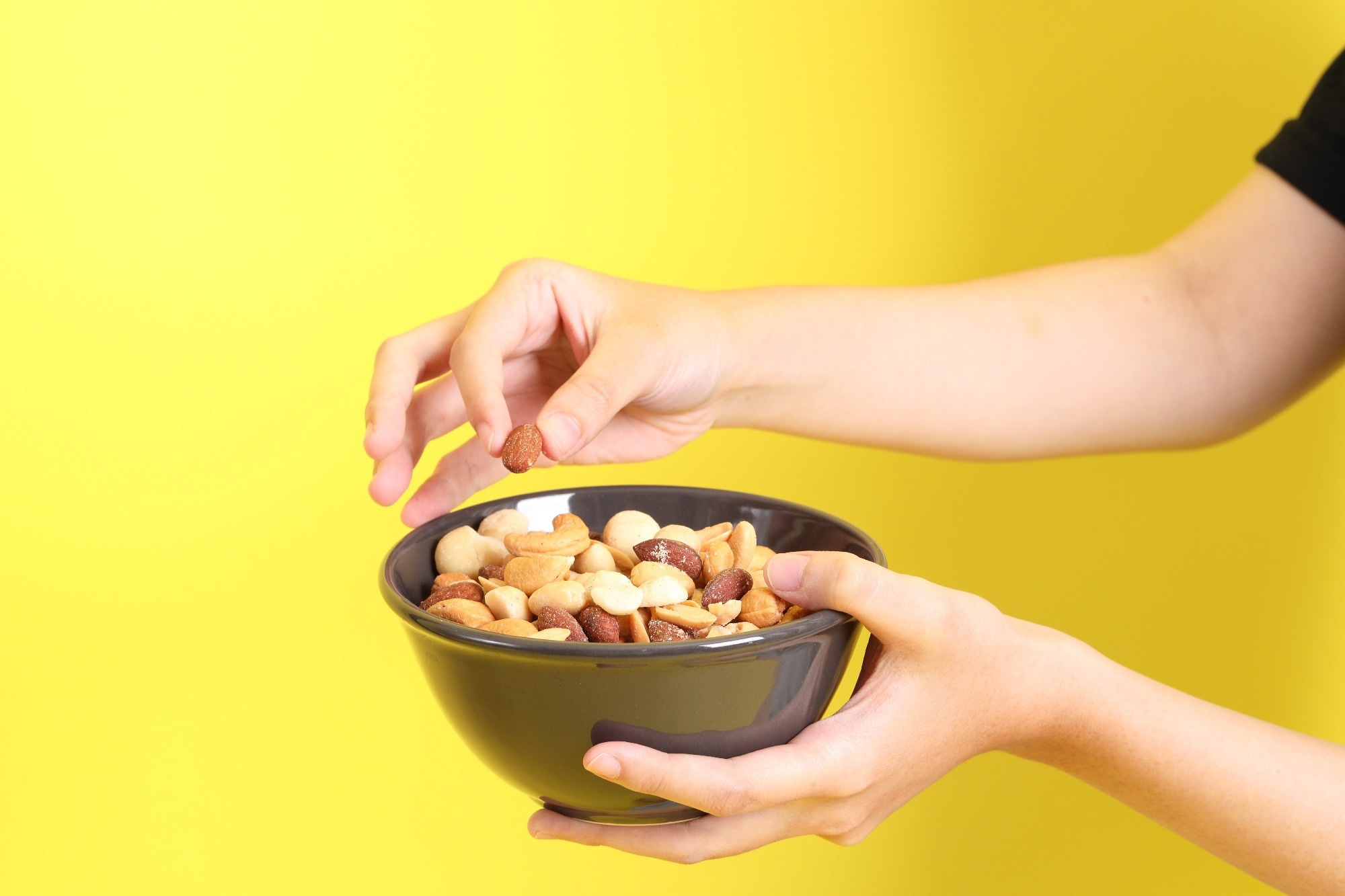
Review: Effects of Nut Consumption on Body Composition: A Systematic Review and Meta-Analysis of Randomized Controlled Trials with Subgroup Analyses by Nut Fatty-Acid Profile. Image Credit: kimberrywood / Shutterstock
Nuts are nutrient-dense foods with high energy value, yet they do not generally appear to increase obesity risk and may be linked to improved metabolic health. A recent systematic review and meta-analysis of randomized trials published online in the journal Foods investigated the differential effects of nuts with varying fatty acid profiles on body composition and reported modest reductions in body fat without significant weight loss.
Background
Avoiding or reducing metabolic health risks involves maintaining an optimal body composition, characterized by lower fat mass and higher lean mass. Nuts are rich in unsaturated fatty acids, protein, fiber, vitamins, minerals, and phytochemicals.
Proposed mechanisms vary by fatty acid type. Polyunsaturated fatty acids (PUFA) may increase fat oxidation and promote satiety while reducing energy intake by stimulating various metabolic receptors and pathways. This combination may reduce fat mass and improve body composition without necessarily causing weight loss.
Compared with PUFA, monounsaturated fatty acids (MUFA) may increase heat production in response to the diet (diet-induced thermogenesis, DIT), potentially increasing energy expenditure, especially by encouraging the use of fat for energy.
The authors examined studies of MUFA-rich and PUFA-rich nuts using a range of comparator diets. The study also assessed lipid outcomes, appetite-related measures and energy metabolism.
Study characteristics
The systematic review covered 154 articles representing 119 unique randomized controlled trials (RCTs), and 102 were included in the further quantitative meta-analysis. The median follow-up was 21 weeks, with trial durations varying considerably. The articles reported results from both crossover and parallel-group trials.
Eligible studies enrolled adults and tested whole tree nuts or peanuts. The studies included both healthy participants and people living with a range of metabolic conditions. The authors excluded studies involving physical activity, processed nut products such as butters or oils, nuts combined with other foods, and mixed nuts of unspecified composition.
Nuts were categorized based on USDA fatty-acid data. Nuts with a MUFA ratio of 1.3 or higher were labeled MUFA-rich; the rest were PUFA-rich. The cutoff was adapted from a whole-diet ratio proposed by Hayes and has not been validated for individual foods.
Control diets were also categorized: carbohydrate-rich (CARB), fat-based (FAT), habitual or healthy-lifestyle (HABITUAL/HLS), calorie-restricted, or calorie- and macronutrient-matched.
The authors assessed studies for risk of bias. Using random-effects models to account for differences between trials, they calculated pooled effects, while a separate analysis was performed to assess whether daily MUFA intake from nuts predicted body-composition change. The researchers assessed small-study effects with statistical tests and the certainty of evidence with GRADE.
Nut consumption and body weight
Nut consumption was associated with an increase in energy intake of about 120 kcal/day, which the authors attributed to nuts being added to the usual diet in most trials. Overall, nut consumption did not significantly change body mass, body mass index (BMI), or waist circumference. The authors suggested that participants may have adjusted what they ate alongside nuts, but the trials did not establish why higher reported calorie intake did not produce measurable weight gain.
When analyzed by nut category, neither MUFA nor PUFA subgroups showed significant changes in body weight, BMI or waist circumference. Only the MUFA-rich subgroup showed a significant increase in reported daily energy intake.
Compared with a control group that continued to follow their habitual diet, nut consumption was associated with small reductions in body weight (about 0.24 kg) and waist circumference (about 0.49 cm), even with higher reported energy intake.
Body composition
Overall, nut consumption reduced percentage fat mass by approximately 0.3 percentage points, and absolute fat mass by about 0.41 kg. It also raised percentage lean mass by 0.71 percentage points. Absolute lean mass did not change significantly, suggesting that the higher lean percentage reflected a shift in body proportions rather than demonstrating an actual gain in muscle mass.
The authors suggest that possible MUFA-related improvements in mitochondrial function and lower oxidative stress might help preserve muscle tissue. The trials did not directly establish these mechanisms or an increase in absolute muscle mass.
By fatty acid type, only the MUFA-rich subgroup showed a statistically significant reduction in fat mass by about 0.42 kg. The PUFA-rich estimates were imprecise and not significant.
No subgroup differences were significant for any tested parameter: absolute lean mass, fat mass, or percentage fat mass. Subgroup differences in percentage lean mass could not be tested because all comparisons involved MUFA-rich nuts. So no advantage could be established for MUFA-rich nuts.
Compared with carbohydrate-rich controls, nuts reduced percentage fat mass by about 0.5 percentage points and fat mass by about 0.5 kg. In calorie-restricted trials, nuts were associated with greater lean mass (about 0.97 kg), greater lean percentage and lower fat percentage, together with a reduction in absolute fat mass of about 0.51 kg. The authors tentatively attribute this to nut protein helping preserve muscle during restriction, but a 2024 meta-analysis did not confirm the lean-mass finding.
Impact of nuts on lipids
The findings showed that nut consumption was associated with small reductions in total cholesterol, LDL cholesterol and triglycerides, with no significant effect on HDL cholesterol.
Both nut types lowered total and LDL cholesterol, consistent with earlier research. Only the MUFA-rich subgroup showed a significant reduction in triglycerides, but the evidence for this outcome was very uncertain. The authors suggest that this could be because most trials with carbohydrate-rich controls included MUFA-rich nuts, limiting comparisons between groups. Dietary research predicts that replacing some dietary carbohydrates with fatty acids lowers triglyceride levels.
The researchers offer the following plausible mechanisms for these actions. Both PUFA and MUFA may reduce cholesterol synthesis and increase LDL cholesterol removal from the blood. MUFA could also affect the production and breakdown of triglyceride-rich particles. These pathways were proposed as explanations rather than directly tested in the pooled trials.
The study found no significant change in HDL-C levels after nut consumption, which contrasts with previous findings. The authors note that MUFA and PUFA intake from nuts was modest in this study, perhaps too low to affect the complex regulation of HDL cholesterol.
Appetite and energy metabolism
No meta-analysis could be conducted for these outcomes because few trials measured them, generally only three to seven per outcome. The results of the review were mixed. Of the seven articles assessing appetite, two reported less hunger, and two reported greater fullness.
Two of three studies reported higher DIT, while none showed a change in resting energy expenditure. Reported changes in appetite-regulating hormones also varied in both directions.
Quality and Certainty of Evidence
Of the 154 articles, most were rated low risk of bias; some had methodological concerns, and a small minority were high risk. The main conclusions did not materially change after excluding the high-risk trials. Some analyses suggested possible small-study effects for energy intake, absolute lean mass, LDL cholesterol and triglycerides.
The GRADE certainty of evidence was moderate for percentage fat mass, fat mass and percentage lean mass. It was low for body weight, BMI, total cholesterol and LDL cholesterol, and very low for waist circumference, energy intake, lean mass, HDL cholesterol and triglycerides. The main reasons for downward grading included inconsistency, imprecision and, for some outcomes, possible small-study effects.
Interpretation
The authors concluded that nuts, particularly MUFA-rich ones, were associated with improved body composition by reducing fat mass and percentage fat mass, and that both types were linked to improved lipid profiles. The meta-regression found no significant relationship between daily MUFA intake from nuts and changes in body composition, so the authors could not determine whether MUFA itself explained the findings.
This does not rule out a dose-response relationship, since the study lacked statistical power to detect small effects, especially for lean mass percentage. Nut type was examined in subgroup analyses, but type and dose were not adjusted for together.
MUFA-rich nuts differed from PUFA-rich ones in macronutrient and micronutrient composition, energy density, and physical structure. The authors describe the subgroup findings as exploratory, with effects possibly linked to the food matrix rather than the fatty-acid ratio.
Limitations
Other limitations include the unvalidated MUFA cutoff and the mix of body-composition methods (mainly DXA and bioelectrical impedance), which rely on different measurement assumptions. The pooled data also show substantial differences between studies and a wide range of plausible effects, and some outcomes could not be assessed for publication bias.
Conclusion
Nut consumption modestly reduced fat mass and improved body composition without changing body weight. It also improved total cholesterol and LDL cholesterol, and MUFA-rich nuts were linked to lower triglycerides, though evidence for this outcome was very uncertain. The effect sizes are small and vary with comparator diet, while the fat-mass findings carry moderate certainty. The review did not establish whether these changes lead to meaningful long-term health benefits.
Source:
Journal reference:
- Hu, W., Chen, M., Wang, Z., et al. (2026). Effects of Nut Consumption on Body Composition: A Systematic Review and Meta-Analysis of Randomized Controlled Trials with Subgroup Analyses by Nut Fatty-Acid Profile. Foods. DOI: 10.3390/foods15203594, https://www.mdpi.com/2304-8158/15/20/3594
 University of Utah researchers discover backup energy system in the heart