Packed with carotenoids and other bioactive compounds, broccoli sprouts and microgreens are attracting scientific attention. Could these tiny greens offer a new dietary approach to managing metabolic disease?
Review: Carotenoids in metabolic disease modulations: role of Brassicaceae microgreens
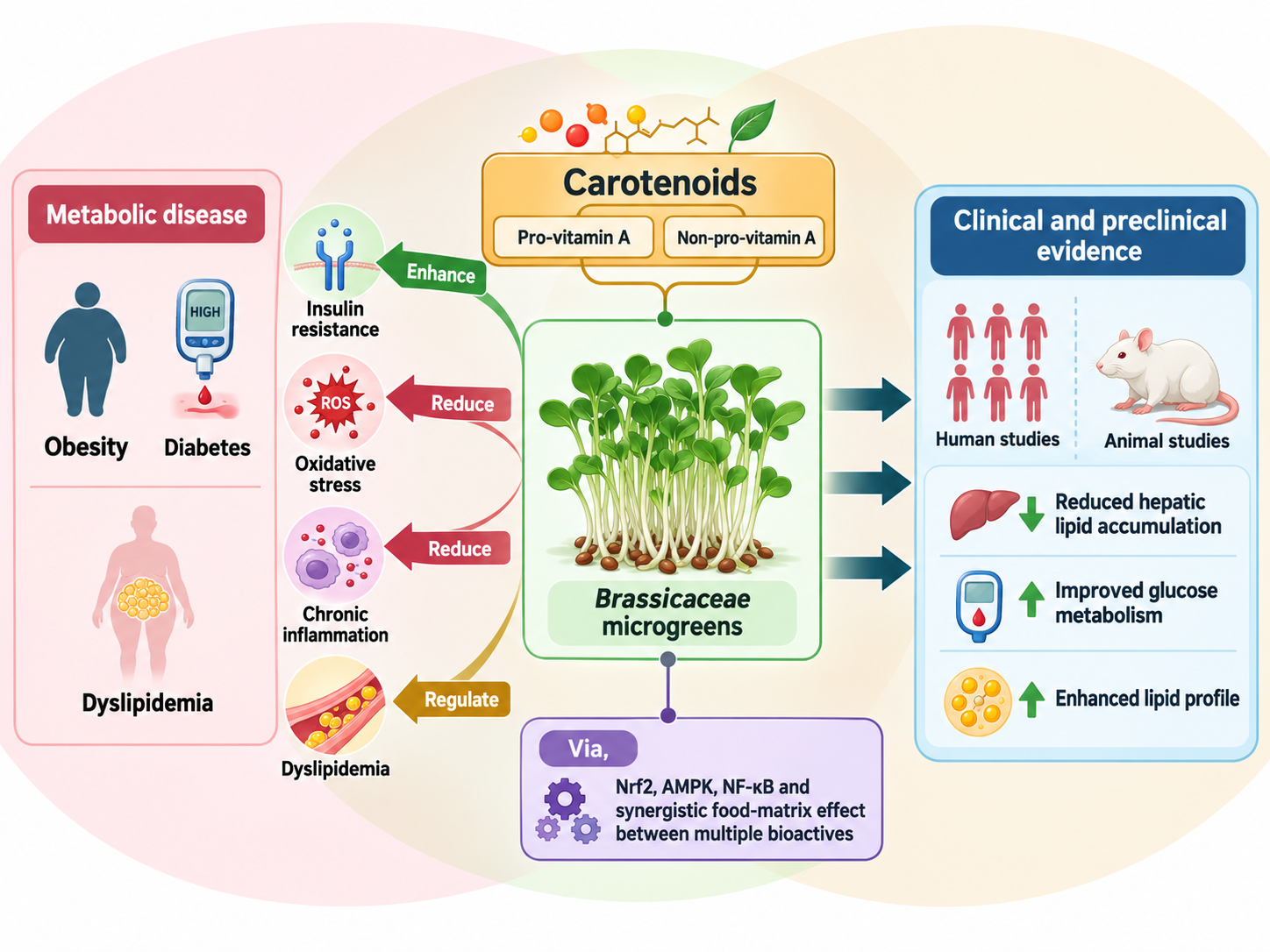
In a recent narrative review published in the British Journal of Nutrition, researchers in Canada synthesized existing evidence on carotenoid metabolism, bioavailability, and the potential role of Brassicaceae microgreens in preventing and managing obesity and type 2 diabetes mellitus. The authors searched four research databases through March 2026 and used a narrative synthesis because the studies differed in their interventions and outcomes.
Background
Carotenoids are dietary pigments that contribute to the color of fruits and vegetables and help in several physiological processes. Population studies have associated higher dietary or circulating carotenoid levels with lower measures of obesity, waist circumference, and metabolic syndrome. But their health effects depend on the type, dose, food matrix, and accompanying nutrients. Microgreens in the Brassicaceae family contain carotenoids and other bioactive substances.
Carotenoids and metabolic health
Carotenoids include provitamin A carotenoids, such as beta-carotene, alpha-carotene, and beta-cryptoxanthin, and non-provitamin A carotenoids, such as lutein, zeaxanthin, and lycopene. Carotenoids may influence insulin sensitivity, lipid metabolism, adipogenesis, and inflammatory signaling. Their proposed effects involve cellular pathways associated with energy metabolism (AMPK), antioxidant defenses (Nrf2), and inflammation (NF-κB). These effects may vary with intestinal absorption, metabolism, diet, and individual physiology.
Absorption and bioavailability
Carotenoid absorption involves several phases, including removing carotenoids from food matrices during digestion. They are incorporated into mixed micelles containing bile salts and dietary lipids before intestinal uptake. Transport proteins, including scavenger receptor class B type I (SR-BI), cluster of differentiation 36 (CD36), and Niemann-Pick C1-like 1 (NPC1L1), participate in this process. The enzyme beta-carotene-15,15′-monooxygenase (BCO1) converts provitamin A carotenoids into retinal, which can then be converted into retinol (vitamin A).
Bioavailability varies with carotenoid structure, food processing, dietary fat intake, genetics, age, health status, and interactions with other dietary components. Cooking and mechanical processing can improve carotenoid release from plant tissues, while dietary fats facilitate micelle formation and absorption. For this reason, a food’s carotenoid concentration does not necessarily indicate how much the body can absorb and use.
Evidence from carotenoid-rich foods
Experimental studies suggest that carotenoids can influence lipid accumulation and glucose regulation. In animal models, beta-carotene derived from pumpkin and sweet potatoes reduced triacylglyceride levels. Fucoxanthin reduced liver cholesterol but increased circulating HDL and non-HDL cholesterol levels in diabetic and obese mice, while astaxanthin reduced lipid accumulation in skeletal muscle in insulin-resistant mice.
A carrot juice intervention in overweight or obese breast cancer survivors did not significantly change most oxidative stress or inflammatory markers, but reduced prostaglandin E2. Lycopene supplementation in individuals with obesity also failed to produce measurable improvements in inflammation or oxidation products.
In people with type 2 diabetes mellitus, lycopene-rich tomato juice increased circulating lycopene levels and increased the resistance of low-density lipoprotein (LDL) particles to oxidation. A six-month intervention involving green banana biomass also improved several lipid and glycemic measures, including fasting glucose and glycated hemoglobin (HbA1c), but its resistant starch and other nutrients may have contributed to these effects. In another trial, beta-carotene-enriched carrot juice increased antioxidant status without significantly improving glycemic indices or inflammatory markers.
Nutritional potential of Brassicaceae microgreens
Brassicaceae microgreens, including broccoli, cabbage, mustard, kale, radish, and cauliflower varieties, are nutrient-dense sources of carotenoids and other bioactive compounds. Their carotenoid content has been reported at approximately 162–224 milligrams of beta-carotene equivalents per 100 grams of dry weight, but concentrations vary by species and growing conditions.
Microgreens also contain glucosinolates, polyphenols, and isothiocyanates, including sulforaphane. Their tender, immature tissues may facilitate carotenoid release during digestion compared with mature vegetables. Whether this leads to greater absorption or metabolic benefits in humans remains uncertain.
Cultivation conditions can influence their nutritional composition. In reported studies, blue and white light-emitting diode (LED) treatments increased carotenoid accumulation by 20%–44% in broccoli and kohlrabi microgreens. Light intensity, photoperiod, nutrient availability, temperature, and harvest timing also affect phytochemical concentrations.
Evidence from broccoli sprouts and microgreens
Clinical studies involving broccoli sprouts have reported improvements in metabolic markers. Evidence from human interventions for other Brassicaceae microgreens remains limited, with most findings coming from animal studies. In three related studies involving 81 participants each with type 2 diabetes, daily intake of broccoli sprout powder at 5–10 grams for four weeks resulted in reduced serum insulin, insulin resistance, oxidative stress indicators, and inflammatory markers. Insulin resistance was assessed using HOMA-IR, an index based on fasting glucose and insulin levels.
A study involving 40 healthy overweight adults found that consuming 30 grams of fresh broccoli sprouts daily for 10 weeks reduced interleukin-6 (IL-6) and C-reactive protein (CRP). In a study of 52 men with fatty liver disease, broccoli sprout supplementation was associated with reductions in liver enzyme markers and urinary 8-hydroxy-2′-deoxyguanosine, a marker of oxidative DNA damage.
Animal studies of Brassicaceae sprouts and microgreens have also reported reduced body weight, adipose tissue mass, and triglyceride levels, alongside improvements in glucose tolerance and insulin sensitivity. However, the effects of carotenoids cannot be confidently separated from those of other compounds in whole microgreens, and interactions among the compounds have not been confirmed.
Mechanisms and research limitations
AMPK activation may promote fatty acid oxidation, while Nrf2 signaling supports antioxidant enzyme activity. Suppression of NF-κB signaling may reduce proinflammatory cytokines, including tumor necrosis factor-alpha (TNF-α) and IL-6. But the evidence remains limited by small clinical samples, short intervention periods, heterogeneous populations, and differences between animal models and humans.
Conclusions
The authors conclude that carotenoids and Brassicaceae microgreens may support metabolic health through antioxidant, anti-inflammatory, and insulin-sensitizing mechanisms. Broccoli sprouts have been associated with improvements in selected metabolic and inflammatory markers in small human trials, while evidence for other Brassicaceae microgreens comes mainly from animal studies. But inconsistent human outcomes and the inability to isolate carotenoid-specific effects limit definitive conclusions. Changes in these markers have not been shown to prevent obesity or diabetes or improve long-term clinical outcomes.
The authors call for larger, longer-term randomized controlled trials, standardized dietary interventions, and mechanistic investigations to clarify bioavailability, dose-response relationships, and interactions among phytochemicals. Such evidence is necessary to establish reliable dietary recommendations for obesity and diabetes management.
Further studies are needed to establish the specific contributions of individual bioactive compounds and determine how Brassicaceae microgreens can be incorporated effectively into the diet.
Source:
Journal reference:
 New therapies could help type 1 diabetes care move beyond insulin alone