From fish and seaweed to miso soup and pickles, researchers examine how the foods that define traditional Japanese eating patterns may influence long-term health.
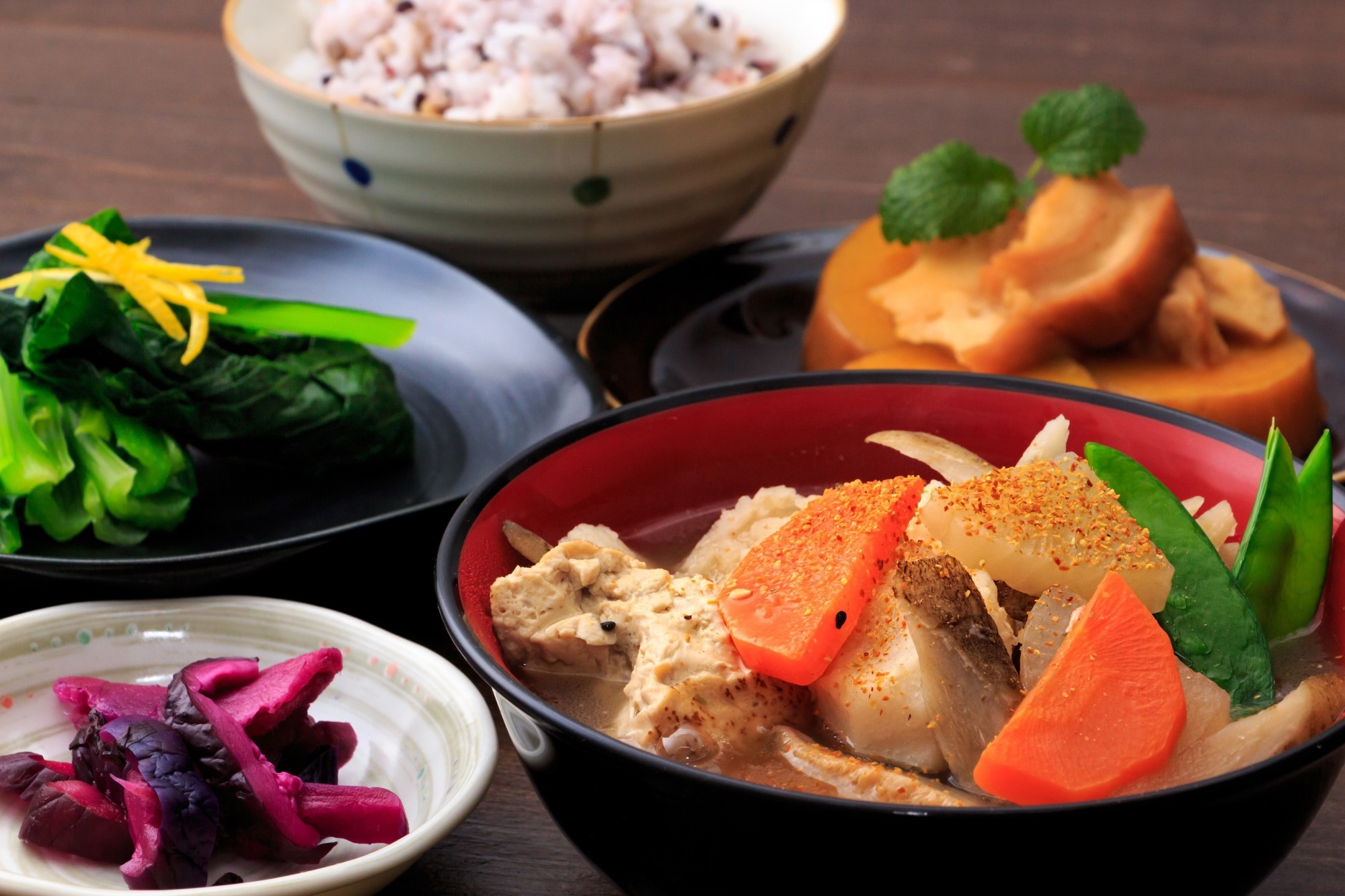
Review: Japanese-style dietary patterns, mortality, and selected cancer outcomes in Japanese populations: a systematic review integrating meta-analysis, food-group loading visualization, and qualitative synthesis. Image Credit: Contrail / Shutterstock
A recent study published in the journal Advances in Nutrition found that greater adherence to predefined Japanese-style dietary patterns (DPs) was associated with lower all-cause and cardiovascular mortality among Japanese people.
These diets commonly comprise rice, soy products, seafood, miso soup, green tea, vegetables, seaweed, and pickles. They have long been studied for their possible links to health, longevity, and mortality. Unlike the Mediterranean diet, research on Japanese-style DPs lacks a widely accepted scoring system and absolute intake criteria, limiting evidence synthesis and comparison.
About the study
In the present study, researchers synthesized evidence on the associations between Japanese-style DPs and health outcomes. First, PubMed/Medline and Web of Science were searched for cohort or cross-sectional studies in community-dwelling populations across Japan. Exposures included predefined (a priori) Japanese-style dietary scores and data-derived (a posteriori) patterns. The team defined a priori DPs as scores measuring adherence to predefined Japanese-style food structures.
A priori Japanese-style DPs encompassed the Japanese Diet Index (JDI) family and other related DP scores. Data-derived patterns were those identified from dietary intake data using factor analysis or principal component analysis (PCA). Predefined scores were examined using random-effects meta-analyses. The data-derived patterns were visualized using reported estimates, JDI-9 similarity, and food-group loadings (the contributions of different foods to each pattern).
Similarity to the JDI-9 was examined using two complementary measures of how closely the food groups in each pattern matched the index. JDI-9-like DPs were data-derived patterns classified as close or closest by both measures, while all other DPs were defined as non-JDI-9-like DPs. Studies not contributing to the meta-analyses or visualizations were summarized by health outcome.
The study's outcomes included all-cause mortality (ACM), cardiovascular disease (CVD) mortality, cancer incidence and mortality, falls and fractures, frailty, sarcopenia, cognitive function, functional disability, and long-term care need. Heterogeneity and the risk of bias were assessed using the I-square statistic and the risk of bias in non-randomized studies of exposures (ROBINS-E) tool, respectively.
Findings
The search protocol identified 1,362 records. After deduplication, title/abstract screening, and full-text review, 37 reports were retained, including 12 for the analytical synthesis and 25 for the qualitative synthesis. Three studies on predefined Japanese-style dietary scores were included in meta-analyses. Higher scores were associated with lower ACM and CVD mortality than lower scores.
The pooled analyses for ACM and CVD mortality showed substantial heterogeneity between studies. There was no clear association with total cancer mortality, but associations may differ by cancer type. Another nine studies contributed 43 data-derived dietary patterns for visual comparison. Twenty-one patterns were JDI-9-like, while 22 were non-JDI-9-like. The study assigned names to those classified as JDI-9-like, such as traditional, prudent, healthy, Japanese, animal food, and vegetable.
JDI-9-like prudent, vegetable, or Japanese DPs had point estimates in the lower-risk direction for CVD mortality, as did some non-JDI-9-like "Dairy product" and "Westernized" patterns. ACM findings differed between JDI-9-like traditional and prudent DPs. JDI-9-like traditional and healthy DPs showed opposing estimates for gastric cancer incidence. The traditional pattern had stronger contributions from rice, miso soup, fish, and pickles, while the healthy pattern included a broader range of plant-based and contemporary foods. The researchers highlighted the possible relevance of sodium-rich traditional foods to gastric cancer risk. Gastric cancer mortality results also differed across patterns. The qualitative synthesis included eight cross-sectional and 17 longitudinal studies.
Fifteen studies assessed data-derived patterns, seven examined predefined patterns, and three used both approaches. Plant-food and Japanese-style patterns showed inverse associations with mortality, but some ACM comparisons were inconclusive. In cross-sectional studies, findings for cognitive outcomes and sarcopenia varied by sex, outcome, and dietary score. Several longitudinal studies reported associations with lower risks of dementia or functional disability. Frailty findings were inconsistent across patterns.
Cancer findings also differed by subgroup and pattern, with some Westernized patterns linked to higher prostate or breast cancer risk. Estimates for fracture were imprecise. Among the studies included in the analytical synthesis, three were assessed as having a high risk of bias; nine had some concerns. Of the studies included in the qualitative synthesis, 10 had a high risk of bias, and 7 had some concerns; cross-sectional studies did not receive an overall judgment.
Conclusions
Overall, pooled estimates from three studies suggested lower ACM and CVD mortality with greater adherence to predefined Japanese-style dietary patterns. Visualizations of data-derived patterns showed that classifying diets as similar or dissimilar to the JDI-9 did not consistently explain differences in health outcomes without examining individual food-group contributions. This similarity classification has not been validated as a measure of dietary healthfulness.
These results suggest developing health-oriented scoring systems for Japanese-style DPs that build on current dietary indices while distinguishing potentially beneficial traditional foods, sodium-rich traditional foods, and contemporary dietary components. The proposal requires validation against specific health outcomes. The observational evidence cannot establish causation, and the small number of cohort studies, dietary measurement limitations, and substantial differences between studies limit confidence in the mortality findings and their applicability beyond the populations studied.
The review was funded by Meiji Co., Ltd. and Ajinomoto Co., Inc., which employed two authors; the researchers stated that the funders had no role in the research.
Source:
- Yu T, Yamagishi M, Okoshi K, Nomura S, Yamamoto N, Tsugane S (2026). Japanese-style dietary patterns, mortality, and selected cancer outcomes in Japanese populations: a systematic review integrating meta-analysis, food-group loading visualization, and qualitative synthesis. Advances in Nutrition. DOI: 10.1016/j.advnut.2026.100756, https://advances.nutrition.org/article/S2161-8313(26)00170-5/fulltext
Journal reference:
 Mediterranean-style diet during pregnancy lowers risk of infant colic and eczema