Sponsored Content by EvotecReviewed by Emily MageeNov 20 2026
Human pluripotent stem cells (PSCs) are a potential starting point for highly effective, tailored allogeneic cell therapies.
 Image Credit: Shutterstock.com/Anusorn Nakdee
Genetically engineered clonal lines enable targeting of otherwise difficult-to-treat diseases, for example, in the fields of immune oncology, neuronal and metabolic disorders, thereby constituting the basis for the custom production of defined effector lineages.
Advanced therapy medicinal product (ATMP) manufacturing relies upon the availability of fully characterized starting material. This means it is important to conduct a comprehensive genetic integrity validation of PSC starting material both during and following genetic engineering.
PSC genome editing for clinical applications is typically multifactorial. Commonly used therapeutic edits include enhancing disease-relevant functions, for example via chimeric antigen receptor (CAR) expression; ameliorating cell function by inactivating suppressive factors; and introducing immune-shielding modifications to promote long-term therapeutic cell persistence.
In addition to generating the desired edit, genome engineering carries a risk of unintended editing-related changes or the accidental acquisition of genetic aberrations.
A new journal paper examines the importance of genetic integrity testing approaches for gene-edited PSCs, outlining how these procedures enable the identification of comprehensively characterized, ON-target genome-edited PSC clones that are ideally suited for use as starting material for effective, safe cell therapy products.
Autologous cell therapies leverage patient-derived starting material and are a potentially highly efficacious means of treating lymphoma, multiple myeloma, leukemia, or B-cell-mediated autoimmune diseases.1,2
Cells for this treatment approach are challenging to manufacture, however. Commercialization of these cells is also difficult due to limited scalability, limited patient cell availability, and cumbersome logistics that lead to very high manufacturing costs.
Allogeneic, healthy donor-derived cell therapy approaches can be prepared off the shelf and offer a viable means of addressing many of these issues. These approaches face challenges due to immune incompatibilities between donor and recipient (Figure 1) and, overall, limited cell yields.
A wide range of potential therapeutic avenues is now open, thanks to the development of directed and scalable differentiation procedures for generating therapeutic cell types from pluripotent stem cells, including embryonic and induced pluripotent stem cells.3-5
Their unlimited expansion potential means that allogeneic PSC-derived products are key to overcoming these manufacturing bottlenecks, while well-characterized master cell banks can help facilitate the mass manufacturing of homogeneous cell therapy products with the potential to provide off-the-shelf doses for a wide range of patients (Figure 1).
Different cell therapy applications
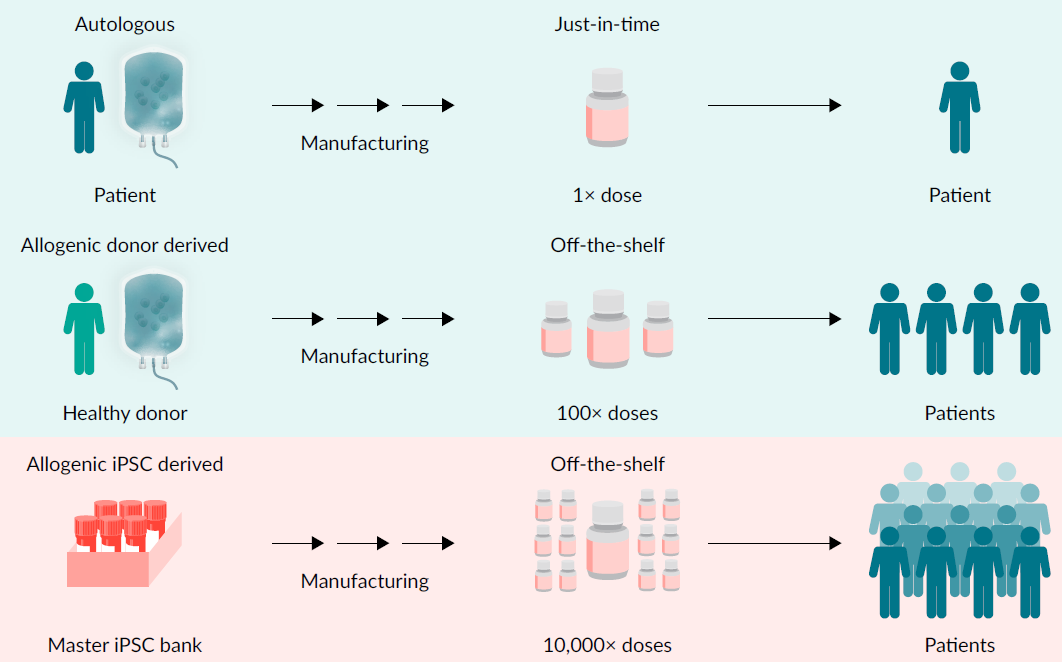
(Top) Autologous approaches use patient cells with their inherent perfect immune match. Manufacturing is personalized and serves one patient at a time. (Middle) Allogeneic healthy donor-derived cells serve as off-the-shelf products. However, due to limited expandability and donor immune signatures, they have a limited range of potential patients. (Bottom) Allogeneic PSC-derived cell therapy products can be expanded as validated master cell banks, can be genetically engineered to, e.g., enhance effector function or to avoid host immune responses, and can be off-the-shelf differentiated into required effector cells, making them available to a vast number of patients and disease applications. Image Credit: © 2025, BioInsights Publishing Ltd
Allogeneic PSC-derived cell therapy products offer a range of significant benefits. For example, manufacturing complexity is reduced because no dedicated patient material is required. These products are also extremely versatile, because a single platform can be used to manufacture multiple cell types for an array of diseases.
A total of 116 approved clinical trials using allogeneic PSC-derived cell products had been registered by December 2024, highlighting the continuing significance of cell therapy approaches.6
PSC-derived cell therapy products are applicable across a significant number of disease areas, but unmodified PSC products typically have limited applicability due to limited functionality or immune restrictions, such as allograft rejection.7
The majority of applications require starting material with genetic modifications tailored to the target disease. For instance, differentiated effector cells have a strongly improved therapeutic effect when expressing chimeric antigen receptors (CARs) in immune-oncology applications using PSC-derived macrophages, T cells, or NK cells. These effector cells drive specific recognition and killing of target cells.8-10
PSC-derived immune cells have also been shown to benefit from the overexpression of accessory factors that have been adapted to the respective therapeutic program: for example, overexpressing chemokine receptors or cytokines to improve iNK-based tumor therapies.11
The recognition and clearance of grafted cells can be reduced (or eliminated) if the envisioned clinical regimen involves repeat dosing or long-term engraftment.
This is especially important if PSC-derived effector cells must persist in the patient’s body, for example, in cell therapy targeting type 1 diabetes. Grafted PSC-derived islet cells used in these therapies are required to persist and function over many years despite alloimmunity, while also protecting beta cells from persistent autoimmunity.12,13
PSCs are known to accumulate genetic aberrations in culture, meaning that the designated PSC starting material must be well characterized and its genetic stability confidently validated. This has been reviewed in depth in other publications.14
This new paper focuses on specific considerations and challenges in the genetic integrity testing of PSCs following genome engineering, outlining a range of strategies to ensure high-quality gene-edited PSC starting material suitable for use in allogeneic ATMPs.
Genetic engineering of PSCs
The majority of genome engineering approaches leverage clustered regularly interspaced short palindromic repeats (CRISPR)-based systems to generate targeted DNA double-strand breaks (DSBs).15
Endogenous repair pathways are used to repair these DSBs. Break points will be rejoined by one of the predominant and fast-acting end-joining pathways in the absence of a homologous donor template.
These pathways include microhomology-mediated end joining (MMEJ), non-homologous end joining (NHEJ), or polymerase theta-mediated end joining.16
The use of end-joining pathways generally results in precise repair outcomes, but ongoing CRISPR ON-target activity can lead to insertions or deletions (indels) when the repair machinery is exhausted. The size of these indels depends on the respective end-joining pathway, though they are typically less than 10 nucleotides in length.
This end result is especially useful if there is a need for functional disruption of a target gene (knockout, KO) because any exon-based indel not divisible by three will consistently translate to a functionally inactivated protein.
Homology-dependent repair (HDR) can occur if a homologous donor is presented at the DSB. This results in precise insertion of the custom transgene repair cassette (knock-in, KI).17
This procedure facilitates cell generation with the potential to (over-) express any beneficial factor that can help effector cells establish immune evasion or better treat their respective disease type. Overexpression from a predefined locus will result in a better controlled outcome, unlike with, for example, largely random lentiviral vector insertions.
Reagents for DSB generation should be carefully pre-selected prior to beginning the editing procedure. This is especially applicable to target-specific single-guide RNAs (sgRNAs) designed to specifically recruit the nuclease and generate a single specific DSB.
A number of bioinformatic tools can be used to help select ‘good’ over ‘bad’ sgRNA options.18 The output of these tools is driven by potential off-targeting events based on gaps in the protospacer-target pairing and sequence similarity, but their algorithms do not currently offer extensive information for ON-target efficiency or in cellulo effects.
Rather, these tools can be used to reliably identify guides by recognizing almost identical regions with a high risk of OFF-targeting.
Two phases should be defined when attempting to reduce the risk of OFF-targeting. Experimental OFF-target nomination should be done after bioinformatic selection to evaluate the precision of the selected sgRNAs’ editing spectrum. Next, the nomination should be applied post-edit to validate the absence of potential off-targeting.
This approach means that in silico approaches like CRISPOR or Cas-OFFinder are used to initially select sgRNAs, helping to ensure minimal collateral editing propensity.19
Proper OFF-target nomination can be performed in vitro in the subsequent experimental step, with isolated genomic DNA treated with RNA-complexed CRISPR effector nucleases. It is also possible to identify any cut (ON- or OFF-target) via short-read WGS (for example, Digenome-Seq) or targeted sequencing (for example, BreakTag).20,21
Isolated genomic DNA is digested in vitro in the absence of cellular compartments or chromatin, with any digestion pattern most likely representing over-digestion due to over-accessibility of target regions.
It may be preferable to de-risk a worst-case scenario of potential OFF-targeting and begin with a ‘maximum damage’ scenario. This approach may also be less prone to missing events in the subsequent analysis of isolated clonal lines.
The ligation of indexing adapters is used to map in cellulo nomination methods that treat cells with the selected RNP and ON- and OFF-target DSBs in situ. These approaches include GUIDE-Seq, CHANGE-Seq, CASTSeq, and Uncover-Seq.19
These in cellulo assays investigate nucleases cutting the actual chromatinized template, meaning they are potentially immune to over-digestion and better able to mimic the cells’ actual status.
The enzymatic ligation of index adaptors could, however, represent a limiting factor in nominating the full set of potential OFF-targets.
It is important to note that the FDA does not specify a preferred OFF-target discovery method, but it emphasizes the importance of OFF-target analysis and nomination to ensure the safety and efficacy of CRISPR-based therapies.
The dataset will serve as the basis for the subsequent OFF-target validation procedure once the nomination procedure has been accomplished. Any nominated potential OFF-target will be validated after editing, for example, by ensuring its absence in the final clonal line. This procedure preferentially employs deep targeted sequencing of the nominated sites.
PSC clonal lines with the desired ON-target edit must be identified and characterized following genome editing.
While it is straightforward to screen for, perfect ON-target editing may not be the predominant engineering outcome. Potential accompanying OFF-targeting events should, therefore, also be screened for.
The precise genetic engineering of PSCs with CRISPR is a reliable and well-established technology platform, but the action of cellular DNA repair pathways means that cell-intrinsic events can add a degree of unpredictability to gene-editing outcomes.
For instance, there is increasing evidence that DNA repair pathways have the potential to create genomic rearrangements, both globally and in the inserted homology-dependent repair templates (HDRTs).22 When gene-editing PSCs, it is, therefore, important to identify clonal lines with the desired ON-target edit and that are also free of unwanted editing events.
References and further reading
- Patel, K.K., et al. (2025). From concept to cure: The evolution of CAR-T cell therapy. Molecular Therapy, 33(5), pp.2123–2140. DOI: 10.1016/j.ymthe.2025.03.005. https://www.cell.com/molecular-therapy-family/molecular-therapy/fulltext/S1525-0016(25)00179-0.
- Georg, S., et al. (2024). Advancements and challenges in CAR T cell therapy in autoimmune diseases. Nature Reviews Rheumatology, 20(9), pp.531–544. DOI: 10.1038/s41584-024-01139-z. https://www.nature.com/articles/s41584-024-01139-z.
- Yu, J. and Thomson, J.A. (2008). Pluripotent stem cell lines. Genes & Development, 22(15), pp.1987–1997. DOI: 10.1101/gad.1689808. https://genesdev.cshlp.org/content/22/15/1987.short.
- Takahashi, K. and Yamanaka, S. (2026). Induction of Pluripotent Stem Cells from Mouse Embryonic and Adult Fibroblast Cultures by Defined Factors. Cell, 126(4), pp.663–676. DOI: 10.1016/j.cell.2006.07.024. https://www.cell.com/cell/fulltext/S0092-8674(06)00976-7?.
-
-
-
- Paasch, D., et al. (2022). Ex Vivo Generation of CAR Macrophages from Hematopoietic Stem and Progenitor Cells for Use in Cancer Therapy. Cells, 11(6), p.994. DOI: 10.3390/cells11060994. https://www.mdpi.com/2073-4409/11/6/994.
-
- Wang, X., et al. (2025). An iPSC-derived CD19/BCMA CAR-NK therapy in a patient with systemic sclerosis. Cell, 188(16), pp.4225–4238.e12. DOI: 10.1016/j.cell.2025.05.038. https://www.cell.com/cell/abstract/S0092-8674(25)00625-7.
- Yuma Fukutani, et al. (2025). Human iPSC-derived NK cells armed with CCL19, CCR2B, high-affinity CD16, IL-15, and NKG2D complex enhance anti-solid tumor activity. Stem Cell Research & Therapy, 16(1). DOI: 10.1186/s13287-025-04461-9. https://link.springer.com/article/10.1186/s13287-025-04461-9.
- Lanza, R., Russell, D.W. and Nagy, A. (2019). Engineering universal cells that evade immune detection. Nature Reviews Immunology, 19(12), pp.723–733. DOI: 10.1038/s41577-019-0200-1. https://www.nature.com/articles/s41577-019-0200-1.
- Vantyghem, M.-C., et al. (2019). Advances in β-cell replacement therapy for the treatment of type 1 diabetes. The Lancet, 394(10205), pp.1274–1285. DOI: 10.1016/s0140-6736(19)31334-0. https://www.thelancet.com/journals/lancet/article/PIIS0140-6736(19)31334-0/abstract.
- Zanella, F. and Marcu, R. (2024). Genetic stability of hPSCs and considerations for cell therapy. Cell and Gene Therapy Insights, 10(01), pp.159–170. DOI: 10.18609/cgti.2024.023. https://cdn.insights.bio/uploads/attachments/Zanella%20&%20Marcu.pdf.
- Pacesa, M., Oana Pelea and Jinek, M. (2024). Past, present, and Future of CRISPR Genome Editing Technologies. Cell, 187(5), pp.1076–1100. DOI:10.1016/j.cell.2024.01.042. https://www.cell.com/cell/fulltext/S0092-8674(24)00111-9.
-
Gelot, C., Magdalou, I. and Lopez, B. (2015). Replication Stress in Mammalian Cells and Its Consequences for Mitosis.
Genes, 6(2), pp.267–298. DOI:10.3390/genes6020267.
https://www.mdpi.com/2073-4425/6/2/267.
- Haider, S. and Mussolino, C. (2025). Fine-Tuning Homology-Directed Repair (HDR) for Precision Genome Editing: Current Strategies and Future Directions. International Journal of Molecular Sciences, 26(9), pp.4067–4067. DOI:10.3390/ijms26094067. https://www.mdpi.com/1422-0067/26/9/4067.
- Liu, G., Zhang, Y. and Zhang, T. (2020). Computational approaches for effective CRISPR guide RNA design and evaluation. Computational and Structural Biotechnology Journal, 18, pp.35–44. DOI: 10.1016/j.csbj.2019.11.006. https://www.sciencedirect.com/science/article/pii/S2001037019303551.
- Guo, C., et al. (2023). Off-target Effects in CRISPR/Cas9 Gene Editing. Frontiers in Bioengineering and Biotechnology, 11(1143157). DOI: 10.3389/fbioe.2023.1143157. https://www.frontiersin.org/journals/bioengineering-and-biotechnology/articles/10.3389/fbioe.2023.1143157/full.
- Kim, D., Kang, B.-C. and Kim, J.-S. (2021). Identifying genome-wide off-target sites of CRISPR RNA–guided nucleases and deaminases with Digenome-seq. Nature Protocols, 16(2), pp.1170–1192. DOI: 10.1038/s41596-020-00453-6. https://www.nature.com/articles/s41596-020-00453-6.
- Gabriel, et al. (2024). Linking CRISPR–Cas9 double-strand break profiles to gene editing precision with BreakTag. Nature biotechnology. DOI: 10.1038/s41587-024-02238-8. https://www.nature.com/articles/s41587-024-02238-8.
- Teboul, L., et al. (2020). Variability in Genome Editing Outcomes: Challenges for Research Reproducibility and Clinical Safety. Molecular Therapy, 28(6), pp.1422–1431. DOI: 10.1016/j.ymthe.2020.03.015. https://www.cell.com/molecular-therapy-family/molecular-therapy/fulltext/S1525-0016(20)30149-0.
Acknowledgments
Produced from materials originally authored by Philip Hublitz, Vipul Patel, Heloise Philippon, Lukas Gebauer, Alexander Vogt, Felix Hermann, Manuel Landesfeind, and Matthias Austen from Evotec.
About Evotec
Evotec is a life science company that is pioneering the future of drug discovery and development. By integrating breakthrough science with AI-driven innovation and advanced technologies, we accelerate the journey from concept to cure – faster, smarter, and with greater precision. Our expertise spans small molecules, biologics, cell therapies and associated modalities, supported by proprietary platforms such as Molecular Patient Databases, PanOmics and iPSC-based disease modeling.
With flexible partnering models tailored to our customers’ needs, we work with all Top 20 Pharma companies, over 800 biotechs, academic institutions, and healthcare stakeholders. Our offerings range from standalone services to fully integrated R&D programs and long-term strategic partnerships, combining scientific excellence with operational agility.
Through Just – Evotec Biologics, we redefine biologics development and manufacturing to improve accessibility and affordability. With a strong portfolio of over 100 proprietary R&D assets, most of them being co-owned, we focus on key therapeutic areas including oncology, cardiovascular and metabolic diseases, neurology, and immunology.
Evotec’s global team of more than 4,500 experts operates from sites in Europe and the U.S., offering complementary technologies and services as synergistic centers of excellence. Learn more at www.evotec.com and follow us LinkedIn and X/Twitter @Evotec.
Sponsored Content Policy: News-Medical.net publishes articles and related content that may be derived from sources where we have existing commercial relationships, provided such content adds value to the core editorial ethos of News-Medical.net, which is to educate and inform site visitors interested in medical research, science, medical devices and treatments.