Sponsored Content by EvotecReviewed by Emily MageeNov 20 2026
Autologous chimeric antigen receptor (CAR) T-cell therapies are now part of the standard of care for hematological malignancies, but they are limited by delayed patient access and high costs.
 Image Credit: Shutterstock.com/Nemes Laszlo
Off-the-shelf availability is enabled by allogeneic donor-derived CAR T cells, but their efficacy has remained modest, especially in solid tumors. This is primarily due to insufficient tumor infiltration, allorejection, and functional exhaustion within the hostile tumor microenvironment (TME).
Newly developed approaches to in vivo CAR T aim to remove the need for ex vivo manufacturing, but these approaches currently require validation in safety, efficacy, and therapeutic control.
Allogeneic induced pluripotent stem cell (iPSC)-derived CAR T cells represent a convincing alternative approach, enabling cost-efficient, unlimited, homogeneous, off-the-shelf products with a defined phenotype and genotype.
Rational customization for disease-specific challenges is possible due to iPSC-derived CAR T cells’ amenability to extensive genetic engineering, including resistance to TME-mediated suppression and improved tumor trafficking.
Hepatocellular carcinoma (HCC) remains largely incurable at advanced stages and is the third leading cause of global cancer-related mortality. A scalable, xeno-free bioprocessing platform was developed to address this unmet need.
This platform enables safe, efficacious, and cost-competitive CAR T-cell therapy for HCC by generating immune-shielded, TME-resistant iPSC-derived CAR γδ T cells (CAR iγδ T cells), which combine γδ T cells’ favorable safety profile and intrinsic tissue infiltration with a proprietary HCC-targeting CAR and Evotec’s immune-shielding strategy.
iPSC-derived CAR T cells offer advantages over other cell therapy modalities
| Final product |
Allogeneic iPSC-derived CAR T cells
Off-the-shelf CAR T cells |
In vivo CAR T cells

Off-the-shelf CAR vectors |
Allogeneic donor-derived CAR T cells
Off-the-shelf CAR T cells |
| Availability |
 |
|
|
| Scalability |
|
|
|
| COGS |
|
|
|
Gene editing
capacity & clonality |
|
|
|
In-depth QC &
therapy control |
|
|
|
Figure 1. Allogeneic iPSC-derived CAR T cells are available off the shelf and can be manufactured as a clonal drug product at large scale and lower cost compared with allogeneic donor-derived and in vivo-generated CAR T cells. They enable complex and precise genetic engineering that is not feasible in primary T cells, whether sourced from patients (in vivo CAR T) or healthy donors (donor-derived CAR T). Importantly, iPSC-derived CAR T cells provide a fully controlled therapeutic product, allowing extensive screening for genetic integrity and defined cellular phenotype. (COGS: cost of goods sold). Figure Credit: Evotec
Armored iγδ T cells offer a uniquely suited therapy for solid tumors
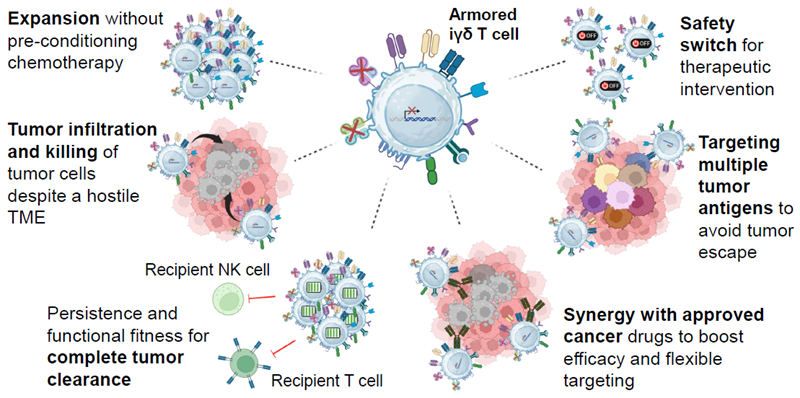
Figure 2. Genetic engineering of iPSCs allows modeling of iγδ T cell features, e.g., improved persistence. Combined with the inherent infiltration and multimodal killing capacity of γδ T cells, iγδ T cells offer a potent anticancer therapy, especially for solid tumors. (TME: Tumor microenvironment). Image Credit: Evotec
GMP-compatible gene editing process and iPSC quality control (QC)
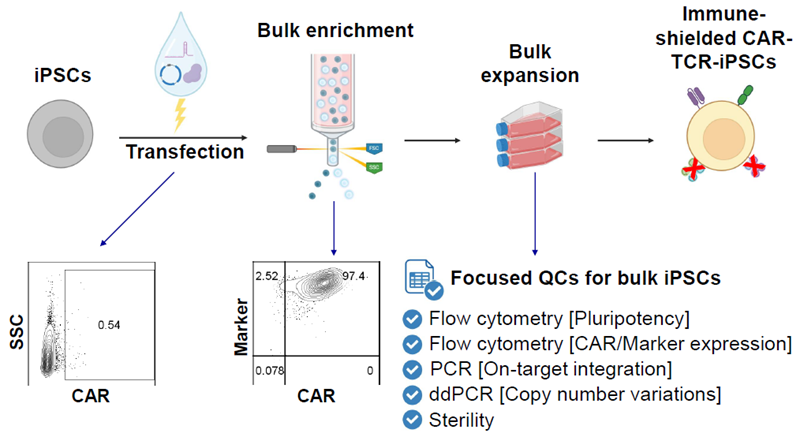
Figure 3. iPSCs were modified by introducing an HCC-targeting CAR, a γδ TCR, and immune-shielding modifications into selected loci by nucleasemediated homology-directed repair. For enrichment of edited cells, iPSCs were sorted with selection markers cointroduced with transgenes. For the proof-of-concept work presented here, CAR-TCRiPSCs were used as a bulk population without clonal isolation. The edited bulk was expanded and analyzed as shown to ensure transgene expression and genomic integrity of the final product. Image Credit: Evotec
Feeder- and xeno-free generation of immune-shielded CAR iγδ T cells
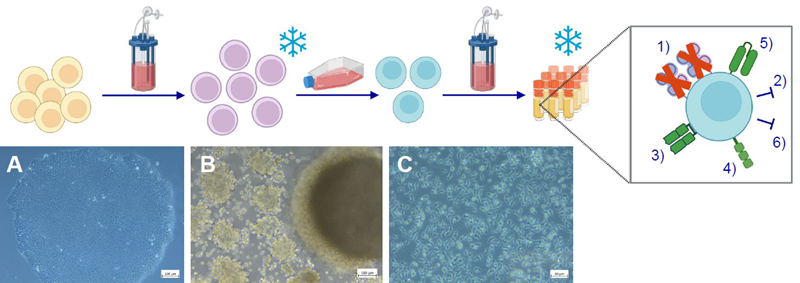
Figure 4. Edited iPSCs (A) are differentiated in 3D into induced CD34+ hematopoietic progenitor cells (HPCs, B). HPCs are cryopreserved and differentiated in 2D into iγδ T cells post thaw. Those iγδ T cells are further matured and expanded (C) in 3D prior to cryopreservation. The final iγδ T cell product 1) is devoid of HLA surface display, preventing allorecognition via T cells, 2) includes an Evotec proprietary gene edit preventing allorecognition via NK cells, 3) expresses a γδ TCR, 4) contains a safety switch for therapeutic intervention, and 5) carries an Evotec proprietary HCC-targeting CAR as well as 6) a TME-resistance mechanism. Image Credit: Evotec
High-quality HPCs generated from a xeno-free (XF) bioreactor process
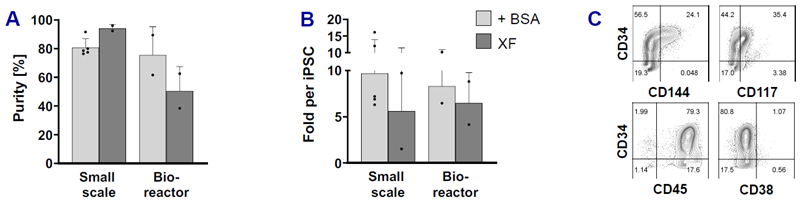
Figure 5. Hematopoietic progenitor cells (HPCs) can be generated in high purity (% CD34+Lineage‒ cells, A) and yield (CD34+ Lineage-cells per iPSC input, B) and with bona fide hematopoietic progenitor phenotype (C) with Evotec’s xeno-free (XF) bioreactor process. Data points in (A) and (B) represent individual experiments. HPCs can be used for T cell differentiation without enrichment. Image Credit: Evotec
Mature CAR iγδ T cells with favorable phenotype and TME-resistance edit
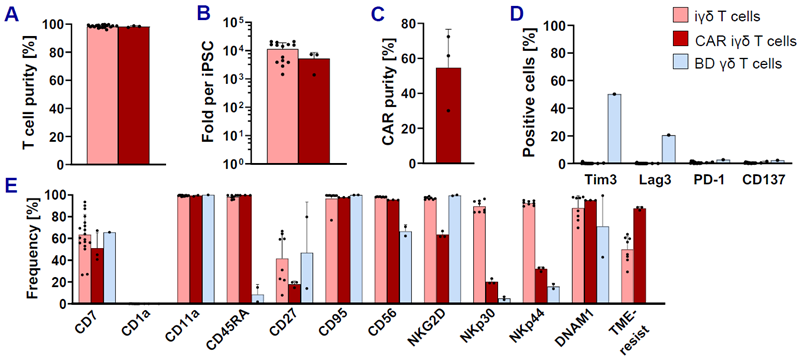
Figure 6. (A) T cell purity of iγδ T cells (%CD3+TCRγδ+) and (B) yield (%CD3+TCRγδ+ cells per iPSC input) post expansion is unaffected when differentiated from TCR-iPSCs or CAR-TCR-iPSCs. (C) CAR purity deviates from 100% because, for proof of concept, the CAR-TCR bulk population was differentiated. (D-E) CAR iγδ T cells display a non-exhausted (lack of Tim3, Lag3, PD1, CD137), mature (CD1a-CD11a+), stem cell memory (CD45RA+CD27+CD95+) phenotype and express multiple NK cell receptors and a TME-resistance edit. Blood-derived (BD) γδ T cells were used as control. Data points represent individual experiments (iγδ T cells) or donors (BD γδ T cells). Image Credit: Evotec
Immune-shielded CAR iγδ T cells show trimodal anti-tumor activity
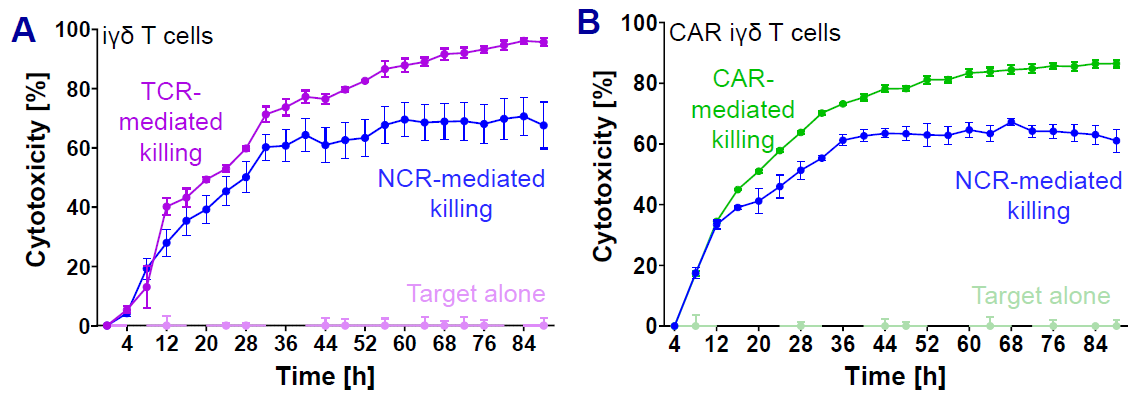
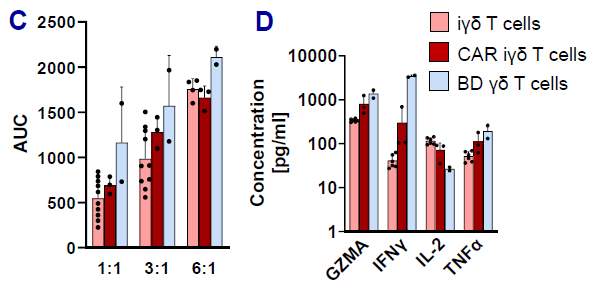
Figure 7. (A) iγδ T cells and (B) CAR iγδ T cells (proof-of-concept bulk) show killing of liver cancer cell line (target) at a 3:1 E:T ratio. Both iγδ T cells and CAR iγδ T cells show natural tumor cell killing via their NK cell receptors (NCR). Zoledronate pre-treatment of target cells upregulates TCR ligand and allows TCR-mediated killing in (A). CAR iγδ T cells are co-cultured with CAR antigen + and CAR antigen – cells to discriminate CAR-mediated killing in (B).
(C) Quantification of area under the curve (AUC) for iγδ T cells, proof-of-concept bulk CAR iγδ T cells, and blood-derived (BD) γδ T cells in co-culture with CAR antigen + target cells at different E:T ratios. (D) Cytokine secretion for iγδ T cells, CAR iγδ T cells, and BD γδ T cells in co-culture with CAR antigen + target cells at a 3:1 E:T ratio. Data points in (C) and (D) represent individual cell batches (iγδ T cells, CAR iγδ T cells) or donors (BD γδ T cells). BD γδ T cells were used as a control despite their expectedly high donor variability. Image Credit: Evotec
Immune-shielded cells are protected from alloreactive T and NK cells
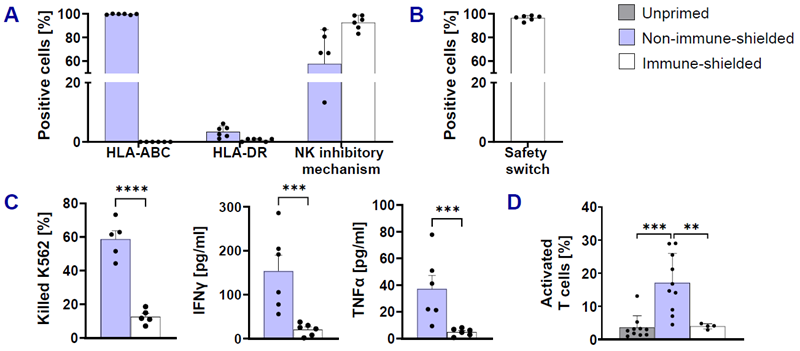
Figure 8. (A) Immune-shielded iγδ T cells lack HLA-ABC surface display and show lower HLA-DR surface display. Immune-shielded iγδ T cells demonstrate consistent, high expression of an Evotec-proprietary inhibitory mechanism that prevents allorecognition by NK cells. (B) Immune-shielded iγδ T cells express a therapeutic safety switch. Data points in (A) and (B) represent individual experiments.
(C-D) Immune-shielding strategy of iγδ T cells was tested on K562 cells (C) and iPSC-derived surrogate cells (D). Immune-shielded K562 cells are protected against NK cell killing and do not trigger release of IFNγ and TNFα by NK cells (C). Immune-shielded surrogate cells prevent T cell activation in coculture (D). Data points in (C) and (D) represent individual donors. A ratio paired T-test was performed. (**** p < 0.0001, *** p < 0.001, ** p < 0.01). Image Credit: Evotec
Summary
The study presented here saw the generation of immune-shielded CAR-TCR-iPSCs via a GMP-compatible gene-editing process. It was possible to differentiate CAR-TCR-iPSCs in a xeno-free process, developing them into mature, functional CAR iγδ T cells.
These cells featured a non-exhausted stem-cell-memory phenotype able to carry a TME-resistance mechanism. Trimodal anti-tumor activity was demonstrated, enabling robust cytotoxicity despite tumor heterogeneity.
Evotec’s immune-shielding strategy was shown to protect cells from allorecognition by recipient NK and T cells, with a safety switch included for any required therapeutic intervention.
The iPSC-derived CAR γδT cells outlined here represent a versatile platform for the creation of safe, affordable, accessible, and curative cell therapeutics for the treatment of solid tumors.
Acknowledgments
Produced from materials originally authored by Tommaso Pezzica, Judith Hartmann, Tabea Erdmann, Jessica Nolte, Lea Renneberg, Stefanie Kober, Theresa Klisch, Thomas Aleyt, Marion Philippe, Caroline Stienne, Philip Hublitz, Karine Pingris, Céline Poussereau Pomie, Michael Esquerre, Katrin Ridders, Andreas Scheel, Matthias Austen, Stephanie Sontag, and Audrey Holtzinger from Evotec.
About Evotec
Evotec is a life science company that is pioneering the future of drug discovery and development. By integrating breakthrough science with AI-driven innovation and advanced technologies, we accelerate the journey from concept to cure – faster, smarter, and with greater precision. Our expertise spans small molecules, biologics, cell therapies and associated modalities, supported by proprietary platforms such as Molecular Patient Databases, PanOmics and iPSC-based disease modeling.
With flexible partnering models tailored to our customers’ needs, we work with all Top 20 Pharma companies, over 800 biotechs, academic institutions, and healthcare stakeholders. Our offerings range from standalone services to fully integrated R&D programs and long-term strategic partnerships, combining scientific excellence with operational agility.
Through Just – Evotec Biologics, we redefine biologics development and manufacturing to improve accessibility and affordability. With a strong portfolio of over 100 proprietary R&D assets, most of them being co-owned, we focus on key therapeutic areas including oncology, cardiovascular and metabolic diseases, neurology, and immunology.
Evotec’s global team of more than 4,500 experts operates from sites in Europe and the U.S., offering complementary technologies and services as synergistic centers of excellence. Learn more at www.evotec.com and follow us LinkedIn and X/Twitter @Evotec.
Sponsored Content Policy: News-Medical.net publishes articles and related content that may be derived from sources where we have existing commercial relationships, provided such content adds value to the core editorial ethos of News-Medical.net, which is to educate and inform site visitors interested in medical research, science, medical devices and treatments.