Introduction
Continuous monitoring systems
Redefining traceability with blockchain
Foreseeing risks through predictive AI
Challenges in implementation
Future directions
References
Further reading
From sensor-equipped packaging to predictive algorithms and blockchain records, digital tools are changing how food is monitored as it moves from farm to consumer, but their growing role brings technical and regulatory questions that remain unresolved.
 Image Credit: ultramansk / Shutterstock.com
Introduction
As the global population continues to rise, the demand for increased food production requires sufficient guardrails to maintain food safety in globalized supply chains. Continuous-monitoring technologies that track environmental conditions are crucial, as they can identify conditions associated with potential hazards and support efforts to maintain food quality and safety during storage. Advances in digital technologies such as the Internet of Things (IoT), artificial intelligence (AI), and blockchain are further transforming food safety management by enabling rapid risk detection, predictive analytics, and improved traceability, thereby supporting earlier intervention against contamination risks and enhancing consumer protection.1,2,3
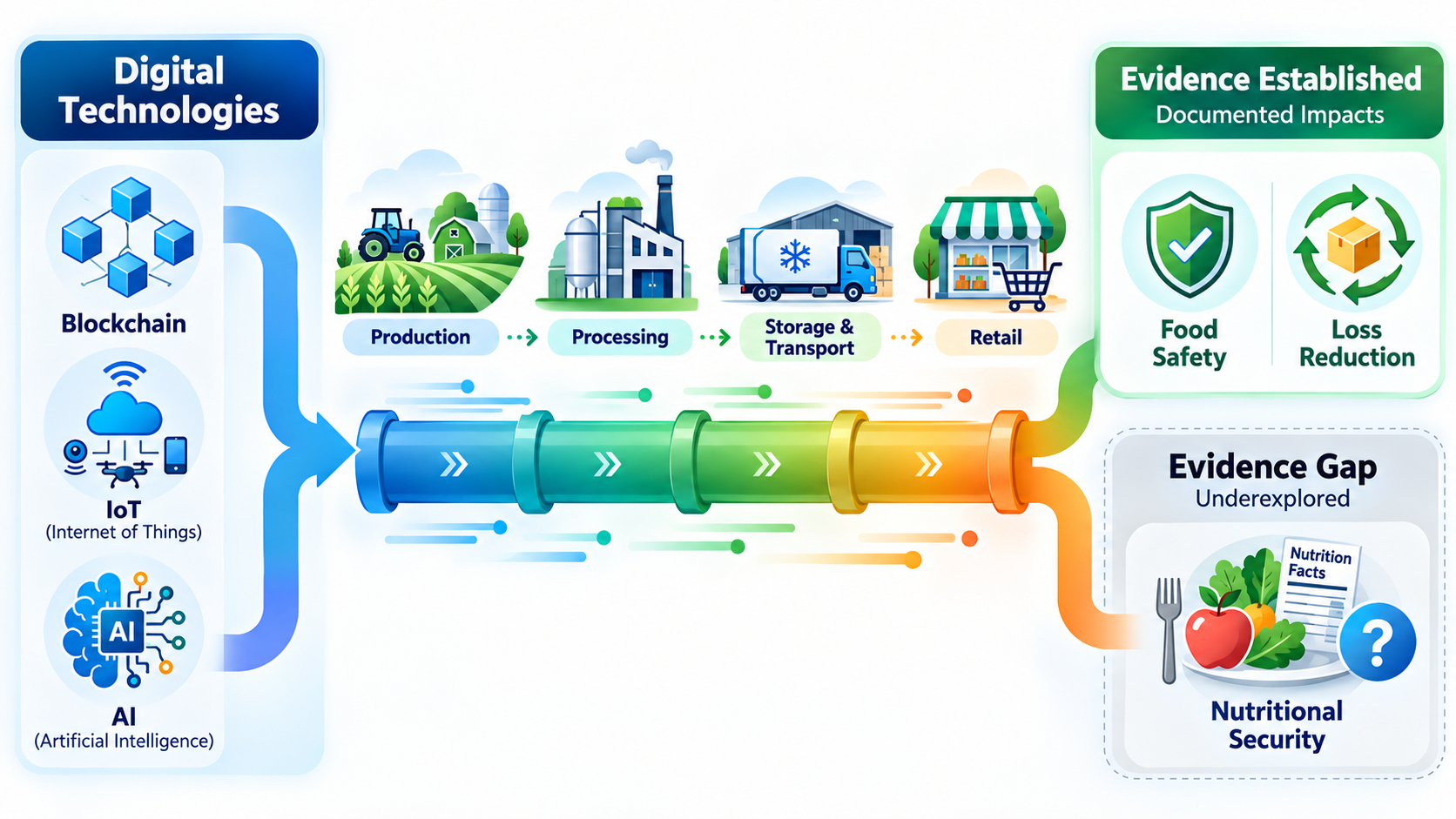
Conceptual framework of digital technology-driven sustainable food supply chains.3
Continuous monitoring systems
The introduction of IoT-based sensing solutions enables real-time tracking of food from production through distribution, providing greater visibility into the status and environmental conditions of food products across the global supply chain. Smart sensors and other connected devices collect data on key environmental conditions and transmit it to centralized monitoring platforms, enabling supply-chain participants to track product status throughout transportation and storage.1,2,5
Sensors equipped with IoT technology can issue immediate alerts, enabling rapid corrective actions to prevent food deterioration and reduce contamination risks. Advanced biosensors can similarly improve food safety management through early detection of pathogens and other chemical hazards.2,3,5
Continuous monitoring is combined with rapid data analysis, in which massive amounts of sensor-generated data are processed to identify patterns, evaluate risk, and support decision-making. The integration of IoT data with AI and machine learning (ML) algorithms can support shelf-life prediction and food quality assessment, improve traceability, and help reduce food waste, while supporting the resilience of the global food supply chain.1,2,3
Redefining traceability with blockchain
Blockchain technology serves as a decentralized ledger that securely stores and shares information on production, processing, distribution, and retail across the supply chain.4,5 Compared with traditional traceability methods that are vulnerable to human error, blockchain technologies can create tamper-resistant records that help supply-chain participants verify provenance and identify inconsistencies associated with food fraud, adulteration, or mislabeling. Blockchain records are only as reliable as the data entered into them and do not independently verify the physical authenticity or safety of a food product.1,4,5 When integrated with IoT devices and sensor networks, blockchain can securely record and share data generated through continuous monitoring of environmental conditions and contamination risks throughout transportation and storage.1,5
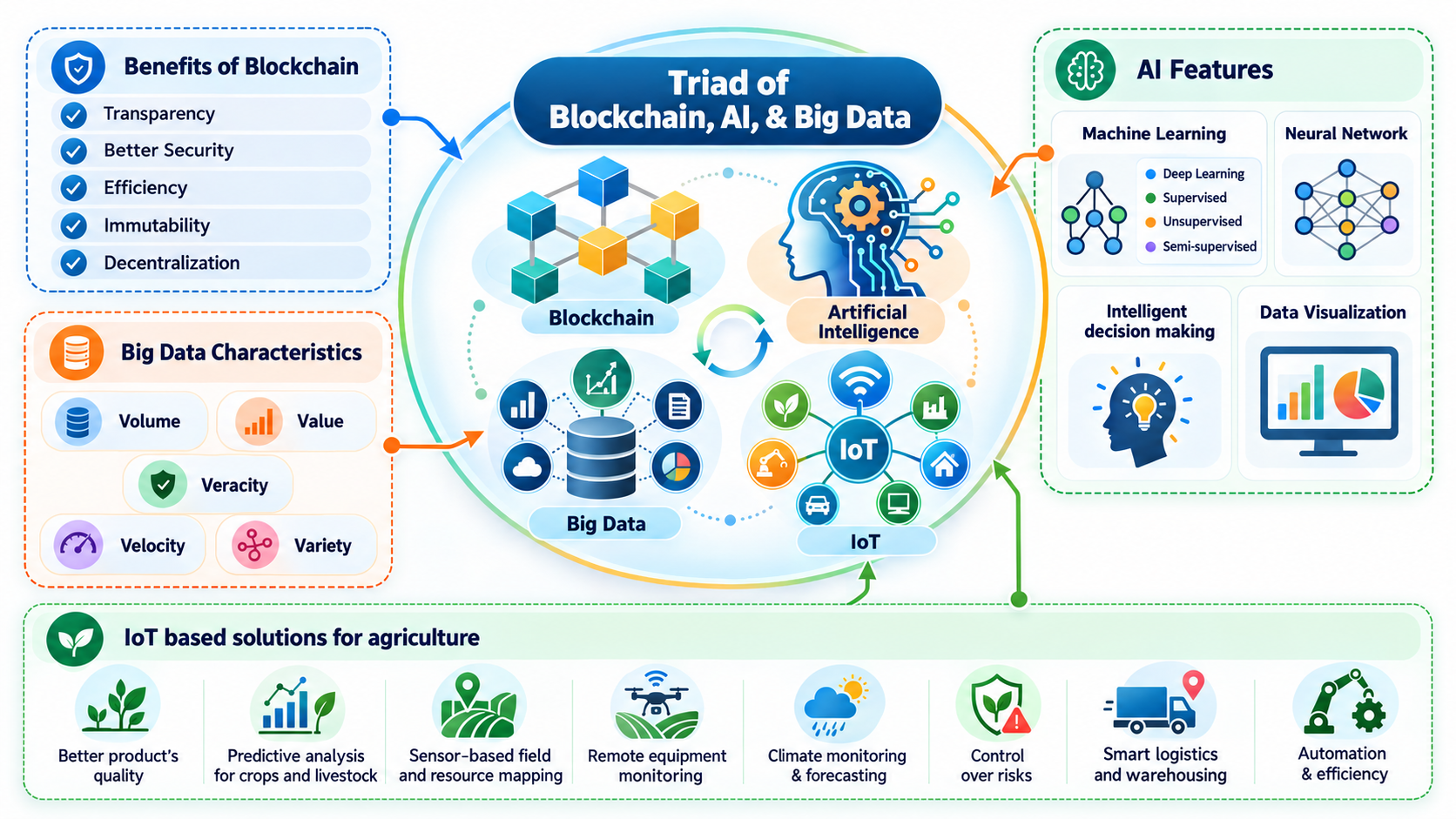
Characteristics of blockchain, AI, IoT, and big data for smart farming.6
Blockchain has the potential to improve recall efficiency by enabling the rapid identification and isolation of affected products during food safety incidents. Rather than tracing contamination sources through lengthy manual investigations, supply-chain participants can retrieve recorded product histories much more rapidly. In one widely cited Walmart trial, tracing a package of mangoes to its source fell from more than six days to 2.2 seconds, illustrating the potential for faster source identification during traceability investigations.3,4
Food Safety and Blockchain: Trust Through Transparency
Foreseeing risks through predictive AI
Food safety systems are progressively integrating AI and predictive analytics to improve risk assessments, detect contamination, and support proactive efforts to improve food safety. By utilizing data generated from sensors, traceability platforms, and food safety records, AI-based systems can use algorithms to identify previously undetected patterns and predict future risks of food safety incidents.1,2 The integration of ML with genomic and multi-omics data supports more precise detection, characterization, and prediction of microbial hazards, supporting more targeted interventions.1,2
AI-based risk assessment models assist supply-chain participants in evaluating vulnerabilities across the food supply chain by estimating contamination risk and identifying priority areas for corrective actions. AI-based early warning systems and rapid analytics can provide alerts that allow timely responses, potentially reducing outbreak risks and product losses while strengthening food safety management systems.1,2,3
Challenges in implementation
The high cost of implementing advanced technologies, including blockchain, IoT networks, AI, and cloud-based monitoring systems, is a key barrier to their widespread adoption. Developing sensor infrastructure, data storage systems, connectivity, and analytics platforms requires substantial financial investment and high levels of technical expertise.3,4,5 These barriers can be particularly important for smaller producers and organizations in regions with limited digital infrastructure.1,2,3
In global food supply chains, participants operate across different geographic regions and industries, increasing the complexity of complying with diverse regulatory systems. Currently, there are no universally accepted standards that enable blockchain platforms, sensor networks, and analytics software to work together consistently, reducing the efficiency of monitoring and traceability efforts.4,5 Sensor calibration, data quality, privacy, cybersecurity, and blockchain capacity limits present additional challenges. Large data volumes can increase processing demands, while compromised sensors or inaccurate source data can undermine the reliability of downstream analyses and traceability records.1,2,5 Addressing these challenges requires greater collaboration among supply-chain partners, investment in digital infrastructure, and harmonized standards that support compatible data exchange across international food networks.3,4,5
 Image Credit: Sidorov_Ruslan / shutterstock.com
Future directions
Increasing automation, intelligent packaging solutions, and greater international collaboration on regulatory requirements will shape how technologies influence the future of food safety. The widespread use of digital technologies could allow food supply chains to incorporate AI, IoT devices, blockchain, robotics, and advanced analytics. These connected systems could facilitate continuous monitoring of the food supply chain, enabling automated responses, predictive risk management, and rapid responses to food safety hazards at multiple points along the chain. If successfully implemented at scale, such systems could improve operational efficiency, help reduce food waste, and refine traceability from farm to the consumer.1,2,3
Smart packaging incorporates advanced technology, including sensors, indicators, and communication systems, to collect and share data on environmental conditions such as temperature and humidity that affect food quality. Some systems can also incorporate biosensors or indicators for microbial activity, gases, pH, or other markers of deterioration.1,2 When integrated with IoT platforms and digital traceability systems, smart packaging can improve transparency and inventory management while supporting timely interventions to prevent food waste and contamination. Collectively, these technologies could provide consumers and supply-chain participants greater confidence in product quality and safety.2,3
Moving forward, global regulatory harmonization will be important for wider and interoperable adoption of digital food safety technologies. Harmonized regulations and technical standards could make adoption easier while supporting more consistent data exchange and food safety practices across global markets.2,3
References
- Priyadharsshini, S., & Adeyeye, S. A. O. (2026). Advances in the application and use of AI, IoT and blockchain in microbial analysis and safety of food: A comprehensive review. Food Control. DOI: 10.1016/j.foodcont.2026.112285. https://www.sciencedirect.com/science/article/abs/pii/S0956713526003300
- Kirubakaran, D., Meer, M.S., Jayakodi, S., et al. (2025). Smart technologies enhance detection, monitoring, and traceability in global food safety. Discover Food. DOI: 10.1007/s44187-025-00716-9. https://link.springer.com/article/10.1007/s44187-025-00716-9
- Li, S., Li, H., & Kong, T. (2026). Digital technologies for sustainable food supply chains: a scoping review of impacts on food safety, loss reduction, and implications for nutritional security. Frontiers in Nutrition, 13. DOI: 10.3389/fnut.2026.1796752. https://www.frontiersin.org/journals/nutrition/articles/10.3389/fnut.2026.1796752/full
- Ellahi, R. M., Wood, L. C., & Bekhit, A. E. A. (2023). Blockchain-Based Frameworks for Food Traceability: A Systematic Review. Foods 12(16). DOI: 10.3390/foods12163026. https://www.mdpi.com/2304-8158/12/16/3026
- Sathiya, V., Nagalakshmi, K., Raju, K., & Lavanya, R. (2024). Tracking perishable foods in the supply chain using chain of things technology. Scientific Reports 14(1). DOI: 10.1038/s41598-024-72617-3. https://www.nature.com/articles/s41598-024-72617-3
- Bhat, S.A.; Huang, N.-F.Sofi, I.B.; Sultan, M. Agriculture-Food Supply Chain Management Based on Blockchain and IoT: A Narrative on Enterprise Blockchain Interoperability. Agriculture 2022, 12, 40. DOI: 10.3390/agriculture12010040, https://www.mdpi.com/2077-0472/12/1/40
Further Reading
Last Updated: Sep 29, 2026
 Insect flour could boost gut health and cut environmental impact