Introduction
How cooking affects nutrition
How heat and pressure change food at the molecular level
How boiling leads to nutrient loss
High-pressure mitigation of antinutritional factors
Pressure cooking vs. boiling
Other factors that influence nutrient retention
Conclusions
References
Further reading
Pressure cooking often preserves more nutrients than boiling by reducing cooking time, water exposure, and oxidation, but outcomes depend on food type, nutrient stability, and whether cooking liquids are consumed. Both methods also differently influence nutrient bioaccessibility after digestion, meaning the “best” method varies by context.
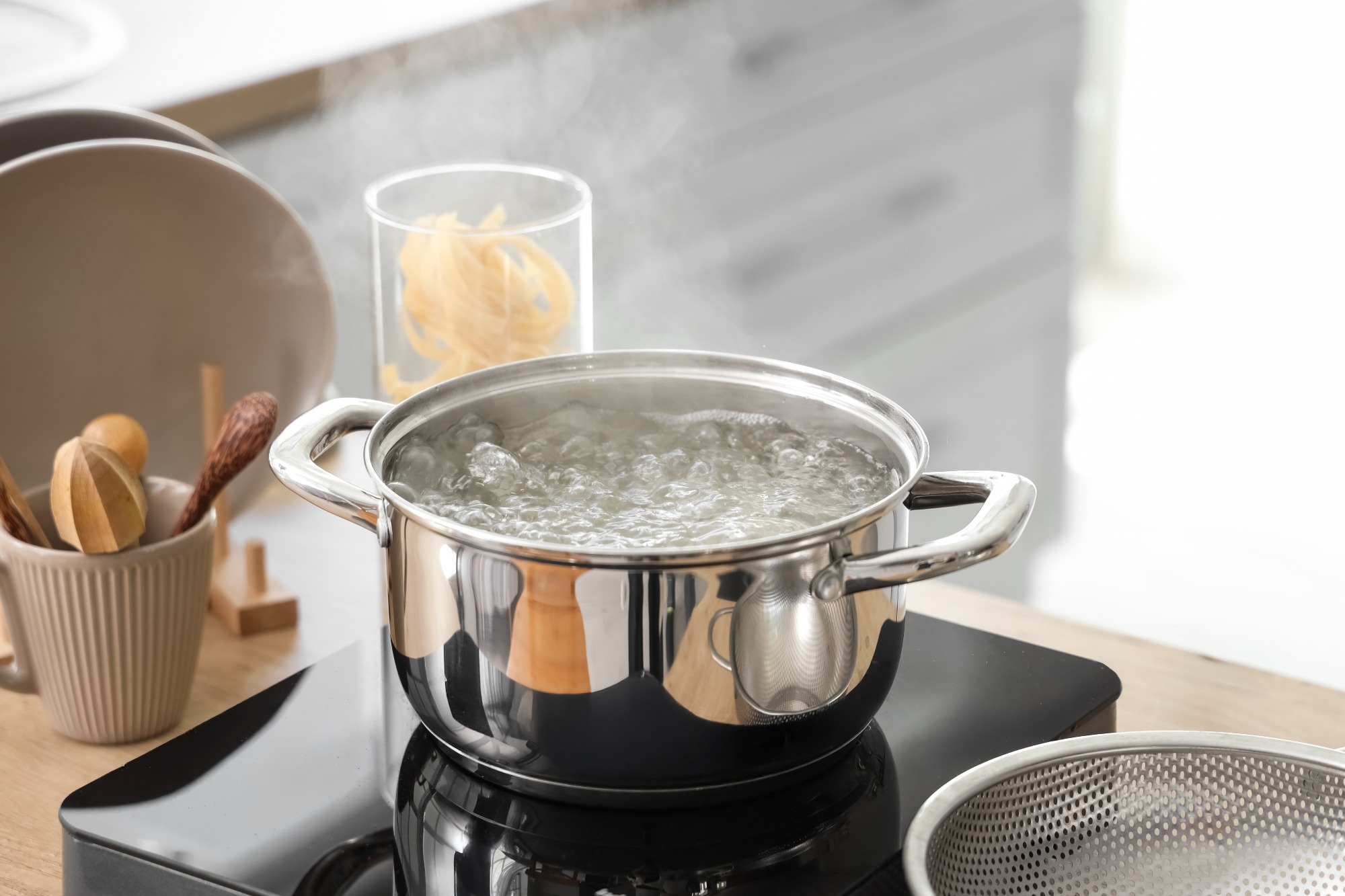 Image Credit: Pixel-Shot / Shutterstock.com
Introduction
Pressure cooking offers an alternative method to boiling that more effectively preserves nutrients, particularly water-soluble vitamins, by limiting heat exposure and water contact.
How cooking affects nutrition
Heat has historically been used for cooking food to enhance its palatability, digestibility, and immunological benefits.1 Different cooking methods can significantly influence the final nutritional architecture of foods, potentially dictating the extent of starch gelatinization, protein denaturation, and phytochemical oxidation.1
Both traditional boiling and pressure cooking utilize heated water to transform raw foods into their cooked end products. Despite this core similarity, these methodologies differ in their thermodynamic principles, leading to end products with different nutritional outcomes.1
Boiling, for example, can lead to aqueous leaching, significantly depleting water-soluble vitamins. In contrast, the aggressive barothermal disruption characteristic of pressure cooking degrades recalcitrant antinutritional factors (ANFs), thereby increasing the bioaccessibility of essential minerals and proteins.1,2
How heat and pressure change food at the molecular level
Boiling is an open-system cooking method in which food is submerged in water at a maximum temperature of approximately 100 °C. During boiling, thermal energy transfer from water to the food matrix primarily occurs through convection.3
The maximum temperature at which food can be cooked by boiling is determined by the boiling point of water; therefore, achieving adequate cellular breakdown in dense foods often requires prolonged cooking.3 In contrast, pressure cooking utilizes a hermetically sealed environment, wherein water boils within the pressure cooker and vaporizes into steam. This trapped steam raises the internal pressure above atmospheric levels, thereby increasing the boiling point to 120 °C or higher.2 Unlike convection-driven boiling, pressurized steam in this cooking method rapidly penetrates food tissues, thereby reducing cooking times by 50-70% as compared to boiling.
The Science Behind Pressure Cookers
Nutrient retention in both boiling and pressure cooking is determined by temperature magnitude, total cooking duration, oxygen exposure, and the volume of water in direct contact with the food.2 Whereas conventional boiling exposes raw ingredients to continuous oxidative stress and extensive water contact, pressure cooking minimizes both oxidation and water immersion by relying on high-heat steam, which retains significantly more nutrients than conventional boiling.2
How boiling leads to nutrient loss
Boiling induces profound biochemical alterations in a wide range of vegetables that are primarily characterized by the leaching of water-soluble compounds into the surrounding liquid.1 Importantly, nutrient leaching, the primary detriment of boiling, is mitigated when the cooking liquid is ingested in the form of soups or stews, thereby allowing the recovery of water-soluble vitamins and minerals.3
Notable boiling-associated thermal kinetic degradation and physical migration have also been reported, particularly for water-soluble vitamins like vitamin C and B-complex vitamins. Specifically, boiling reduces ascorbic acid content by up to 71% in leafy greens like spinach, primarily through the rapid conversion to dehydroascorbic acid.1
Aqueous diffusion of elemental minerals like potassium, magnesium, and zinc also contributes to significant reductions in their intracellular concentration.1 Prolonged boiling at 100 °C also facilitates the degradation of thermolabile secondary metabolites, as demonstrated by reduced total phenolic and flavonoid content.3
High-pressure mitigation of antinutritional factors
Despite higher operating temperatures, the shorter duration and oxygen-depleted environment of pressure cooking lead to superior retention of heat-sensitive compounds.3 For example, high-pressure processing maintains higher concentrations of phenolic compounds as compared to boiling, which is attributed to limited water volumes restricting solute leaching.3
The barothermal environment during pressure cooking alters the tertiary structure of proteins, accelerating protein denaturation and increasing the crystallinity of starches, thereby exposing peptide bonds to enzymatic cleavage and improving digestibility.3 Pressure cooking is particularly effective at neutralizing heat-labile antinutritional factors (ANFs) like trypsin inhibitors, tannins, and phytic acid.4 This reduction in ANFs is associated with enhanced intestinal bioaccessibility of critical micronutrients like iron as compared to traditional boiling methods.6
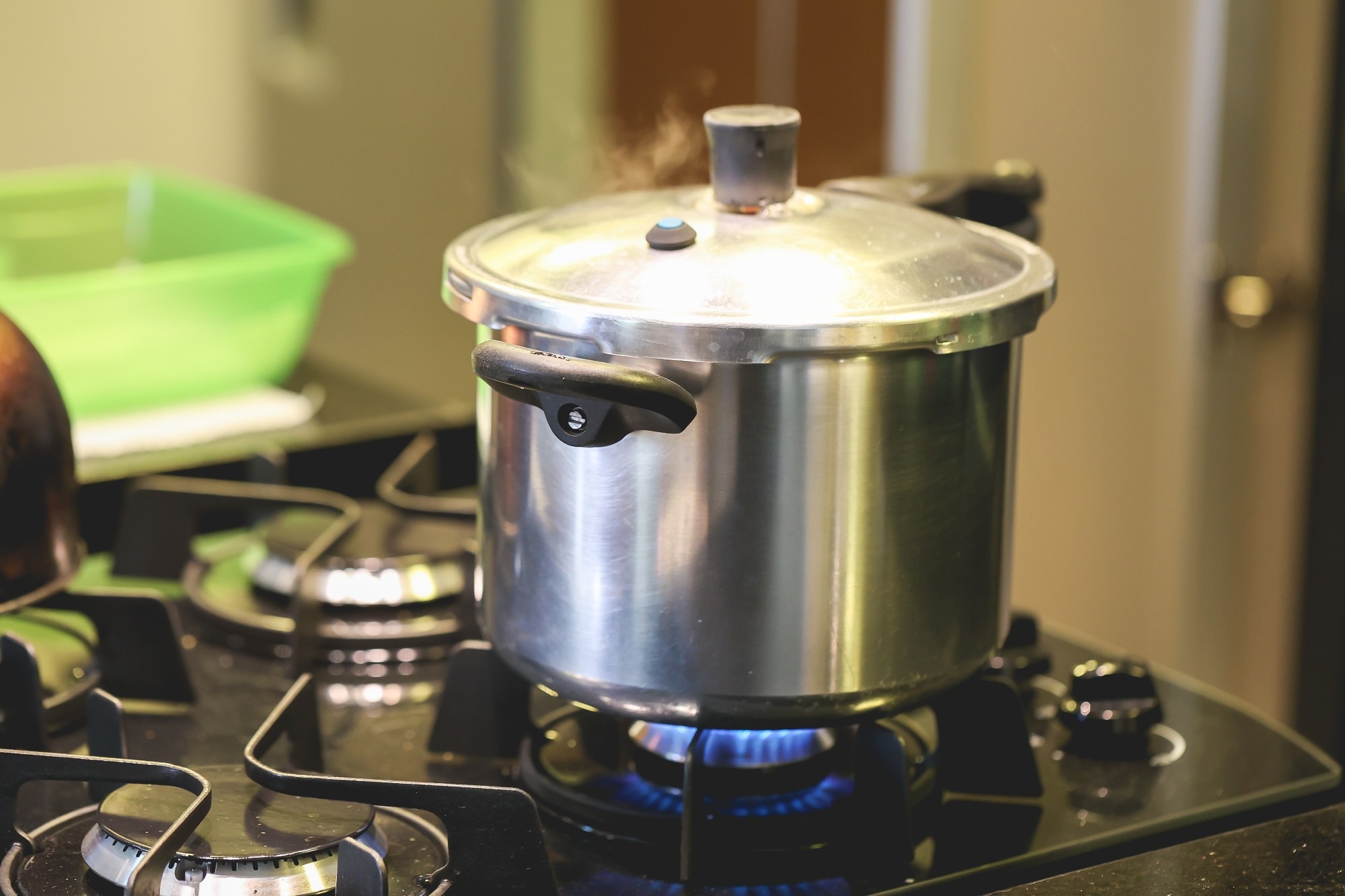 Image Credit: rafastockbr / Shutterstock.com
Pressure cooking vs. boiling
Comparative analyses suggest that the overall performance of both boiling and pressure cooking is highly dependent on the morphological and chemical structure of the raw food being cooked. Consequently, many studies compare these cooking methodologies on the same or similar food types to facilitate their direct comparison.
Pressure cooking results in significantly shorter cooking times, thereby limiting the temporal window for nutrient degradation.2 Whereas boiling requires high volumes of water that allow for solute migration, pressure cooking uses minimal water, which increases nutrient retention within the food matrix.2
Oxygen exposure is significantly higher in open-pot boiling, which promotes the oxidation of polyphenols. The sealed environment of a pressure cooker displaces oxygen through steam generation, thereby reducing oxidation.2
Taken together, these factors influence nutrient retention across various food groups differently. For delicate vegetables, boiling results in significant nutrient dilution, whereas pressure cooking minimizes leaching but requires precise timing to avoid thermal damage.1
For legumes, pressure cooking is considered unequivocally superior, as it breaks down flatulence-inducing oligosaccharides and stable phytates while preserving a higher total antioxidant profile than boiling.2 Traditional boiling of grains like white rice has been found to yield a glycemic index (GI) of approximately 21.6, whereas pressure cooking provides excellent mineral retention but may result in a higher rate of starch hydrolysis and higher GI.7,8
Other factors that influence nutrient retention
Food type and cellular structure often determine the baseline thermal resistance of raw foods. For example, dense root vegetables and legumes possess robust cellular walls that require the intense energy of pressure cooking for lysis.3
The duration and temperature of the selected cooking method are critical factors, as prolonged boiling results in greater losses than brief, high-temperature pressure-cooking. Preparation methods also impact nutritional outcomes, as chopping ingredients, for example, increases the surface area exposed to water and oxygen, thereby accelerating degradation. Conversely, soaking grains and legumes before cooking initiates the enzymatic breakdown of antinutrients and hydrates the matrix, thereby reducing cooking time and mitigating subsequent thermal damage.4,5
Conclusions
While both boiling and pressure cooking are nutritionally acceptable culinary practices, their nutritional outcomes depend heavily on the desired outcome and food matrix. Boiling remains an acceptable method for meals where the nutrient-dense cooking liquid is retained and consumed. However, for dense plant structures such as legumes and whole grains, pressure cooking is superior.
References
- Razzak, A., Mahjabin, T., Khan, M. R. M., et al. (2023). Effect of cooking methods on the nutritional quality of selected vegetables at Sylhet City. Heliyon 9(11); e21709. DOI: 10.1016/j.heliyon.2023.e21709. https://cell.com/heliyon/retrieve/pii/S240584402308917X
- Abubakar, S. O., Alabi, M. A., Ibrahim, R. B., et al. (2025). Pressure Cooking Triumphs: Maximizing Nutrient Bioavailability and Minimizing Flatulence Factors in Cowpea (Vigna unguiculata) Through Modern Culinary Techniques. Tropical Journal of Phytochemistry and Pharmaceutical Sciences 4(9). DOI: 10.26538/tjpps/v4i9.3. https://tjpps.org/index.php/home/article/view/238/270
- Vargha, S., Igual, M., Miraballes, M., et al. (2024). Influence of Cooking Technique on Bioaccessibility of Bioactive Compounds in Vegetable Lentil Soup. Foods 13(15); 2405. DOI: 10.3390/foods13152405. https://www.mdpi.com/2304-8158/13/15/2405
- Ghaffar, F., Mehmood, Z., Khurshid, H., & Sana, R. (2025). Influence of Wet Processing Techniques (Soaking, Boiling, and Pressure Cooking) on Phytic Acid Reduction, Mineral Retention, and Solubility in Common Beans Phaseolus Vulgaris L, VignaUnguiculata, Vigna Radiata, and Cicer Arietinum L. Indus Journal of Bioscience Research 3(4); 782-793. DOI: 10.70749/ijbr.v3i4.1168. https://ijbr.com.pk/IJBR/article/view/1168/1166
- Melini, F., Lisciani, S., Camilli, E., et al. (2023). Effect of Cooking on Phenolic Compound Content and In Vitro Bioaccessibility in Sustainable Foods: A Case Study on Black Beans. Sustainability 16(1); 279. DOI: 10.3390/su16010279. https://www.mdpi.com/2071-1050/16/1/279
- Bajo, W., Chambal, B., & Macuamule, C. (2026). Effect of processing methods on mineral bioaccessibility in common beans. Scientific Reports 16(1). DOI: 10.1038/s41598-025-34639-3. https://www.nature.com/articles/s41598-025-34639-3
- Sekarmuti, A., Rimbawan, R., & Nasution, Z. (2025). Effects of Cooking Techniques on the Nutritional Profile, Glycemic Index, and Sensory Evaluation of Rice: A Systematic Review. Preventive Nutrition and Food Science 30(5); 419-432. DOI: 10.3746/pnf.2025.30.5.419. https://www.pnfs.or.kr/journal/view.html?doi=10.3746/pnf.2025.30.5.419
- Chauhan, S., Kaur, H., Aggarwal, R., et al. (2024). Exploring the impact of cooking techniques and storage conditions on resistant starch levels in mung beans and their effect upon blood glucose level and lipid profile in vivo. Frontiers in Nutrition 11. DOI: 10.3389/fnut.2024.1424112. https://www.frontiersin.org/journals/nutrition/articles/10.3389/fnut.2024.1424112/full
Further Reading
Last Updated: Mar 25, 2026