New research links Amazon disease clusters to the region’s agrarian divide, showing how forest-linked livelihoods, mining, poverty, and large-scale agriculture shape where vector-borne threats overlap.
Study: Vector-borne disease co-occurrence is shaped by agrarian economy and socioenvironmental contexts in the Brazilian Amazon
In a recent study published in the journal Communications Earth & Environment, researchers investigated how ecological transformations and socioeconomic structures may shape the spatial co-occurrence of vector-borne diseases (VBDs) in the Brazilian Amazon.
Most of these VBDs, including dengue fever, malaria, and leishmaniasis, were introduced into the Brazilian Amazon from other continents during the period of its colonial occupation, except for Chagas disease. Social and environmental changes are crucial determinants of the VBD epidemiological landscape. Biodiversity, climate, and land use impact the distribution, competence, and behavior of vectors, reservoirs, and pathogens. VBDs also often converge in time and space due to overlapping risk factors and ecological niches.
In many cases, the co-occurrence reflects shared vector habitats or specific circumstances, such as poverty, poor sanitation, and deforestation, that increase the risk of exposure to pathogens. Notably, the spatial co-occurrence of VBDs has received limited attention, especially in studies linking disease clustering to land use and structural economic contexts. This highlights the need for ecosystemic health approaches to address multiple diseases concurrently.
The Study and Findings
In the present study, researchers evaluated how socioeconomic structures and ecological transformations were associated with the spatial co-occurrence of VBDs in the Brazilian Amazon. First, they aggregated data from 2015 to 2019 to identify patterns of disease co-occurrence and their drivers; data were acquired from the Technoproductive Trajectories (TTs) and Trajetórias datasets. During 2015–19, 1.28 million VBD cases were reported in the region.
Malaria and dengue accounted for 75% and 20.1% of all reported cases, respectively. Rural areas had substantially higher notification rates of Chagas disease, malaria, and American tegumentary leishmaniasis (ATL), while urban areas had higher rates of visceral leishmaniasis (VL). Dengue cases were not stratified by rural or urban setting in the dataset, although dengue is generally considered predominantly urban. Next, the team used a generalized linear latent variable model (GLLVM) to model the VBD distribution across municipalities. In the null model, which excluded predictors, same-state municipalities showed comparable VBD incidence.
Moreover, Chagas disease and malaria, as well as dengue and ATL, were likely to co-occur, whereas VL was isolated from other VBDs. In a model that included socioeconomic and environmental factors, the covariates explained nearly three-fourths of the covariance among VBDs. The model also reduced the residual correlation between VBDs within municipalities, both in urban and rural areas, especially for VL and Chagas disease.
High deforestation and rural poverty were strongly associated with the co-occurrence of urban and rural Chagas disease within municipalities. Larger river networks and secondary vegetation were associated with rural Chagas disease, whereas agricultural land, forest fragmentation, and mining activities were associated with urban Chagas disease. Municipalities with grain production, roads, fires, positive precipitation anomalies, and forest degradation had lower Chagas disease incidence.
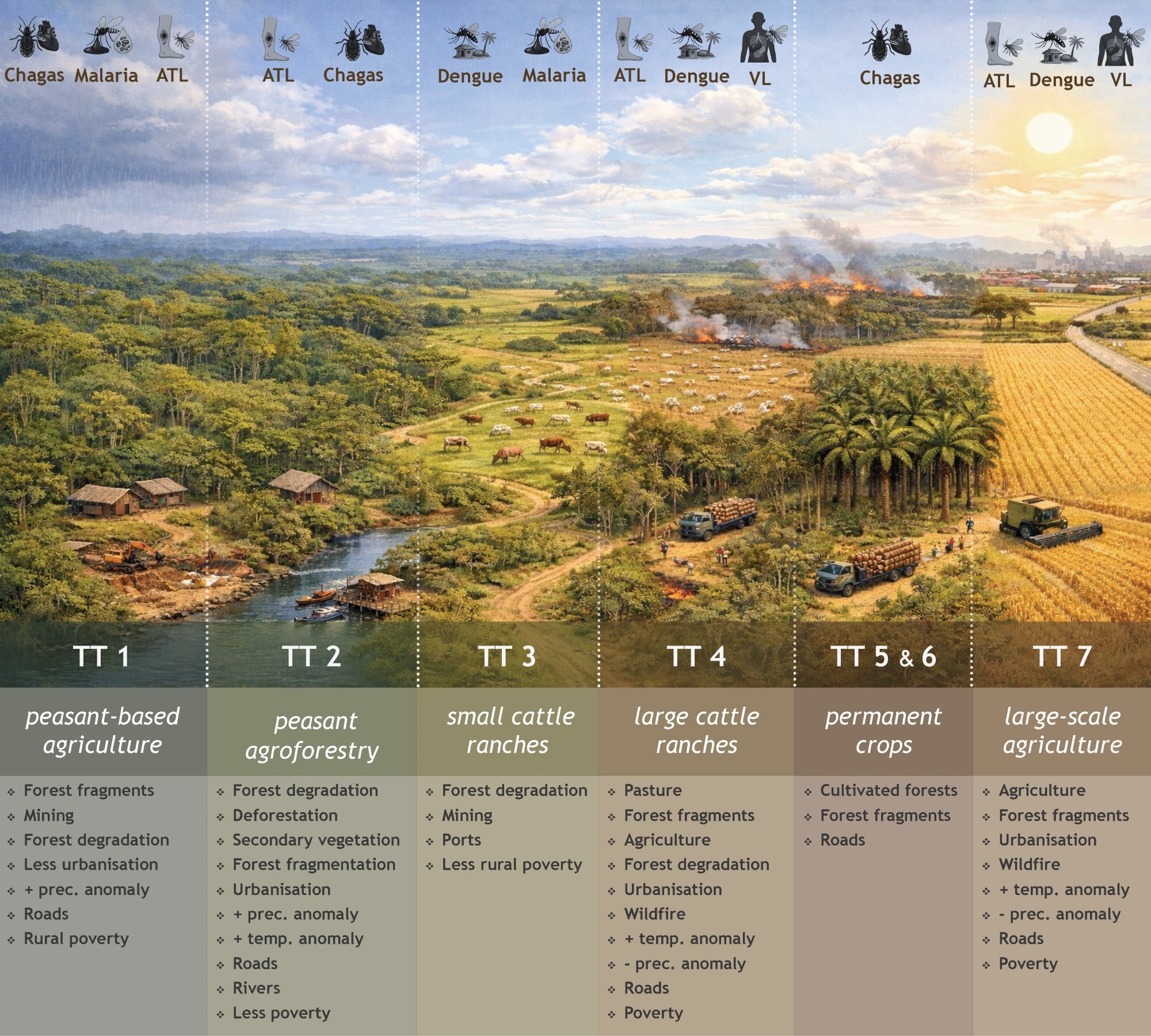
In urban and rural areas, mining activities, rural multidimensional poverty, and forest core areas were the shared associated factors for Chagas disease and malaria. Municipalities without both malaria and Chagas disease were characterized by cattle ranches and large-scale agriculture. Large-scale agriculture, forest core areas, and pasturelands were the shared associated factors for dengue and ATL. Next, the team assessed the geographical locations of VBD co-occurrence. Broadly, the patterns are separated into forest-linked malaria-Chagas landscapes and agricultural dengue-ATL landscapes.
A large hotspot of Chagas disease and malaria was identified across the Western Amazon region, with minor hotspots in northeastern areas, where mining activities and forest cover are dominant. A cold spot for malaria and Chagas disease was identified in the southeast Amazon region, dominated by grain production and cattle ranching-based economies. Most municipalities in the malaria-Chagas disease cluster (88%) were dominated by peasant-based agriculture and peasant agroforestry.
Furthermore, the southeast Amazon region showed a large hotspot of dengue and ATL, which partially overlapped with one coldspot of malaria and Chagas disease. Dengue and ATL coldspots also overlapped with the hotspots of malaria and Chagas disease. Notably, 97% of municipalities in the dengue-ATL cluster were dominated by livestock farming and agricultural exports.
Conclusions
In sum, economic scenarios, operationalized as TTs in the study, substantially influenced the observed biosocial conditions underlying VBD clustering in the Brazilian Amazon. Municipalities characterized by forest-linked peasant economies often had a higher reported incidence of Chagas disease and malaria, reflecting how forest-linked livelihoods, subsistence activities, and human contact with vector and reservoir habitats may sustain exposure risk rather than suggesting that forest conservation alone increases disease risk. In contrast, municipalities with ranching activities and large-scale farming were strongly associated with VL.
The co-occurrence of ATL with dengue and of malaria with Chagas disease suggests that some TTs create socioeconomic vulnerabilities or overlapping ecological niches that are conducive to different pathogens. However, because the analysis was ecological and conducted at the municipality level, the findings do not demonstrate individual co-infection, direct pathogen-pathogen interaction, or transmission coupling.
Overall, the findings highlight the importance of integrating environmental, climatic, and socioeconomic factors into a unified framework to understand and manage VBDs in the Amazon, and the need for place-based strategies beyond conventional, isolated disease-control efforts. The authors also noted limitations, including reliance on reported diagnosed cases, possible under-ascertainment, lack of rural-urban dengue stratification, aggregation across 2015–19, and the inability to capture seasonal or short-term disease dynamics.
Download your PDF copy by clicking here.
Journal reference:
- Barbosa M, Lana RM, Dal’Asta AP, et al. (2026). Vector-borne disease co-occurrence is shaped by agrarian economy and socioenvironmental contexts in the Brazilian Amazon. Communications Earth & Environment. DOI: 10.1038/s43247-026-03619-4, https://www.nature.com/articles/s43247-026-03619-4
 New funding backs pioneering research to make brain cancer treatment more effective