A national French survey finds that foods likely to contain live microbes may be useful markers of healthier, nutrient-rich eating patterns across childhood and adulthood.

Study: Association Between Dietary Live Microbes and Diet Quality Among Children and Adults in France. Image Credit: Kattecat / Shutterstock
In a recent study published in the journal Nutrition Bulletin, a group of researchers examined dietary exposure to foods likely to contain live microbes among French children and adults and evaluated their relationship with diet quality and sociodemographic characteristics.
Background
Did you know that nearly all surveyed children and adults in France consumed foods likely to contain medium or high levels of live microbes during a 3-day dietary assessment, yet their contribution to overall diet quality has rarely been examined?
Foods such as yogurt, unpasteurized cheese, fresh fruits, and raw vegetables can contain live microbes that may support digestive health, the gut microbiota, and normal metabolic function, although the present study did not directly test these health outcomes. These foods can also help increase nutrient intake and encourage healthy dietary habits, supporting a healthier overall lifestyle.
Different countries exhibit different consumption patterns for these foods, so it is critical for researchers and public health officials to understand how frequently people consume them and how they are associated with overall diet quality. Therefore, more research is needed to understand these dietary patterns across different populations.
About the study
The researchers analyzed dietary information from the third French Individual and National Food Consumption Survey (INCA3), a nationally representative cross-sectional survey conducted between 2014 and 2015 by the French Agency for Food, Environmental and Occupational Health and Safety (ANSES).
The study included 1,775 children aged 4 years and older and 2,121 adults aged 18-79 years who resided in mainland France. Dietary intake was measured using three non-consecutive 24-hour dietary recalls, including weekdays and weekends.
Participants aged 15-79 years self-reported intake during telephone interviews conducted by trained professionals, whereas children under 15 completed open-ended food records with caregiver assistance when needed.
Foods listed in the French Information Center on Food Quality (CIQUAL) database were classified into low, medium, or high levels of presumed live microbe content based on previously established criteria. Live microbe levels were estimated from food categories and preparation details rather than directly measured in each food item. Medium- and high-microbe foods were also analyzed together because both contributed meaningful dietary exposure.
The researchers evaluated consumption patterns by age group, gender, body mass index (BMI), socio-economic status, and household income. Diet quality was evaluated using the Program National Nutrition Santé Guideline Score 2 (sPNNS-GS2), the Mean Adequacy Ratio (MAR), which measures adequacy across 24 nutrients, and the Mean Excess Ratio (MER), which reflects excess intake of sodium, saturated fat, and free sugar.
Statistical analyses accounted for the complex survey design, and adjusted comparisons considered total energy intake, socio-economic status, income, and BMI to ensure representative national estimates.
Study results
During the survey period, nearly all participants consumed foods classified as having medium or high levels of live microbes. Overall, 97.7% of children and 98.4% of adults consumed foods classified as having medium or high live-microbe content. Of those, 81.1% of children and 91.7% of adults consumed medium levels of live microbes, whereas 88.5% of children and 88.2% of adults consumed high levels.
The average daily combined consumption of medium- and high-microbe foods was 166.8 g/day for children and 215.9 g/day for adults, indicating that these foods were widely reported in the French diet during the survey.
Raw fruits and vegetables accounted for the largest category of foods with medium levels of live microorganisms. By contrast, dairy products, especially yogurt and unpasteurized cheese, were the main sources of foods containing high levels of live microbes.
Among children, fruits and vegetables accounted for most medium-microbe food intake, whereas dairy products accounted for the majority of high-microbe food intake. Adults showed similar patterns of food consumption as children.
Older adults consumed statistically significantly greater amounts of both medium- and high-live-microbe foods than younger adults. Higher medium/high food consumption was also associated with higher income and higher socio-economic status; however, there were no statistically significant differences concerning sex or BMI.
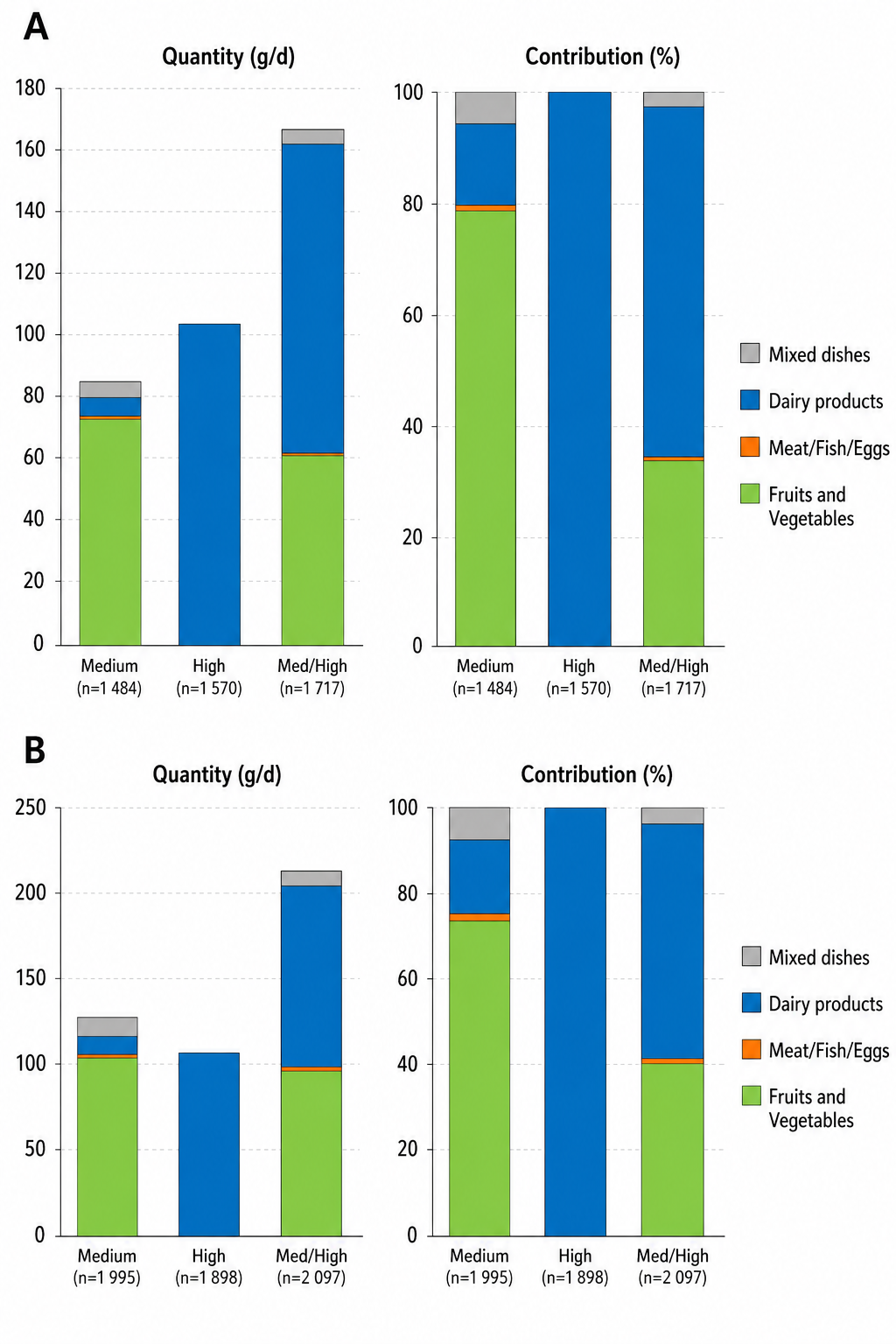
Mean consumption among children (A) and adult (B) consumers of Medium, High, and Medium/High foods by food groups in g per day and as percentage contribution to total intakes of Medium, High and Medium/High foods.
Although medium- and high-microbe foods contributed only 8.5% of daily energy intake among children and 10.7% among adults, they supplied substantial amounts of several essential nutrients. Adults obtained more than 20% of their total daily intake of calcium, vitamin A, vitamin D, myristic acid, lauric acid, saturated fat, and riboflavin from these foods every day.
Similar contributions were observed for vitamin D, calcium, myristic fatty acid, and vitamin A among children, demonstrating that these foods were relatively nutrient-dense despite contributing a modest share of daily calories.
Participants with the highest intake of medium- and high-microbe foods generally followed healthier dietary patterns. After adjustment for energy intake and sociodemographic factors, children and adults in the highest consumption group ate more fruits, vegetables, and dairy products while consuming fewer mixed dishes, sweetened foods, salty and fatty products, dairy desserts, and sugar-sweetened beverages.
Adults in this group also consumed more whole-grain cereals, fish, and crustaceans, whereas children consumed more pulses. Diet quality scores reflected these differences. Higher intake of medium- and high-microbe foods was associated with higher sPNNS-GS2 and MAR values, as well as lower MER values.
Higher consumers of medium- and high-fat foods were more likely to meet the recommended intakes for several nutrients. However, the authors noted that higher medium/high food intake was also linked with higher sodium exposure. Yogurt and cheese were the most frequently consumed fermented foods, whereas kefir, tofu, miso, sauerkraut, and fermented condiments were rarely consumed.
The authors cautioned that the study was cross-sectional and relied on self-reported 24-hour dietary recalls, including proxy reporting for younger children, so it cannot establish causal effects on diet quality or health. They also noted that live microbe exposure was estimated from food categories rather than directly measured, and that microbial content can vary by fermentation process, food handling, storage, and agricultural practices.
Conclusion
The researchers concluded that foods likely to contain medium or high levels of live microbes were widely consumed by French children and adults, with yogurt, unpasteurized cheese, fruits, and vegetables serving as the principal sources. They contributed a modest share of total daily energy intake but supplied substantial amounts of selected nutrients and were associated with a better overall diet quality. Participants with higher consumption of these foods tended to have healthier eating patterns and greater adherence to French dietary recommendations.
The findings suggest that foods likely to contain live microbes may serve as useful indicators of nutrient-rich diets within the French population, rather than evidence that these foods directly improve diet quality or health outcomes.
Want to read later? Download your PDF copy by clicking here.
Journal reference:
- Gazan, R., Maillot, M., Vieux, F., Poinsot, R., & Drewnowski, A. (2026). Association between dietary live microbes and diet quality among children and adults in France. Nutrition Bulletin. 51(2):245-257. DOI: 10.1111/nbu.70057, https://onlinelibrary.wiley.com/doi/10.1111/nbu.70057
 NIH awards $7.6 million grant to advance polyaminopathy research