People with strong muscles in their chest and back are less likely to have heart attacks, according to analysis of heart scans using artificial intelligence which was part-funded by the British Heart Foundation and led by the University of Edinburgh.
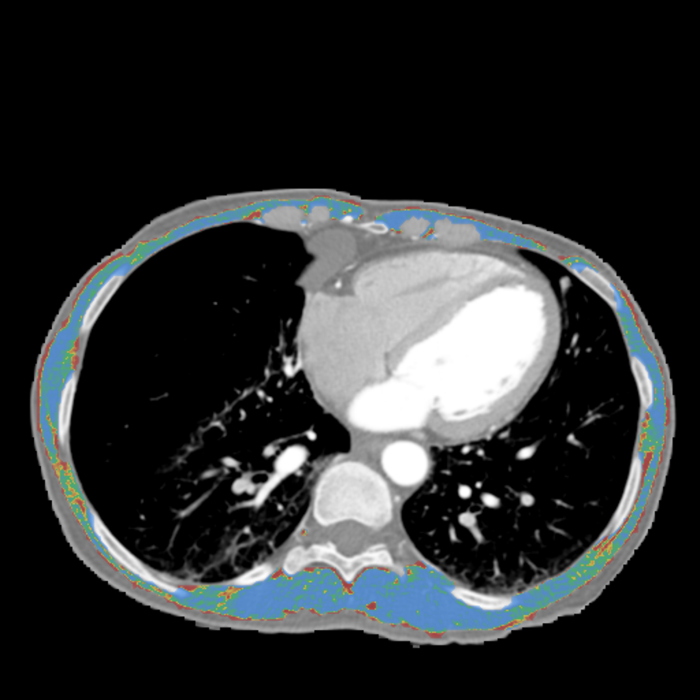 Image Credit: British Heart Foundation
The study, published in the journal Radiology, looked at routinely used heart scans, provided to 1,722 people, who were mostly in their fifties, and had chest pain.
The researchers discovered people with greater muscle density in their chest and back were less likely to have a heart attack or die in the decade after having the scan. They suspect people with this type of ‘good-quality skeletal ’muscle are those who exercise more and have greater strength in their torsos. The results suggest this could help to reduce the risk of having a heart attack or dying early.
Professor Michelle Williams, senior author of the study, has started going to the gym twice a week whenever possible, and tries to walk for an hour a day, because she found the study’s findings so compelling.
She said: “It is fascinating that people’s skeletal muscle could be linked to their risk of having a heart attack. The muscles which show up in the scans we used - coronary computed tomography angiogram scans – are principally the back muscles, part of the pectoral muscles (or ‘pecs’) and the intercostal muscles between the ribs.
“So I am now personally interested in exercises like cycling, planks and pilates, which I enjoy and may have an effect on these muscles. However we need far more research to better understand how exercise may affect muscle density, and how this may relate to heart health.”
Around 350,000 people have a CCTA scan in the UK each year to identify any narrowing or blockages in the coronary arteries that supply the heart muscle with blood, which may put them at risk of a heart attack.
In the study, researchers took a deeper dive into these scan images, using AI to examine people’s muscle, organs, bones and the fat within their upper bodies.
This included looking at skeletal muscle ‘attenuation’, which is the brightness or darkness of the muscle in a scan.
More dense muscle appears lighter in a scan image because more X-ray beams bounce off it. A brighter image indicates that someone has better quality, more dense muscle, which may contain a lower proportion of fat. This matters because fat within people’s muscle - which is much like the fat within Japanese Wagyu beef - has previously been linked to poor cardiovascular health.
The new study grouped people based on how their muscle appeared in scan images, and investigated rates of heart attacks and early deaths using their health records.
For every 10-point increase in scan brightness, indicating better quality muscle with less fat in it, a person was calculated to be 31 percent less likely to have a heart attack. They were also 39 percent less likely to die in the 10 years after having the scan.
This was seen, even after taking into account other factors which may increase people’s risk of heart attacks and death, including their age, sex and the amount of calcium which had built up in their arteries. The AI used in the study took no longer than a minute to measure the quality of someone’s muscle from a single scan. A radiologist would take several hours to do the same thing.
More evidence is needed on how people’s muscle quality may affect their heart health or risk of dying prematurely. The researchers say it is likely that people who exercise enough to have strong muscles in their upper body have a healthy lifestyle which protects their heart in other ways.
The researchers say all kinds of exercise, and not just strength-training, can improve muscle density. It is not simply about being muscly, as the size of people’s muscles was not linked to their risk of a heart attack or early death - suggesting it is the composition of the muscle which matters. Good-quality muscles in the chest and back, which the study examined, are likely to reflect good muscle quality throughout the body.
The results suggest that routine heart scans could in future be used to identify people with less good-quality muscle who may be at greater risk of heart attacks. These higher risk people could then be helped to exercise more, be monitored more closely, or prioritized for drugs such as statins, which can reduce the risk of a heart attack. However more research is needed before scans could be relied upon in this way.
The amount of fat in people’s torsos and liver, which the researchers also examined, were not significantly linked to people’s risk of a heart attack.
Artificial intelligence can rapidly reveal information buried in scan results which provides a more detailed picture of our health than ever before."
Bryan Williams OBE, Professor, Chief Scientific and Medical Officer, British Heart Foundation
“It is likely that people in this study with more dense muscle mass were more physically active and as a result may have better heart health. That is yet more evidence supporting the power of exercise.
“Every time we move, we are making a positive difference to our muscles, our blood vessels and our overall health, and regular exercise can reduce the risk of cardiovascular disease by up to a third.”
This October, women can put the benefits of strength training into practice by taking on the BHF’s Strong Woman Challenge.
The free 31-day challenge is designed by women, for women, and offers expert support, daily exercises and video demonstrations to help participants build strength while raising funds for lifesaving cardiovascular research.
 Research makes strong case for broader use of GLP1 drugs to protect hearts