Madrid data reveal that the timing of NO2 exposure matters, with pollution-related birth risks shifting across pregnancy and appearing more pronounced for some women with lower educational attainment.
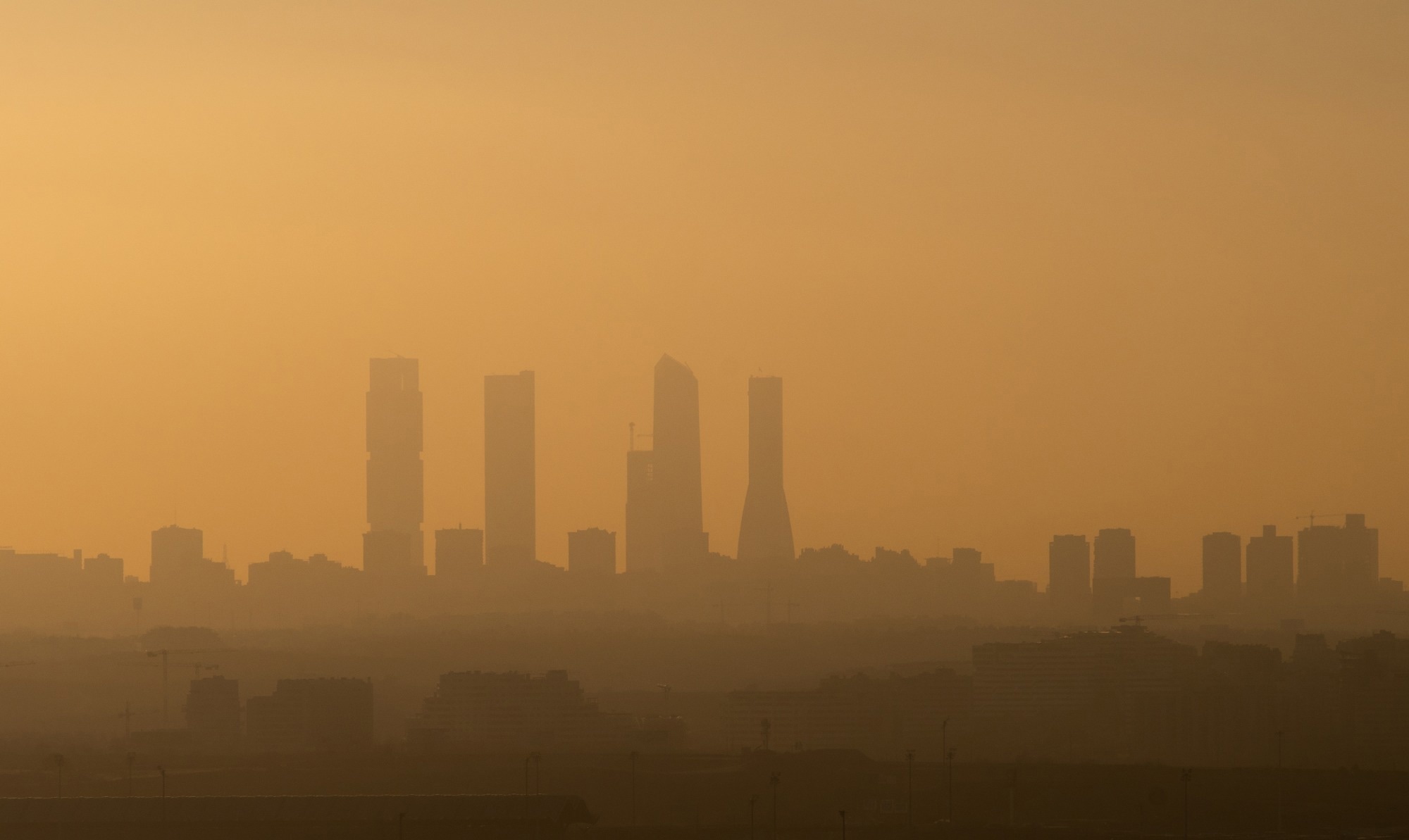
Madrid Business Area skyscrapers with air pollution during sunset. Image Credit: Marcos del Mazo / Shutterstock. Study: Air pollution implies unequal threats to adverse birth outcomes across maternal educational levels in Madrid, Spain
A population-based study from Madrid, Spain, published in the journal Scientific Reports, found that exposure to higher levels of nitrogen dioxide (NO2) during pregnancy was associated with distinct adverse birth outcomes at different stages of pregnancy, with important patterns emerging in the first and third trimesters. Adverse effects may be greater among women with lower education.
Background
Air pollution, the contamination of the atmosphere by chemical, physical, or biological agents, is an ongoing exposure for 99% of the global population and puts them at risk for illness.
Air pollutants comprise a mix of chemicals, mainly particulate matter (PM2.5 and PM10), nitrogen dioxide (NO2), ozone (O3), sulfur dioxide (SO2), and carbon monoxide (CO). Each of these has been linked to cardiovascular and respiratory disease, metabolic syndrome, and lung cancer. Their levels are therefore monitored worldwide, with public health agencies providing recommended air-quality thresholds for each.
In developed countries, most air pollution arises from road traffic and power plants, with secondary contributions from industries and home heating. NO2 is often used as a marker of traffic-related air pollution.
As with other air pollutants, exposure to NO2 in pregnancy has been associated with low birth weight (LBW) and prematurity. Such infants experience worse health outcomes over the long term, with high societal and economic costs.
However, the findings remain inconsistent, perhaps because there is little data on the impact of differences in timing of exposure in pregnancy, and of maternal socioeconomic context. Multiple studies support the importance of factoring in socioeconomic context since this substantially alters the associations with birth outcomes.
However, the authors note significant difficulties in ensuring adequate representation of women with lower socioeconomic status, which are often not accounted for in the study design. This ignores or incompletely accounts for heterogeneity between participants as a major confounding factor.
NO2 may induce oxidative stress, causing damage to the placenta via inflammatory and oxidative injury. It has been linked to LBW and preterm birth, but its causal role remains to be established.
Study characteristics
The current study examined associations between NO2 levels during pregnancy and LBW, prematurity, and high birth weight (HBW) using population register data on births in Madrid, with a final analytical sample of 26,582 live singleton births. The mothers’ residences were linked to NO2 levels in their respective districts using air pollution monitoring data.
While the Madrid region is the wealthiest in Spain by gross domestic product (GDP) per capita, and Madrid City is among the country’s wealthiest municipalities, pockets of poverty exist. Moreover, it has high NO2 levels surpassing both international and European limits, and has the highest NO2-attributable mortality among European cities. Winter levels of NO2 are even higher.
The researchers assessed exposure separately for each trimester of pregnancy and stratified analyses by maternal educational level. They measured mean NO2 levels and, in robustness analyses, also assessed the number of days with concentrations exceeding World Health Organization (WHO) recommendations.
Variation in pollution levels
Southern districts and those located alongside the main motorway encircling the town center had higher pollution levels compared to the North irrespective of measure used. Conversely, some of the wealthiest and best-educated districts were the most polluted.
Descriptively, districts with lower socioeconomic status and with higher NO2 levels had poorer birth weight and prematurity outcomes, but with far from universally consistent patterns.
Whole-pregnancy NO2 exposure
LBW and prematurity rates varied widely across districts. Higher NO2 exposure was linked only to an increased risk of prematurity.
Trimester-specific exposure and LBW
First-trimester exposure was associated with a lower risk of LBW, compared to a higher risk with third-trimester exposure. There was no significant association in the second trimester.
The authors suggest that the apparent protective effect in the first trimester might reflect live-birth bias. That is, pregnancies more severely affected by air pollution may be less likely to survive to live birth, leaving a selectively healthier group among observed births at higher exposure levels.
Future studies are required to directly test this hypothesis, which remains plausible yet speculative. The authors could not observe pregnancies that did not result in live birth and therefore could not directly test this mechanism.
Exposure and prematurity risk
Exposure in the first and second trimesters showed evidence of a higher prematurity risk, although statistical support was stronger for the first trimester, but not in the third.
Exposure and HBW risk
Evidence suggested an increased HBW risk only in association with third-trimester exposure.
Maternal education and exposure
When adjusted by maternal education (as a marker of maternal socioeconomic status), there were no substantial changes in the trimester-specific associations between NO2 exposure and birth outcomes.
Predicted prematurity risks were higher among women with lower education in some trimester-specific analyses, although education-by-pollution interactions were not consistently significant. However, at higher NO2 exposures, some educational differences diminished.
Maternal education moderated the association between LBW and air pollution across the whole pregnancy. Predicted probabilities also suggested that any educational advantage diminished at higher pollution levels. For whole-pregnancy exposure, the pollution-by-education interaction was significant for LBW but not prematurity or HBW.
Interaction model
The interactive model was used to detect the effect of education on the risk posed by pollution. In the third trimester, the NO2-by-education interaction terms were not statistically significant for any of the three outcomes, despite trends towards a higher risk of LBW and prematurity among less-educated women, while NO2 exposure remained significantly associated with HBW in this model.
Probability analysis suggests that air pollution in the third trimester is more problematic for less educated women compared to those with a university degree, possibly increasing the risk of LBW and prematurity. These predicted differences should therefore be interpreted cautiously.
Although higher pollution levels generally showed associations with an increased risk of adverse outcomes across all groups, mothers with higher educational attainment appeared less vulnerable to some of these associations. However, this apparent advantage diminished beyond a certain level of pollution exposure and was significant only in certain trimester-outcome contexts.
With further sensitivity analyses, the researchers found generally corresponding results, except when maternal immigrant status was used as an alternative socioeconomic indicator. Migrant-origin babies appeared less affected than native-origin babies with respect to LBW, migrant status did not moderate the association with prematurity, and third-trimester pollution was associated with a greater increase in HBW risk among migrant-origin newborns.
Limitations
The study has several limitations. Data on lifestyle or maternal health conditions were not available, nor were individual maternal or biological NO2 exposures directly measured; exposure was instead estimated from district-level monitoring stations. The effects of other individual air pollutants were not directly assessed, nor could the authors measure other sources and types of pollution, including indoor pollution, noise, temperature, or exposure occurring outside the residential district, such as at work.
However, prior research cited by the authors indicates that other environmental exposures, including indoor factors, extreme temperatures, and noise, may also contribute to adverse perinatal outcomes, particularly when socioeconomic status is considered.
Without data on spontaneous miscarriage, the authors could not demonstrate that live birth selection bias was operating.
Conclusion
The authors conclude that the effects of air pollution vary according to both the stage of pregnancy and the birth outcome. The authors discuss several plausible mechanisms through which air pollution may affect fetal development and growth through inflammatory and oxidative stress, leading to placental dysfunction and reduced nutrient supply.
Macrosomia, often associated with HBW, may also result from gestational diabetes and the authors note that previous research has linked air pollution exposure with gestational diabetes, although gestational diabetes was not measured in the present study.
As such, the authors suggest that “current limitations are clearly insufficient to protect the most disadvantaged subgroups in the population, who are incidentally those who would benefit the most from a stricter enforcement.” Thus, reducing air pollution exposure, particularly among socio-economically disadvantaged populations, could help improve perinatal health outcomes.
Journal reference:
- Bello-Iglesias, N., & Salazar, L. (2026). Air pollution implies unequal threats to adverse birth outcomes across maternal educational levels in Madrid, Spain. Scientific Reports. DOI: 10.1038/s41598-026-65110-6, https://www.nature.com/articles/s41598-026-65110-6
 Prenatal paracetamol exposure linked to smaller ovaries in daughters