A WEHI-led project has received $7 million in Australian Government funding to expand the nation’s drug discovery capabilities and accelerate the translation of breakthrough research into new therapies.
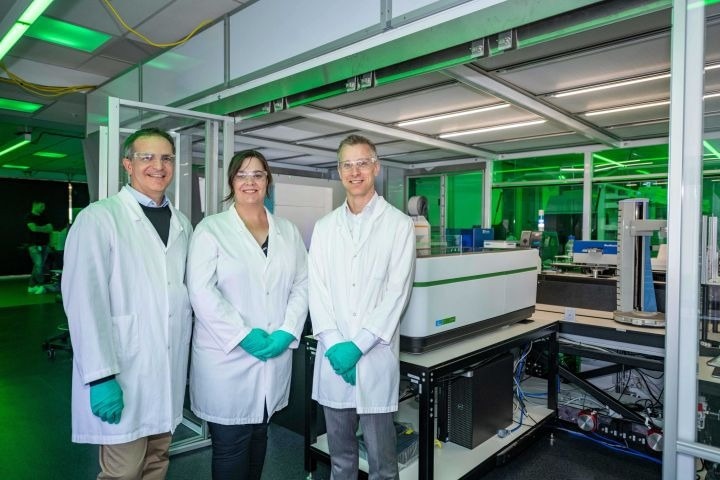 Professor Guillaume Lessene, Associate Professor Kym Lowes and Professor Jeff Mitchell at the National Drug Discovery Centre, the focal point of a new $7 m MRFF funding grant set to strengthen Australia's drug discovery capacity. Image Credit: WEHI
The Medical Research Future Fund (MRFF) investment will give researchers across the country greater access to world-class screening technologies, bridging a critical gap between scientific discovery and new medicines.
Delivered through a collaboration between WEHI, the Bio21 Institute and Therapeutic Innovation Australia, the project will expand the National Drug Discovery Centre – Australia’s premier small-molecule screening facility and a critical component of the nation's drug discovery infrastructure.
Combined with approximately $3.6 million in co-investment from WEHI, the initiative represents a $10.6 million investment in Australia's future drug discovery capability.
At a glance
- WEHI-led project receives a $7 m MRFF grant to accelerate the development of new treatments across a broad range of diseases and conditions with unmet need.
- The funding will expand the National Drug Discovery Centre’s capacity to provide Australian researchers with access to its specialized infrastructure, helping to transform promising discoveries into potential new treatments faster.
- The project is delivered through a collaboration between WEHI, the Bio21 Institute and Therapeutic Innovation Australia.
Addressing a critical challenge
Identifying viable drug candidates is one of the most important steps in the drug discovery pipeline. They serve as the starting point for developing future treatments that can potentially improve and save lives.
Yet this step remains a challenging process in Australian medicine development, as researchers often lack access to the specialized infrastructure needed to efficiently identify potential drug compounds.
The WEHI-led project aims to remove that bottleneck by giving researchers unprecedented access to advanced high-throughput and virtual screening technologies capable of rapidly searching millions of drug candidates.
Chief Investigator Professor Guillaume Lessene said this would strengthen Australia's sovereign capability to translate our world-class research into health outcomes that could potentially improve lives.
Our researchers deserve better access to the advanced tech needed to turn their promising discoveries into future medicines.”
Lessene, Professor, Division Lead and Associate Director of Therapeutic Discovery, WEHI
“This project will provide researchers with the tools they need to build a stronger national drug discovery pipeline – one that can deliver better outcomes for patients, grow Australia's biotechnology sector and reinforce our position as a global leader in medical innovation.
“In doing so, we will empower researchers to pursue ambitious programs that may previously have been beyond reach.”
This project received grant funding from the Australian Government.
Strengthening a national capability
The project will enhance national infrastructure and implement the Discovery Access program at the National Drug Discovery Centre (NDDC) to provide greater access to high-tech screening platforms.
Established in 2020 and based at WEHI, the NDDC enables Australian researchers to use its high-capacity robotic drug discovery technologies typically found only in major pharmaceutical companies. Since launching, the center has screened over 10 million compounds across more than 30 research projects.
The Discovery Access program will provide researchers from universities, medical research institutes and small-to-medium enterprises with subsidized access to specialized screening technologies.
Through the program, researchers will be able to screen more than 20 million virtual compounds and 300,000 physical compounds, dramatically expanding the scale and speed of Australian drug discovery.
Joint Head of the NDDC, Associate Professor Jeff Mitchell, said this expansion will cement Australia's position as a global biomedical innovation leader.
“It will play a critical role in ensuring groundbreaking discoveries made in Australian laboratories have the best possible chance of turning into treatments made on Australian soil,” Assoc Prof Mitchell said.
Associate Professor Kym Lowes, co-head of the NDDC, said: “Our collaborative approach will accelerate the development of treatments for diseases with significant unmet medical need, helping move discoveries from the laboratory towards clinical application more quickly.”
This project received grant funding from the Australian Government. The funding has been awarded through the MRFF National Critical Research Infrastructure grant opportunity.
Over the next three years, the expanded NDDC is expected to support at least nine nationally selected screening projects, helping Australian researchers uncover the next generation of drug candidates and accelerate the development of future treatments for patients.
 AI-powered PeptiVerse could accelerate peptide drug discovery