While deaths from several alcohol-attributable conditions have fallen globally, one cancer followed a strikingly different trajectory during the pandemic years.
Study: Global and national trends in alcohol-attributable deaths from 1990 to 2023 and projections to 2050. Image Credit: Explode / Shutterstock
In a recent study published in the journal npj Science of Food, researchers used data from the Global Burden of Disease (GBD) 2023 study to investigate global, regional, and national trends in alcohol-attributable mortality from four specific conditions (1990 to 2023). The study evaluated these mortality patterns across 204 countries and territories. It further assessed temporal shifts in alcohol-attributable mortality trends coinciding with the COVID-19 pandemic. Finally, trend data were modeled to estimate future alcohol-attributable mortality rates through 2050.
Researchers found that, while global mortality rates for alcohol-attributable cirrhosis, alcoholic cardiomyopathy, and alcohol use disorders declined over the thirty-four years under investigation, alcohol-attributable liver cancer mortality increased. Further investigation revealed that the pandemic period coincided with a sharp reversal in liver cancer trajectories. Before the COVID-19 pandemic, alcohol-attributable liver cancer rates were in decline, but increased during 2020–2023.
The findings emphasize an urgent need for disease-specific surveillance and strengthened cancer screening pathways, alongside tailored interventions addressing alcohol-attributable harm and sex-specific vulnerabilities.
Background
Alcohol consumption has long been recognized as a major preventable cause of global premature mortality and morbidity. Public health reports estimate that in 2019 alone, alcohol-related liver disease accounted for approximately 11 million lost life-years globally, highlighting its substantial global health burden. Alcohol consumption is causally associated with conditions including cirrhosis, cardiomyopathy, and hepatocellular carcinoma.
The COVID-19 pandemic produced severe societal disruptions and psychological distress, alongside major lifestyle changes and changes in alcohol consumption. Reports during the pandemic also described shifts toward solitary, home-based drinking patterns, providing context for interpreting subsequent mortality trends.
Reports from several high-income settings documented pandemic-related changes, including increased alcohol sales in Canada and increases in alcohol-attributable or alcohol-specific deaths in national statistics. However, whether these changes persisted into the later pandemic and recovery period, and how mortality trajectories differed across countries and conditions, remained unclear because comprehensive global evaluations were limited.
Consequently, public health authorities lacked an updated assessment to elucidate how socio-demographic development and pandemic disruptions were associated with condition-specific alcohol mortality burdens.
About the study
The study aimed to address this knowledge gap and inform future public health strategies by tracing global trends in alcohol-attributable mortality both before and after the onset of the pandemic. The dataset was obtained from the Global Burden of Disease (GBD) 2023 study and covered the period from 1990 to 2023 (34 years).
The dataset was analyzed at regional, national, and global geographic scales. The analyses focused on four primary alcohol-attributable causes of death: 1. Alcohol-attributable liver cancer, 2. Alcohol-attributable cirrhosis, 3. Alcoholic cardiomyopathy, and 4. Alcohol use disorders.
Statistical models were used to compute the temporal trajectories of the endpoints under investigation, using age-standardized mortality rates (ASRs per 100,000 individuals) and estimated annual percentage changes (EAPCs). Joinpoint regression models were used to subsequently identify critical inflection points. EAPCs were also examined in relation to baseline ASR in 1990 and the Human Development Index (HDI) and the Socio-Demographic Index (SDI) in 2023.
Finally, the study leveraged Bayesian age-period-cohort (BAPC) models to project alcohol-attributable mortality rates through 2050.
Study findings
GBD estimates indicated that 637,780 alcohol-attributable deaths across the four conditions analyzed occurred globally in 2023. This mortality specifically comprised deaths from cirrhosis (n = 308,829), alcohol use disorders (n = 171,585), liver cancer (n = 95,054), and alcoholic cardiomyopathy (n = 62,312).
At the national level, Mongolia was found to record the highest ASR for both liver cancer (20.60 per 100,000) and alcohol use disorders (24.64 per 100,000). Turkmenistan logged the highest cirrhosis mortality (19.55 per 100,000). Latvia recorded the highest ASR for alcoholic cardiomyopathy, at 14.69 per 100,000. Notably, geographic analyses identified significant variation across the 204 countries and territories included in the dataset.
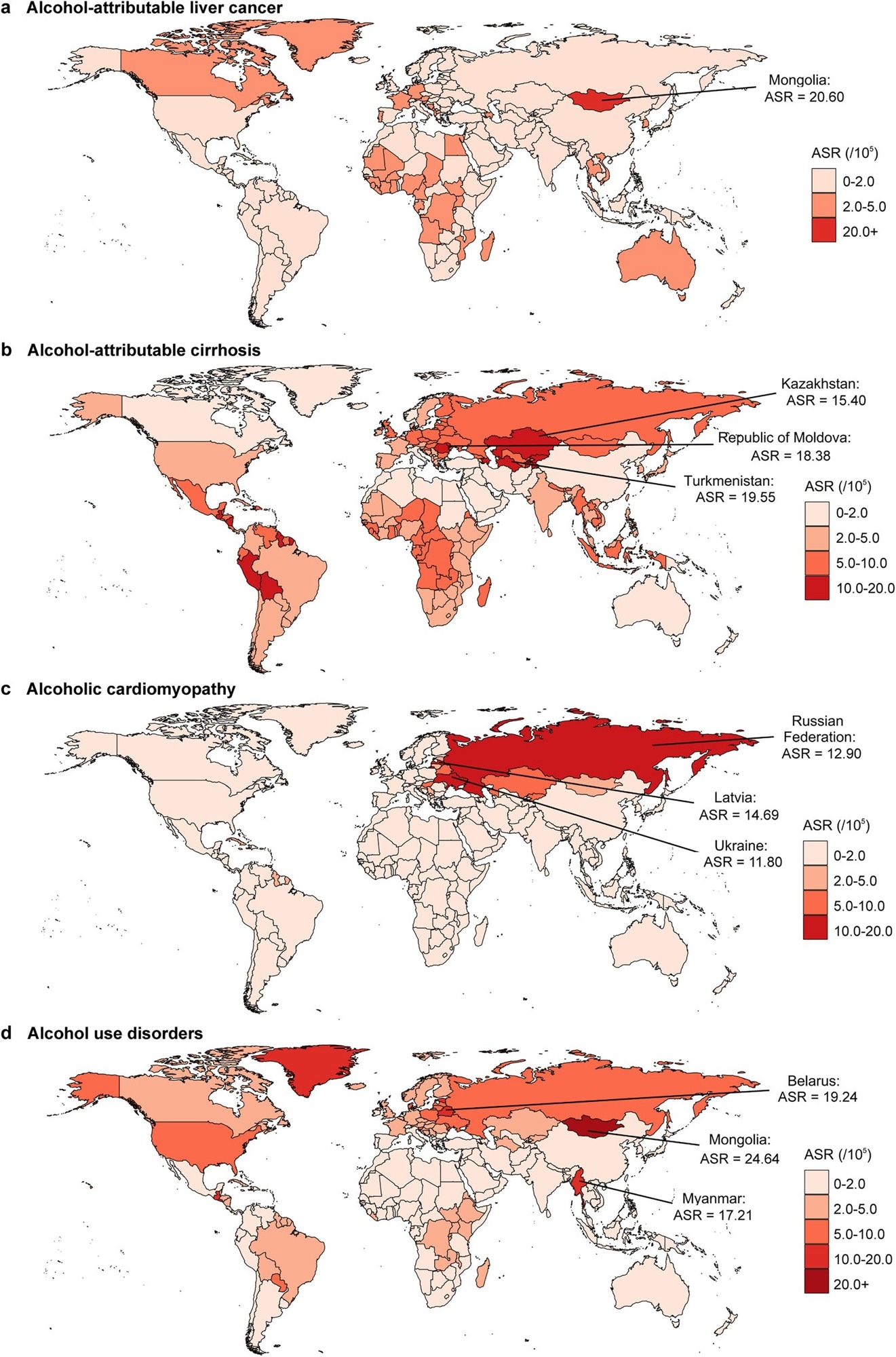
Age-standardized mortality rate of alcohol-attributable conditions in 2023 across different countries and territories. These conditions include alcohol-attributable liver cancer (a), alcohol-attributable cirrhosis (b), alcoholic cardiomyopathy (c), and alcohol use disorders (d). ASR = age-standardized mortality rate.
From 1990 to 2023, the global ASR for alcohol-attributable liver cancer increased slightly from 0.95 to 1.03 per 100,000 (EAPC = 0.07). Concurrently, mortality rates for cirrhosis (EAPC = -1.20), cardiomyopathy (EAPC = -2.38), and alcohol use disorders (EAPC = -1.79) demonstrated long-term global declines. Across the full study period, however, alcohol-attributable liver cancer mortality declined among females (EAPC = -0.18), while the male rate was broadly stable to slightly increasing.
The analyses also identified a temporal inflection that coincided with the pandemic period. Global alcohol-attributable liver cancer mortality was observed to reverse from a pre-pandemic decline (EAPC = -0.74 during 2016–2019) to an increase (EAPC = 1.73 during 2020–2023). During 2020–2023, alcohol-attributable liver cancer mortality increased by an estimated 2.73% per year among females and 1.47% per year among males, representing a larger shift from the 2016–2019 trajectory among females.
Finally, the study’s BAPC models projected that by 2050, global liver cancer mortality would rise to 3.02 and 0.98 deaths per 100,000 in men and women, respectively. Although the absolute rate remained higher in men, the projected relative increase was greater among women. Mortality from the other three conditions was projected to remain stable or decline. The authors cautioned that these long-term estimates have widening uncertainty and should be regarded as indicative scenarios conditional on current trends rather than precise forecasts.
The authors also stressed that the study was based on ecological analyses of model-derived GBD estimates rather than individual-level data and therefore cannot establish causation. For liver cancer and cirrhosis, these figures represent modeled alcohol-attributable burden rather than confirmed alcohol-exclusive cases. Estimates for recent years, such as 2023, also rely more heavily on modeling due to gaps and delays in cause-of-death data.
Conclusions
The study reveals that the global burden of alcohol-attributable mortality across the four conditions examined is geography- and context-specific and impacts men and women differently. The authors suggested that possible contributors to the observed pandemic-period reversal in liver cancer mortality included disruptions in cancer screening, diagnostic and treatment delays, and altered drinking habits. However, because liver cancer typically develops over decades, the authors considered it biologically implausible that pandemic-related changes in alcohol consumption alone could explain mortality changes observed by 2023.
 Single-cell analysis reveals how pancreatic cancer evades treatment