Distinct eating patterns emerged among pregnant women, alongside striking differences in maternal health and subtler signals in how babies grew before birth.

From mother’s plate to newborn’s health: dietary patterns and pregnancy outcomes - a cohort study. Image Credit: Natalia Deriabina / Shutterstock
A recent study published in the European Journal of Clinical Nutrition found that dietary patterns during pregnancy were associated with maternal characteristics, including BMI and gestational weight gain, as well as selected infant birth outcomes.
Background
Maternal nutrition during pregnancy is important in determining the health of both the mother and the fetus or infant. Beyond short-term effects, poor nutrition is associated with an increased risk of non-communicable diseases (NCDs).
NCDs are leading causes of death worldwide, with cardiovascular disease, cancer, respiratory disease, and diabetes among the major contributors. Diet is a major modifiable risk factor and plays an important role in the prevention and management of many NCDs.
Dietary factors during the prenatal period can have lasting effects, making this period critical. In studying such associations, dietary patterns may better reflect the range of nutritional inputs than single-nutrient analyses.
Cluster analysis and similar approaches have shown that healthy dietary patterns include higher intake of fruit and vegetables, whole grains, and nuts. They are relatively low in red and processed meats, sugar-sweetened foods, and refined grains.
Healthier dietary patterns, including the Mediterranean diet, have been linked to lower risks of excessive gestational weight gain, preterm delivery, and low birth weight. Other health-conscious dietary patterns have also been associated with differences in SGA and LGA risk, although findings vary between populations. Unhealthy diets are characterized by high levels of sugar and saturated fat and a high proportion of ultra-processed foods (UPFs). The latter, as defined by the NOVA classification, are linked to overconsumption of dietary energy and overweight and obesity.
Prepregnancy obesity is associated with a higher risk of preterm delivery, and among term infants, higher mean birth weight, large-for-gestational-age (LGA), and small-for-gestational-age (SGA) are all more common.
Gestational weight gain is a proxy for maternal nutrition in pregnancy. Very low and very high weight gain are linked to poorer infant outcomes, including abnormalities in birth weight.
Notably, dietary patterns interact with other lifestyle factors, including BMI, socioeconomic status, and maternal age. Socioeconomic status, cultural norms, and the food environment can influence access to healthy foods and the ability and motivation to follow dietary recommendations.
Yet evidence on population-specific maternal dietary patterns in pregnancy and their associations with fetal growth and birth outcomes remains limited and partly inconsistent.
Study characteristics
The current study examined associations between maternal dietary patterns and maternal and infant characteristics, aiming to provide evidence to support nutritional recommendations during pregnancy. It included 1,404 pregnant women participating in the LIFE Child cohort, a long-term cohort study conducted in Germany between 2011 and 2025. Neonatal data were available for 1,196 newborns.
The researchers used hierarchical clustering to identify four different dietary clusters. They then assessed differences in maternal and infant parameters between the clusters.
These included:
- Mixed diet – cluster 1 (C1)
- Traditional bread-based – cluster 2 (C2)
- High-UPF – cluster 3 (C3)
- Vegetable-rich – cluster 4 (C4)
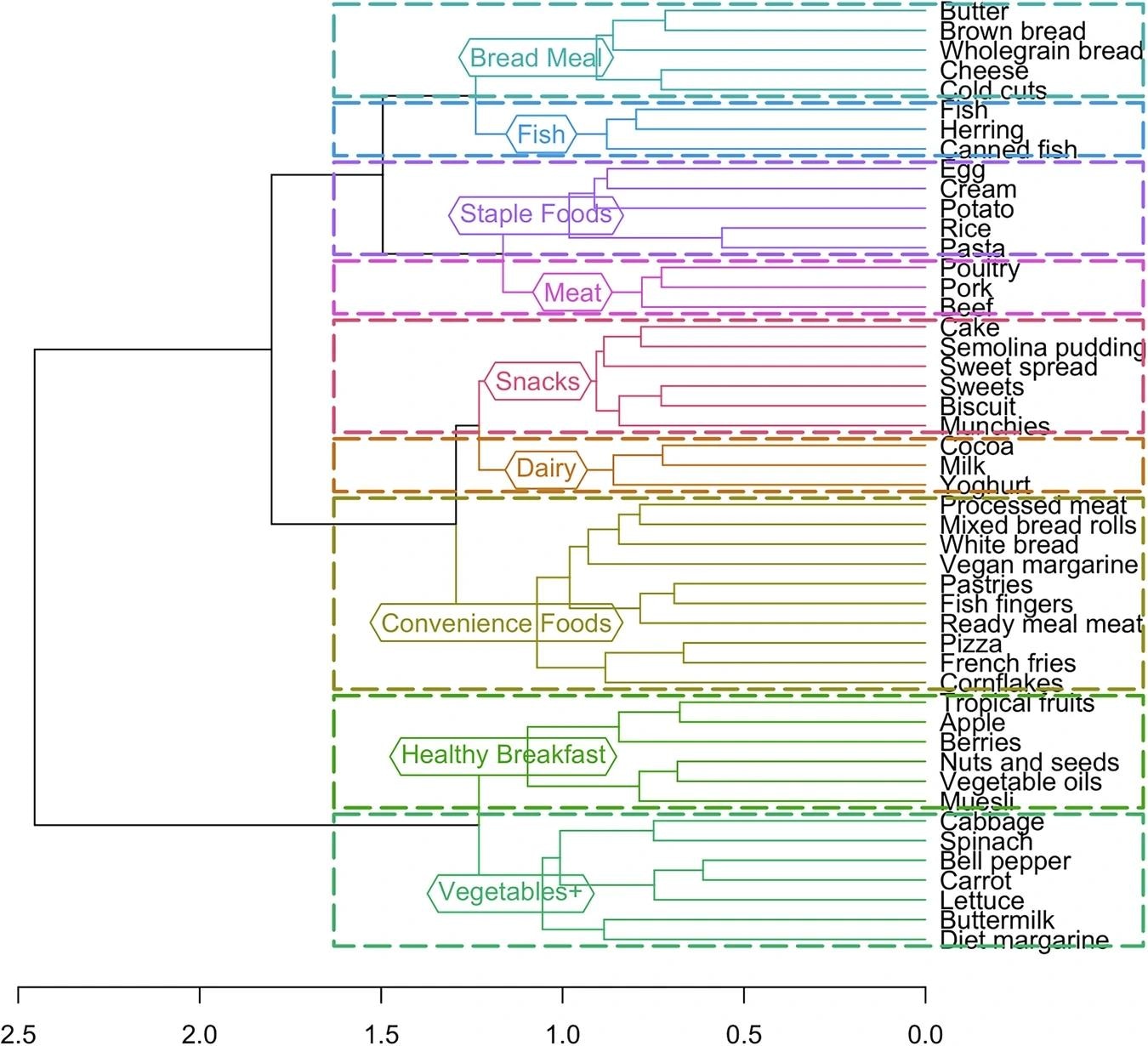
Hierarchical clustering of food items. The dendrogram shows the grouping of individual food items using Ward’s method based on Euclidean distances. Colored branches and dashed boxes indicate the nine identified food-item clusters: Bread Meal, Fish, Staple Foods, Meat, Snacks, Dairy, Convenience Foods, Healthy Breakfast, and Vegetables+.
Dietary patterns and maternal characteristics
Women in C3 were younger than those in other clusters and had the lowest mean socioeconomic status, the highest mean BMI before pregnancy, and the highest mean gestational weight gain. Conversely, women in C4 had a higher mean age, a higher socioeconomic status, and a lower mean prepregnancy and early-pregnancy BMI. Their gestational weight gain was lower than in C3, although it was not the lowest across the four clusters.
Dietary patterns and infant characteristics
Among neonatal outcomes, some of the clearest differences involved C4, with a higher mean gestational age at birth. This association weakened when adjusted for maternal age and educational status.
In this study, 4.4% of infants were born SGA and 11% LGA. SGA prevalence ranged from 3.2% in C1 to 6.1% in C3. Although SGA was more common in C2, C3, and C4 than in C1, none of these differences were statistically significant.
Mean birth weight was similar across clusters. Nonetheless, the authors highlight the direction and consistency of the associations, despite their lack of statistical significance.
The highest gestational-age-adjusted birth length was observed in C4 infants and was significantly greater than in C2 infants. After adjustment for maternal age and education, birth length remained significantly greater in C4 than in both C1 and C2.
Limitations
The authors note that the relatively low prevalence of adverse infant outcomes reduced statistical power to detect differences. The researchers used a single dietary assessment at one point in pregnancy, which may not capture changes in dietary habits over the whole pregnancy or from before to during pregnancy.
Self-reported dietary assessments may introduce measurement error and recall bias. Persistent confounding due to differences in sleep and stress patterns during pregnancy may have contributed to the observed associations, independent of dietary patterns.
The participants were entirely German, limiting the study’s generalizability. The cohort also had a relatively favorable socioeconomic profile, which may have attenuated some associations, while the low prevalence of adverse outcomes reduced statistical power to detect differences. The findings are exploratory, and multiple comparisons were performed without a global correction for multiple testing, increasing the possibility of false-positive associations. The authors therefore emphasize the consistency and direction of findings across related measures rather than isolated statistical results.
Finally, the observational nature of the study precludes causal inference, though reverse causation is less likely because maternal diet was assessed during pregnancy.
Conclusions
The researchers demonstrated the feasibility of using hierarchical clustering to identify distinct, interpretable dietary patterns in pregnancy that may be linked to maternal characteristics and certain infant outcomes. This approach is based on the reality that foods are typically consumed in combination, which may be more useful in this context than looking at isolated components.
They also found associations between dietary clusters and birth outcomes, though these were generally modest, not always statistically significant, and varied by outcome.
The high-UPF pattern resembled processed-food patterns previously associated with higher birth weight and greater LGA risk in international studies. However, the current study found no significant differences in mean birth weight or LGA risk between dietary clusters, so its findings do not independently establish these associations.
Conversely, the C4 pattern resembled healthier dietary profiles reported in other cohorts, which have been associated with lower preterm-birth risk, differences in fetal growth, and lower maternal BMI.
The lack of significant associations between maternal dietary patterns and newborn birth weight may partly reflect the cluster-based approach, which captures relative dietary behaviors rather than adherence to a predefined healthy-diet index. The low prevalence of adverse outcomes may also have limited statistical power.
The study supports the importance of considering maternal nutrition and providing nutritional guidance early in pregnancy care. However, confirmation in independent cohorts is needed before these patterns can be used to guide targeted preventive strategies. “Overall, if confirmed in independent cohorts, these findings may provide a basis for developing more targeted preventive strategies to support maternal and neonatal health during pregnancy.”
Journal reference:
- Zacher, T., Opel, R., Sobek, C., Ober, P., Kiess, W., & Vogel, M. (2026). From mother’s plate to newborn’s health: Dietary patterns and pregnancy outcomes: A cohort study. European Journal of Clinical Nutrition, 1-9. DOI: 10.1038/s41430-026-01817-z, https://www.nature.com/articles/s41430-026-01817-z
 Maternal opioid use in pregnancy linked to childhood hospitalizations