Could the amount of water you drink during exercise affect what happens after your protein shake?
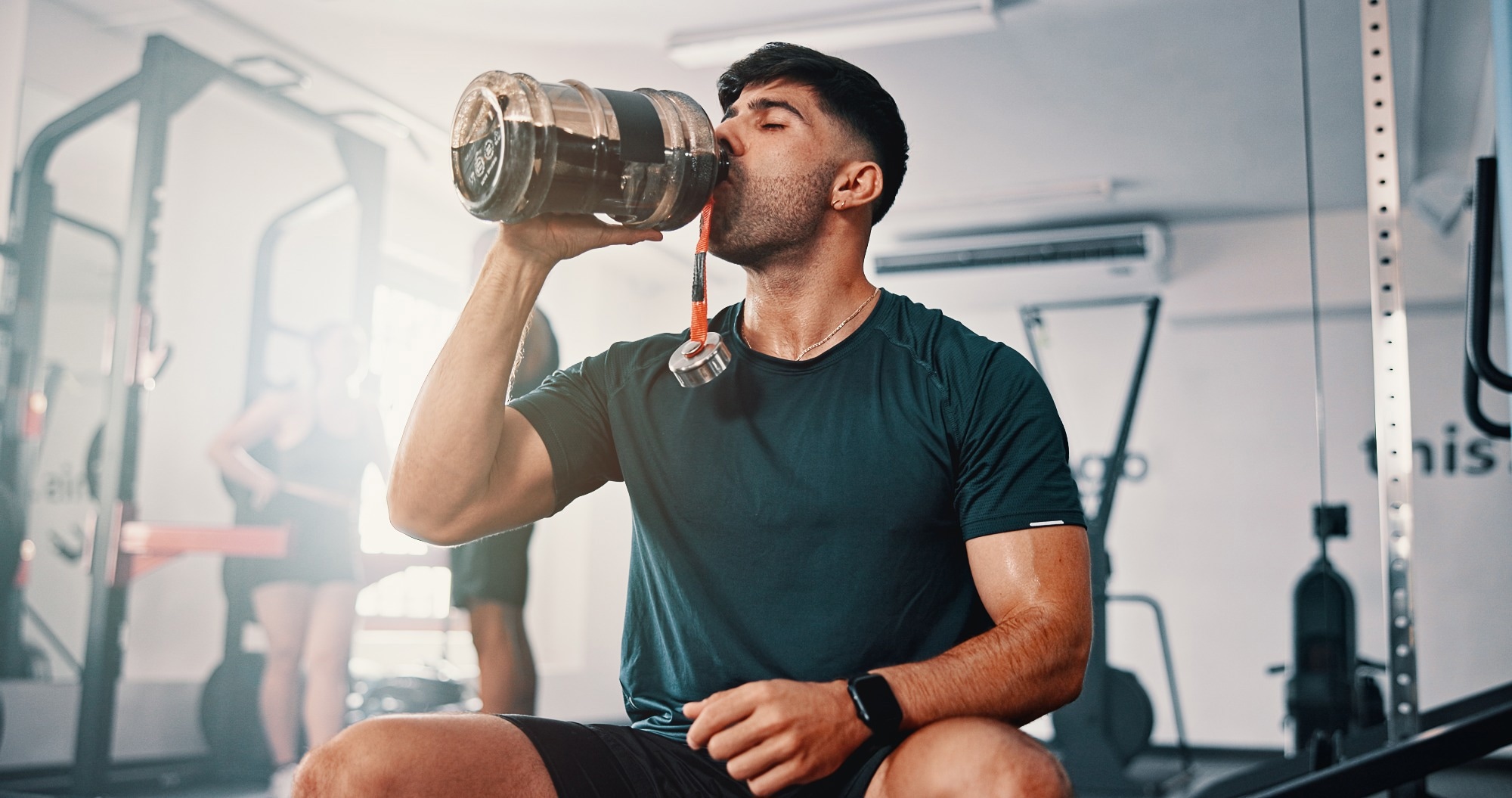 Study: Exercise-Induced Dehydration Limits the Effectiveness of Post-Exercise Whey Protein Supplementation in Healthy Young Men. Image Credit: People, Sports/Recreation / Shutterstock.com
In a recent study published in Nutrients, researchers examined whether different levels of exercise-induced dehydration alter the serum amino acid response to post-exercise whey protein ingestion.
Can dehydration affect your post-workout protein shake?
Whey protein is a well-known supplement used for post-exercise recovery because it is quickly digested, absorbed, and supplies important amino acids. Importantly, dehydration can reduce the intensity of the amino acid response from protein supplementation.
According to a study of 527 elite athletes, protein products were the most frequently reported supplement category, used by 41% of supplement users. Adequate hydration supports nutrient digestion and absorption, while dehydration may slow gastric emptying and contribute to gastrointestinal (GI) distress.
Athletes typically lose about 1.1% of body mass (BM) during training, and exercise-induced dehydration is common. Thus, further research is needed to clarify how hydration status affects post-exercise whey protein responses.
How researchers tested hydration and protein responses
A total of 13 healthy young men, with an average age of 22.7, participated in the current study. All study participants were nonsmokers, not professionally trained, and exercised no more than three times weekly. The Beijing Sport University Ethics Committee approved the protocol (No. 2025294H), and written informed consent was obtained.
A partially randomized crossover design was used. Each participant completed three trials at least 7 days apart, which included a dehydration trial without fluid replacement (DEH), a 50% fluid-replacement trial (EUH_50%), and a euhydration trial with 100% fluid replacement (EUH).
The DEH trial established individualized exercise duration and BM loss. Participants completed repeated 20-minute treadmill-running bouts at 80–85% heart rate reserve (HRR). Water intake during EUH_50% and EUH replaced 50% and 100% of the DEH BM loss, respectively. Adequate hydration before each trial was confirmed using urine specific gravity (USG <1.020), and diet and water intake were standardized.
After exercise, each participant drank 45 g whey protein isolate (WPI) in 450 mL water. Researchers collected blood samples before exercise, immediately after exercise but before protein ingestion, and at 60 and 120 minutes after supplementation. Circulating amino acid concentrations were measured in these samples using mass spectrometry.
Researchers also measured perceived exertion (RPE), thirst, GI symptoms, and sweat production. Data were analyzed using repeated-measures statistical tests, while overall changes in circulating amino acid concentrations during the two-hour recovery period were also calculated.
Dehydration reduces the early amino acid response
The hydration protocols produced different body water states. BM loss was 1.7 kg in the DEH, 0.93 kg in the EUH_50%, and 0.2 kg in the EUH. Relative BM losses were 2.2%, 1.2%, and 0.3%, respectively, and each hydration condition differed significantly from the others.
Pre-exercise USG was similar across trials, whereas post-exercise values were higher in DEH. Mean exercise heart rate did not differ significantly among conditions.
Local sweat rate and sweat sodium, potassium, and chloride concentrations were also similar. Thirst, by comparison, was higher in DEH during exercise and remained higher through the 120-minute recovery period.
During recovery, RPE differed by condition and time. As compared to EUH, RPE was higher in DEH immediately after exercise, at 60 minutes, and at 120 minutes. At 120 minutes, RPE was also higher in DEH than in EUH_50%.
GI symptoms remained low after whey protein ingestion. The total GI symptom score changed over time, without a condition effect or condition-by-time interaction. Only 17 of 1,638 individual item ratings, or 1%, exceeded a score of 4, indicating that serious GI symptoms were uncommon across hydration conditions.
Serum levels of total amino acids, branched-chain amino acids (BCAAs), leucine, isoleucine, valine, and glutamine increased after whey protein ingestion. For total amino acids, BCAAs, leucine, isoleucine, and glutamine, condition-by-time interactions were significant, but not for valine.
At 60 minutes, serum total amino acid, BCAA, leucine, isoleucine, and glutamine concentrations were lower in DEH than in both EUH_50% and EUH. The two fluid-replacement conditions produced similar concentrations.
Overall changes in circulating amino acid levels over the two-hour recovery period differed among conditions for total amino acids, BCAAs, leucine, isoleucine, and glutamine, but not valine. These changes were lower in DEH than in both fluid-replacement trials for total amino acids, BCAAs, isoleucine, and glutamine.
The overall leucine response was lower in DEH than in EUH, but did not differ between DEH and EUH_50%. No significant differences in these measures were found between the two fluid-replacement conditions.
These differences were most apparent one hour after protein ingestion. Together, these results suggest that substantial dehydration weakens the initial rise in circulating amino acid levels, while partial fluid replacement may be sufficient to preserve this response under the conditions tested.
Researchers proposed that dehydration may affect gastric emptying, intestinal blood flow, or amino acid processing; however, they did not directly measure these mechanisms.
Conclusions
In healthy young men, exercise-induced hypohydration of approximately 2.2% BM attenuated the early circulating amino acid response to post-exercise whey protein ingestion. After dehydration, total amino acids, BCAAs, leucine, isoleucine, and glutamine were lower, and overall amino acid responses during recovery were reduced for several measures. Replacing 50% of exercise fluid loss produced responses comparable to 100% replacement.
The study was limited by its small sample of healthy young men and its two-hour observation period. Researchers also did not directly measure intestinal protein absorption or muscle protein synthesis, and the dehydration trial was always conducted first.
Hydration status may influence circulating amino acid availability following post-exercise protein supplementation; however, the underlying mechanisms remain uncertain. Maintaining adequate fluid intake during exercise may help preserve this early response. Further research is needed to determine whether maintaining hydration during exercise improves muscle recovery or long-term training outcomes.
Journal reference:
- Xin, Z., Gao, M., Wu, X., et al. (2026). Exercise-Induced Dehydration Limits the Effectiveness of Post-Exercise Whey Protein Supplementation in Healthy Young Men. Nutrients 18(19). DOI: 10.3390/nu18193267. https://www.mdpi.com/2072-6643/18/19/3267
 Synthetic protein targets TLR4 membrane region to reduce inflammation