Two people can have the same BMI but very different health profiles. A study spanning four countries examines whether waist measurements and organ function can provide a clearer picture of obesity and its long-term health implications.

Study: Validation of clinical and preclinical obesity across global cohorts. Image Credit: New Africa / Shutterstock
In a recent study published in the journal Nature, researchers analyzed data from more than 844,000 adults in four countries to examine how waist measurements and organ function affect obesity classification and its association with mortality.
The research was conducted by scientists from Huazhong University of Science and Technology and North China University of Science and Technology in China, in collaboration with institutions in the United States, Spain, Italy, and the United Kingdom, including Pennington Biomedical Research Center, the University of Girona, the University of Colorado Anschutz Medical Campus, and King's College London.
Background
Body mass index (BMI) plays a key role in diagnosing obesity, but people may have similar BMIs yet face different obesity-related health risks. In 2025, the Lancet Commission proposed differentiating between clinical obesity and preclinical obesity. Clinical obesity involves excess adiposity that impairs organ function or daily activities, while preclinical obesity involves excess adiposity with preserved function. The Commission also recommends using waist circumference (WC) and waist-to-height ratio (WHtR) alongside BMI to assess excess adiposity. Questions remained about how these criteria would change obesity classification, how preclinical obesity progresses, and how the categories relate to mortality across populations.
About the study
The researchers conducted a multinational population-based analysis involving 844,108 adults from four cohorts: the Kailuan Study in China (137,795 participants), the United Kingdom Biobank (UKB; 436,203 participants), the All of Us (AoU) Research Program in the United States (218,841 participants), and the Information System for the Development of Research in Primary Care (SIDIAP) database in Spain (51,269 participants). Participants were aged 18 to 74 years, had no history of stroke, heart attack, or cancer at baseline, and had the required anthropometric and organ dysfunction data.
Obesity was categorized according to the criteria outlined by the Lancet Commission. The combined anthropometric definition of obesity (CAD-obesity) used BMI with population-specific WC and WHtR thresholds. A BMI of at least 40 qualified on its own; lower obesity-range BMIs required elevated WC or WHtR, while overweight-range BMIs required both.
Clinical obesity involved excess adiposity accompanied by at least one of 18 indicators of obesity-related organ dysfunction or functional impairment, whereas preclinical obesity involved excess adiposity without dysfunction attributable to obesity.
The researchers applied an attributable fraction (AF) approach to estimate the proportion of organ dysfunction statistically attributable to obesity at the population level, rather than assuming that excess adiposity caused all coexisting conditions. This adjustment informed prevalence and progression estimates, while mortality analyses used recorded obesity and organ dysfunction status. Longitudinal analyses evaluated progression from preclinical to clinical obesity. Survival analyses examined associations with all-cause mortality. Multiple imputation addressed missing data, and sensitivity analyses examined whether the findings were consistent across cohorts.
Study results
CAD-obesity reclassified some participants compared with BMI alone. Across the four cohorts, BMI-based classification overestimated obesity in 1.2 to 3.1% of participants and underestimated it in 5.2 to 8.6%. Incorporating additional anthropometric measures increased overall obesity prevalence by 3.5 percentage points in China, 3.3 percentage points in the UK, 5.6 percentage points in the United States, and 7.4 percentage points in Spain. The resulting obesity prevalence was 21.3%, 27.3%, 48.1%, and 26.1%, respectively.
After adjustment for organ dysfunction statistically attributable to obesity, clinical obesity accounted for 22.7 to 31.3% of individuals with CAD-obesity. Its adjusted prevalence in the overall population was 5.6% in the Kailuan Study, 8.3% in the UK Biobank, 10.9% in the AoU Research Program, and 8.2% in the SIDIAP database. The adjustment also accounted for organ dysfunction that might have causes unrelated to obesity, but it could not establish the cause in individual patients.
Longitudinal analyses demonstrated that most individuals with preclinical obesity did not progress to clinical obesity. Over 10 years, the estimated cumulative incidence of clinical obesity was 21.2% in the Kailuan Study, 8.7% in the UK Biobank, and 22.6% in the SIDIAP database. The AoU cohort had a shorter follow-up, with an estimated four-year incidence of 8.5%. These adjusted estimates indicate that most did not progress to clinical obesity, but some developed organ dysfunction that could not necessarily be attributed to obesity.
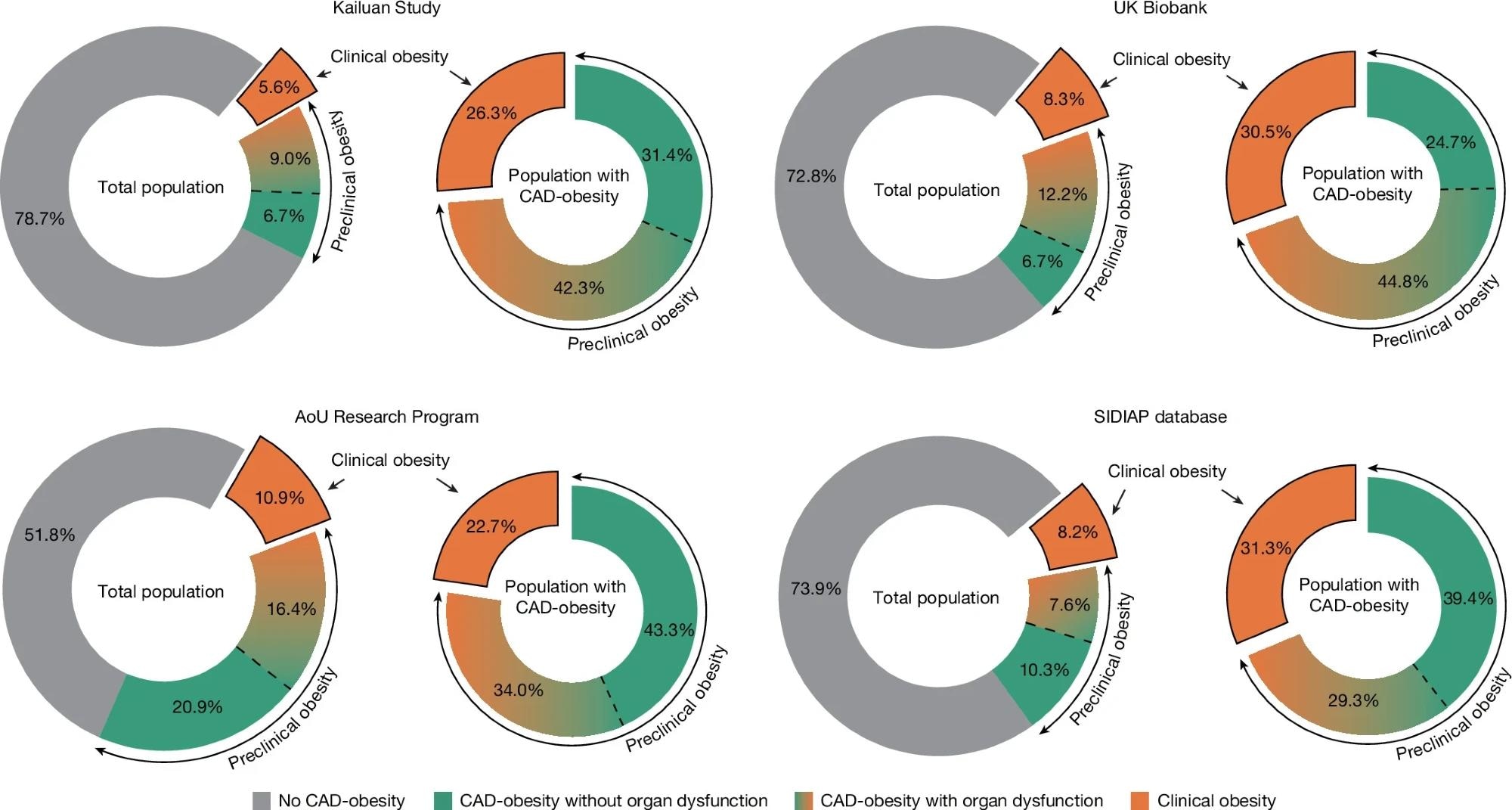
The analyses included 137,795 participants from the Kailuan Study, 436,203 participants from the UK Biobank, 218,841 participants from the All of Us Research Program and 51,269 participants from the SIDIAP database. Grey segments represent individuals without CAD-obesity. Orange segments represent the estimated AF-adjusted prevalence component of clinical obesity, corresponding to CAD-obesity with organ dysfunction statistically attributable to CAD-obesity at the population level. Green segments represent individuals with CAD-obesity but without evidence of organ dysfunction. Segments with a color gradient represent the estimated non-attributable prevalence component among participants with CAD-obesity and organ dysfunction after application of the AF adjustment. Together, the green and gradient segments represent the estimated AF-adjusted prevalence of preclinical obesity.
Mortality analyses revealed important differences between conventional BMI-based classification and CAD-obesity. BMI-defined overweight and obesity without CAD-obesity were not associated with increased all-cause mortality. Their mortality hazards were slightly lower than those of participants without overweight or obesity. Conversely, participants meeting CAD-obesity criteria had modestly increased mortality hazards, irrespective of whether their BMI fell within the overweight or obesity range.
The strongest association with mortality was observed in clinical obesity, which was linked to a 69% higher all-cause mortality hazard than in people without CAD-obesity or organ dysfunction. Preclinical obesity was associated with a 19% higher all-cause mortality hazard. People with organ dysfunction but without CAD-obesity also had elevated mortality. The association of clinical obesity with mortality was stronger in women and those younger than 60 years. The AoU cohort was excluded from mortality analyses because follow-up was too short.
Further analyses indicated that using a universal WHtR threshold of 0.50 would substantially increase the number of people meeting the anthropometric criterion for obesity. Those identified only by this lower threshold did not have increased mortality risk, while higher ethnicity-specific thresholds provided more meaningful risk stratification. Additional analyses produced consistent findings.
Conclusions
The findings support distinguishing clinical obesity from preclinical obesity and incorporating multiple anthropometric measures into obesity diagnosis. BMI alone may miss people with elevated mortality risk and classify others as obese who do not meet the combined criteria. Clinical obesity was associated with substantially higher mortality, while most people with preclinical obesity were not estimated to progress to clinical obesity during follow-up. These differences support care based on individual risk, with preventive treatment for preclinical obesity and more intensive management when obesity-related organ dysfunction is established. Preclinical obesity should not automatically exclude active treatment, including medication or surgery when clinically appropriate.
The retrospective design, reliance on health records, differences in available organ dysfunction indicators and assessment frequency, and limitations in individual-level attribution call for prospective studies using clinically validated diagnoses across diverse populations.
Source:
Journal reference:
- Pan, A., Yang, S., Ramos, R., Li, X., Xie, J., Eckel, R. H., Mingrone, G., Blanch, J., Jiang, J., Liu, H., Chen, S., Geng, T., Wu, S., Ravussin, E., Fernández-Real, J. M., & Rubino, F. (2026). Validation of clinical and preclinical obesity across global cohorts. Nature. DOI: 10.1038/s41586-026-11237-5, https://www.nature.com/articles/s41586-026-11237-5
 Obesity impairs key immune cells but bariatric surgery reverses damage