From restaurant menus to delivery apps, a large-scale analysis reveals how the price of each calorie shifts as meals become more energy-dense, raising questions about what consumers really pay for healthier choices.
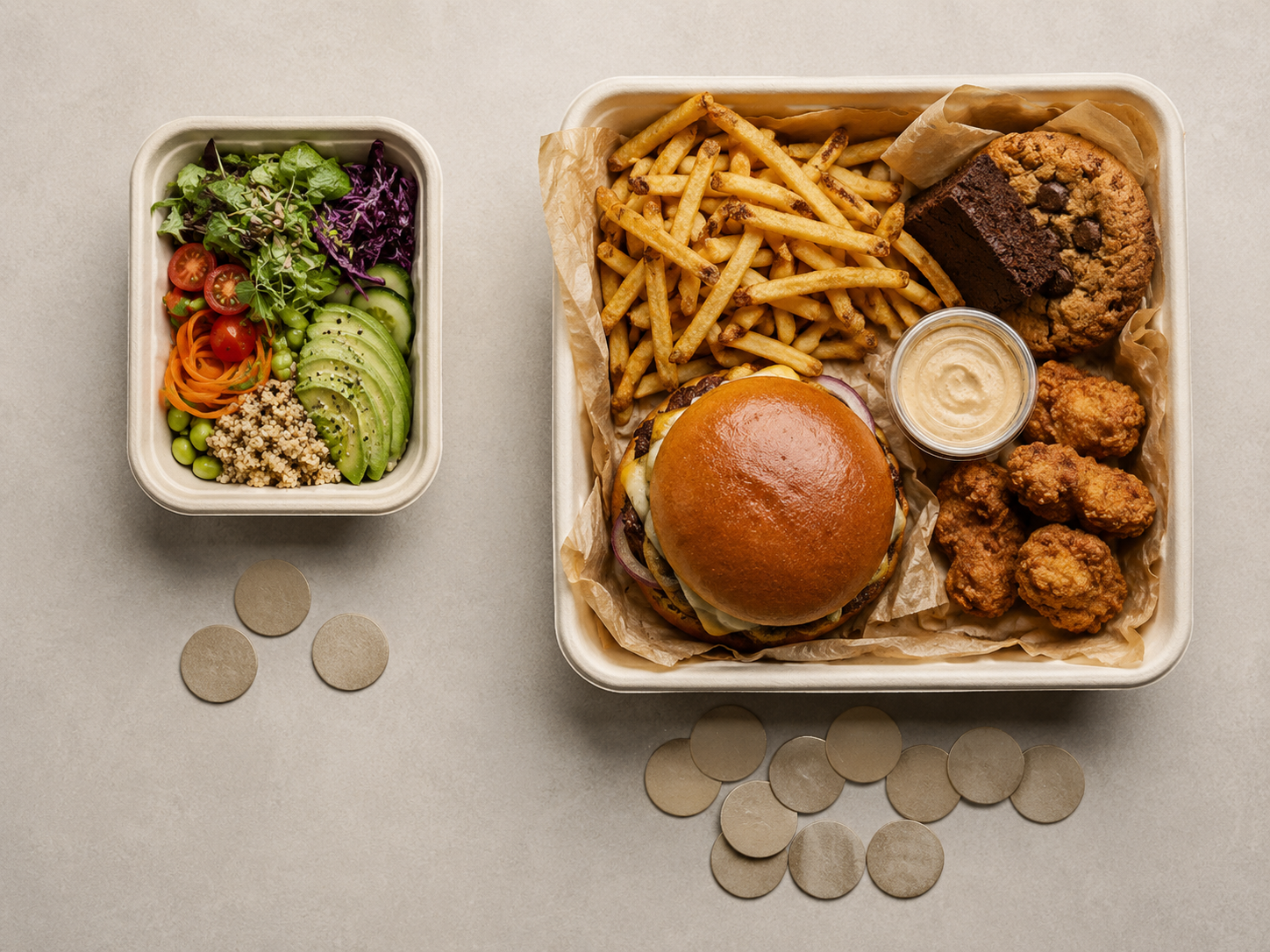
Study: Is there a healthy-food premium? A cross-sectional analysis of the UK online food delivery sector. Image Credit: Shutterstock AI
Lower-calorie menu items from large restaurant chains on two major UK online food delivery platforms cost more per calorie than higher-calorie options, according to a new study published in the journal Health Promotion International.
Background
A suboptimal diet, characterized by low intake of vegetables, fruits, and whole grains and high intake of salt, is a leading risk factor for cardiometabolic diseases, accounting for an estimated 11 million deaths each year worldwide. The risk is more pronounced among socioeconomically disadvantaged individuals, augmenting health disparities.
In the UK, obesity and diet-related diseases are disproportionately prevalent in socioeconomically deprived areas, where physical fast-food outlet density is higher, and residents can access more food outlets through online food delivery platforms.
The growth of online food delivery platforms has increased significantly since the COVID-19 pandemic. These platforms aggregate menus from a wide range of food outlets, providing access to a variety of cuisines. However, these platforms frequently feature high-calorie, nutritionally poor foods for consumers.
Price is a primary determinant of food choice. In retail settings, calorie-dense foods are generally cheaper per unit of energy, while previous research has also found frequent price promotions on online delivery platforms, which may encourage the selection of calorie-dense foods.
In England, restrictions on volume-based price promotions for high-fat, high-salt, and high-sugar products in retail settings took effect in October 2025. The out-of-home food sector, including food purchased through online apps and aggregator platforms, is exempt from these restrictions, potentially allowing financial incentives favoring higher-calorie options to persist.
Given the disparities in pricing patterns within the UK online food delivery sector, researchers at the London School of Hygiene and Tropical Medicine, UK, explored the association between food price and calorie content across large restaurant chains and assessed whether a price premium exists for food items containing less than 600 kcal, consistent with recommendations for calorie content per meal in England.
Key findings
A total of 7392 unique adult menu items from 200 restaurant chains were examined by the researchers. The findings indicated that about 41% of the food items contained at least 600 kcal, which is at or above the recommended calorie content per meal. This included 52% of the main dishes.
The analysis of the price-calorie relationship showed that prices generally increased as calorie content rose, but the increase became progressively smaller at higher calorie levels. This meant that higher-calorie foods provided more calories for each pound spent, although the pattern varied across menu categories.
Specifically, food items containing less than 600 kcal were, on average, 70 pence more expensive per 100 kcal compared to items containing 600 kcal or more, after accounting for menu category. The premium was particularly pronounced for soups, salads, and bowls, at about £1.22-£1.27 per 100 kcal.
Study significance
The study suggests that these pricing patterns within the UK online food delivery sector financially favor higher-calorie options and may discourage the selection of lower-calorie alternatives. It means that consumers seeking lower-calorie food choices may pay more per 100 kcal, even though these items have lower average absolute prices.
This inverse relationship between calorie density and price per calorie is a documented structural feature of global retail food markets. The relatively higher cost of fruits and vegetables is one of the major reflections of this inverse relationship.
Although this study examined only ready-to-eat products from the out-of-home food sector, similar pricing patterns have been observed in UK supermarkets, where unhealthy foods are cheaper per calorie than healthier foods. However, the findings are not directly comparable because supermarket studies defined healthiness using nutrient profiles, whereas the current study classified items based on whether they contained fewer than 600 kcal.
To some extent, this cost reduction per additional calorie is expected, because nonfood costs associated with each menu item, such as labor and rent, may not scale proportionally with calorie content. This may partly explain why high-calorie items are relatively less expensive per calorie than low-calorie items.
The authors also suggest that fresh, lower-energy-density ingredients may incur higher storage and preparation costs, while some energy-dense or ultra-processed ingredients may provide calories at a lower unit cost. These factors could contribute to the higher base cost of low-calorie food items.
Collectively, these findings indicate that the current pricing structure within the UK online food delivery sector may impose an economic barrier to lower-calorie food choices, particularly for socioeconomically disadvantaged individuals. Furthermore, these financial incentives may contribute to diet-related health inequalities, as a premium on lower-calorie options could consume a larger share of the food budgets of lower-income consumers. However, the study contained no purchaser-level information and therefore could not determine who bought individual menu items or whether pricing differences influenced actual purchasing behavior.
Besides economic constraints, people with limited time for cooking due to work-related pressure or limited mobility due to health complications may be more reliant on online food delivery platforms and could therefore be more affected by per-calorie pricing disparities. A similar concern applies to younger adults and households with children, among whom app use is more common.
Taken together, these findings support consideration of structural policy interventions to mitigate diet-related health inequalities and ensure more equitable access to lower-calorie options.
The analysis focused on menu items from large restaurant chains available on two leading UK online food delivery platforms. Although this study design captured a significant market share, the findings may not be generalizable to independent restaurants or other delivery services.
The study analyzed individual menu items rather than complete meal orders. The findings therefore cannot reflect the economic incentives associated with multiproduct meal combinations and bundle discounts. Sensitivity analyses that reintroduced bundles, set meals, and sharing items nevertheless produced findings consistent with the main analysis.
Nutritional quality was assessed only through calorie content, without information on ingredients, macronutrients, or micronutrients, meaning that items below 600 kcal cannot automatically be considered nutritionally healthier. The study also lacked weight or volume data, so it could not determine whether the observed premium reflected production costs or differences in portion size.
Only one listed price was available for each item, so the researchers could not distinguish standard prices from temporary promotional prices or account for order-level promotions, personalized offers, delivery fees, or service charges.
Larger-scale future research is needed to further examine pricing patterns associated with children’s menus and items marketed as healthy regardless of their actual nutritional quality. The authors also recommend linking menu data with sales or household purchasing data to determine how prices, promotions, bundles, and complete orders influence real-world food choices.
 Prenatal exposure to higher water fluoride levels associated with lower child cognition