A 34-country analysis comparing absolute and relative excess deaths reveals how the apparent mortality divide between men and women shifted across successive stages of the COVID pandemic.

Study: Sex differences in excess mortality during the COVID-19 pandemic: a longitudinal ecological analysis of 34 high-income countries. Image Credit: Billion Photos / Shutterstock
In a recent study published in the journal eClinicalMedicine, a group of researchers assessed absolute and relative sex differences in all-cause excess mortality across three phases of the coronavirus disease 2019 (COVID-19) pandemic in 34 high-income countries.
Background
What does it mean when men account for more deaths during a pandemic: greater vulnerability to infection, or a reflection of a pre-existing mortality gap? Females have lower all-cause mortality than males, although sex differences have narrowed in high-income countries. Early in the COVID-19 pandemic, male mortality was higher, consistent with survival disadvantages reported in crises. Immune differences, along with occupational and social differences in exposure, may contribute to sex differences. Yet absolute death counts may exaggerate disparities because men begin with higher mortality.
About the study
The analysis followed the Strengthening the Reporting of Observational Studies in Epidemiology (STROBE) guidelines and used the Short-Term Mortality Fluctuations (STMF) dataset, which covers 34 high-income countries from February 2020 through July 2023.
Expected weekly deaths were estimated from 2013 to 2019, using the Human Mortality Database for population denominators. Person-weeks of exposure were calculated using cubic interpolation, with age-specific values extrapolated up to 2 years when needed.
A Generalized Additive Model (GAM) with smooth seasonality and a log-linear time trend, using a Negative Binomial distribution, was fitted separately for each country and sex for age groups 0-15, 15-64, 65-74, 75-84, and 85 years or older.
Expected and observed deaths were aggregated monthly across pre-vaccine, post-vaccine Delta/Omicron, and endemic phases. Excess deaths were calculated as observed minus expected deaths and left-censored at zero.
Excess death rates were expressed per 100,000 person-years, while P-scores represented percentage excess mortality relative to expected deaths. Absolute sex gaps compared male and female excess death rates; relative gaps compared their P-scores. Direct age standardization used the 2013 European Standard Population (Eurostat). Prediction intervals were generated from 250 simulated datasets using a parametric bootstrap.
Analyses were performed in RStudio version 2023.9.1.494. Because the analysis examined all-cause excess mortality, it captured both deaths directly attributable to COVID-19 and indirect mortality resulting from the pandemic's broader effects.
Study results
Across 34 countries, pre-pandemic male-to-female mortality ratios varied substantially. During the pre-vaccine period, observed male-to-female mortality ratios were generally higher than expected from pre-pandemic trends, particularly in Czechia, Poland, and Bulgaria. The gap narrowed as the pandemic progressed. In 31 of 34 countries, observed sex ratios were smaller during the endemic phase than during the pre-vaccine phase; Estonia, Latvia, and Iceland were exceptions.
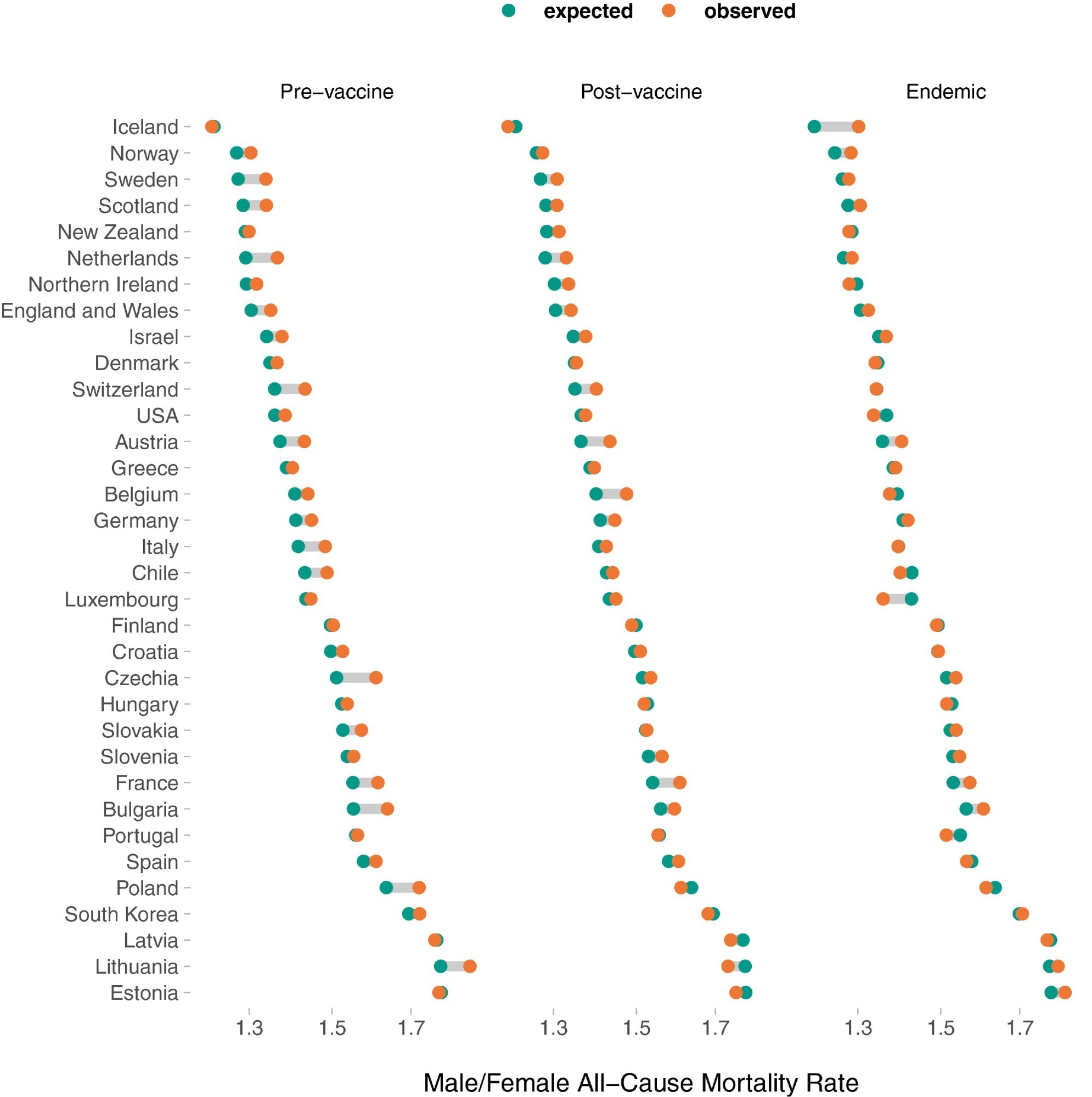
Sex ratios (male/female) in all-cause mortality by country and pandemic phase, comparing expected and observed mortality. A ratio of 1 indicates no sex difference. Ratio > 1 indicates higher male mortality. Ratio < 1 indicates higher female mortality. Expected mortality is based on pre-pandemic trends (2013–2019). Pandemic phases: pre-vaccine (February 2020–April 2021), post-vaccine Delta/Omicron (May 2021–April 2022), endemic (May 2022–July 2023).
Monthly analyses showed that absolute male-female differences in excess mortality closely followed overall mortality levels. During higher-mortality months, males generally experienced greater absolute excess mortality, whereas during lower-mortality months, the 95% prediction intervals for male and female estimates largely overlapped.
Bulgaria and the United States had sizable male disadvantages during excess-mortality peaks in the pre-vaccine and post-vaccine phases, although differences narrowed during the endemic phase. England and Wales and Italy showed clear male disadvantages during high-mortality months in the pre-vaccine phase.
Germany had mortality peaks in all three phases, with significant sex differences mainly among people younger than 75 years.
Relative measures produced a different pattern. Male disadvantage in P-scores was not consistently evident. In some groups, females had higher relative mortality increases. Examples included adults aged 65-74 and 75-84 years in the United States during the endemic phase.
Overall, absolute findings indicated higher male excess mortality during pandemic peaks, particularly before vaccine introduction, while relative increases were often similar between sexes. Patterns varied across countries and ages.
A significant male disadvantage in absolute excess mortality rates occurred in 60% (81/136) of age-group-country combinations during the pre-vaccine phase, decreasing to 51% (70/136) during the post-vaccine phase and 23% (31/136) during the endemic phase. The headline age-group-country analyses reported results across 136 combinations.
Germany and South Korea showed increased male disadvantage during later phases for some age groups. Iceland, Finland, Luxembourg, and New Zealand showed little evidence of male disadvantage.
For relative differences, a significant male disadvantage in P-scores occurred in 28% (38/136) of combinations during the pre-vaccine phase and 14% (19/136) during the post-vaccine phase. Some combinations showed a female relative disadvantage, including adults aged 65-74 years in Bulgaria and the United States after vaccine introduction.
During the endemic phase, relative sex differences were generally limited, although male disadvantage persisted or re-emerged in selected groups in Germany and Norway, while female relative disadvantage appeared in some groups in the United States and Spain. Absolute male disadvantage increased with age in 56% (19/34) of countries during the pre-vaccine phase, but this pattern weakened later.
The authors noted several limitations. The analysis was restricted to selected high-income countries and should not be generalized to low- and middle-income settings. Population counts for 2022-2023 were extrapolated from 2021; broad age categories limited assessment of within-group differences; and all-cause excess mortality could not distinguish direct COVID-19 deaths from indirect pandemic effects. Left-censoring at zero also excluded periods of mortality deficit or potential mortality displacement.
Conclusions
The findings showed that male excess mortality was higher than female excess mortality in many countries, particularly during high-mortality months and the pre-vaccine phase. However, this disadvantage was neither universal nor persistent.
Absolute differences declined across pandemic phases, while relative differences were smaller and occasionally indicated a female disadvantage, suggesting that higher male mortality partly reflected higher baseline mortality. By the endemic phase, little evidence of persistent relative sex differences remained.
The results support the use of both absolute and relative measures when evaluating mortality inequalities and suggest that COVID-19 did not produce lasting shifts in sex differences in mortality across the high-income countries examined.
Further research is needed to clarify how sex differences change across pandemic stages, age groups, and national contexts.
 Nurses in Latin America faced severe systemic violence during the pandemic