Three decades of follow-up suggest that alcohol and beverage type may relate differently to longevity and heart attack risk, but the observational findings do not prove that drinking itself is protective or harmful.
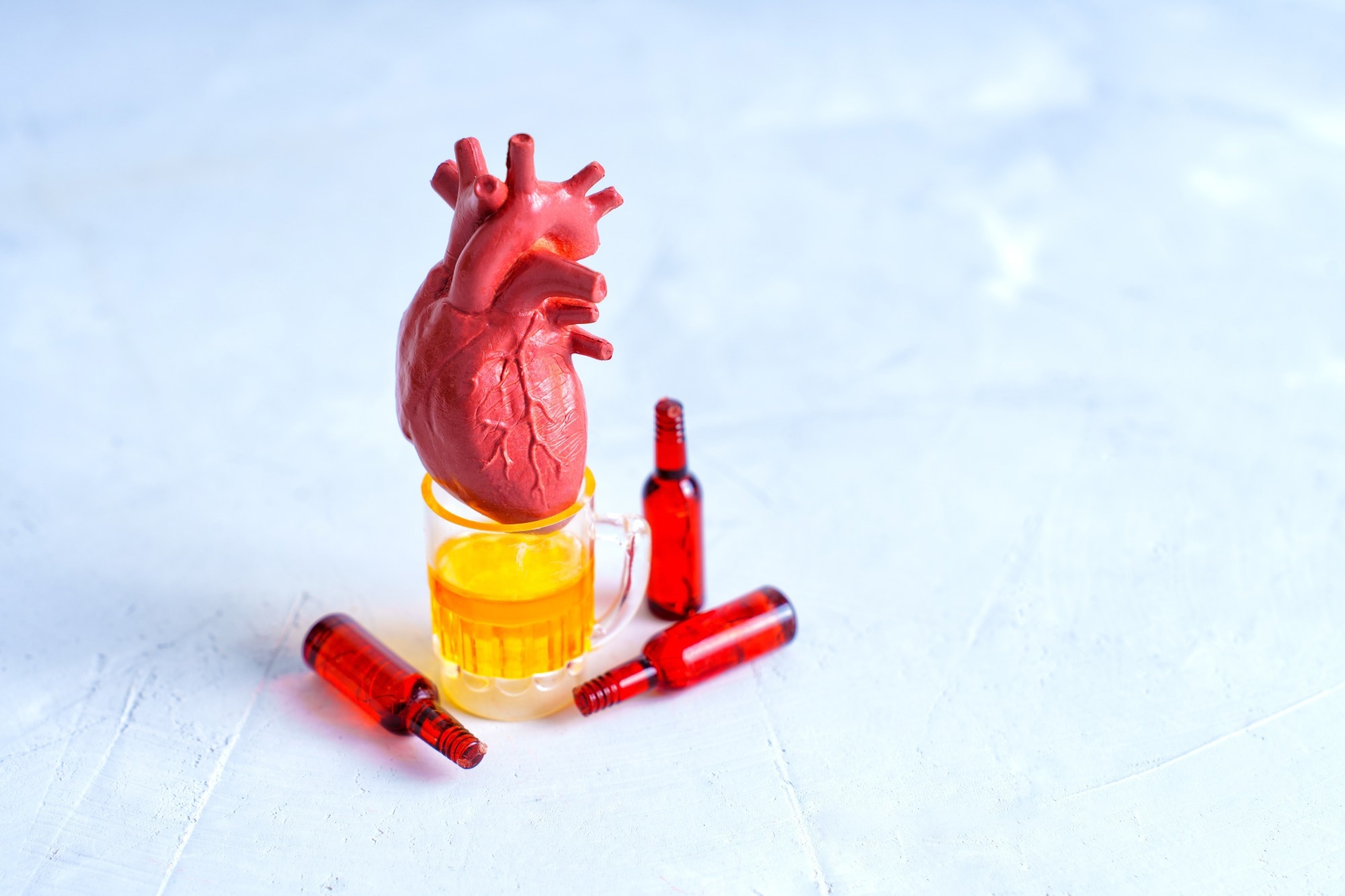
Study: Link between alcohol consumption and myocardial infarction, stroke, and all-cause mortality among Swedish male automotive workers over 30 years. Image Credit: Chizhevskaya Ekaterina / Shutterstock
In a recent study published in the Scandinavian Journal of Primary Health Care, a group of researchers evaluated the associations of alcohol consumption and beverage type with myocardial infarction (MI), stroke, and all-cause mortality among middle-aged Swedish male automotive workers followed for 30 years.
Background
Cardiovascular disease remains a leading cause of death even as Swedish men’s life expectancy increased by about two years between 2001–2010 and 2011–2020. Alcohol’s relationship with cardiovascular health is complex: research has described a J-shaped pattern, while concerns include the “sick quitter” hypothesis and evidence that even low intake can adversely affect health. Findings also vary by region and beverage type.
Alcohol has been associated with MI in some studies, whereas other research has emphasized drinking frequency or reported possible effects of beer or wine. International guidance states that no level of alcohol consumption is risk-free, underscoring the need for further research.
About the study
The prospective longitudinal analysis used data from the Coeur study, initiated in 1993 among 1,144 men aged 45-50 years employed at Volvo in Gothenburg, Sweden. After exclusions for refusal, illness, cardiovascular treatment, one outlier in alcohol consumption, and 26 participants with missing data, 973 men were included.
Baseline information included alcohol use, blood pressure, laboratory tests, smoking, exercise, diabetes, occupational status, and household status. A 1995 sub-study provided 173 blood samples and 84 questionnaires for additional analyses.
Total alcohol intake was calculated from self-reported drinks per week and estimated pure alcohol per beverage: 6 g for beer, 14 g for wine, and 13 g for hard liquor. Participants were categorized by total intake, beverage type, ranked consumption groups, and risk consumption of at least 120 g/week.
Outcomes were all-cause mortality, MI, and stroke, identified through national health registers through December 31, 2023, using International Classification of Diseases (ICD) codes. Descriptive data used medians and interquartile ranges (IQRs); statistical analyses used odds ratios (ORs), Spearman’s rho, Kaplan-Meier estimates, chi-square tests, and Cox regression in the Statistical Package for the Social Sciences (SPSS).
Cox regression models were adjusted for relevant cardiovascular and socioeconomic factors, with the covariates varying by outcome. Some beverage-specific models were also adjusted for consumption of another beverage type.
Study results
Among 973 participants, 237 (24%) died, 100 (10%) experienced MI, and 89 (9%) experienced strokes. Alcohol drinkers had a median intake of 56 g/week versus 0 g/week among non-drinkers.
Alcohol and wine drinkers had slightly higher high-density lipoprotein cholesterol levels than non-drinkers. Drinking groups also contained higher proportions of clerical workers and married or cohabiting participants. Single, divorced, or widowed workers had nearly twice the mortality rate of married or cohabiting workers, while manual workers had almost 59% higher mortality than clerical workers.
Spearman’s rho analysis showed positive correlations between high-density lipoprotein cholesterol and total alcohol, wine, and beer intake. No correlation was found between self-reported alcohol use and gamma-glutamyl transferase in the 1995 sub-cohort; however, self-reported total alcohol intake correlated moderately with the 1995 diet-study assessment (R = 0.58).
Crude all-cause mortality was lower among alcohol drinkers, who had substantially lower mortality odds than non-drinkers. Wine and beer consumption showed similar patterns, while several ranked total-alcohol consumption groups also had lower odds than abstainers. The risk-drinking group, however, did not differ significantly from the non-risk group.
For MI, the direct comparison between alcohol drinkers and non-drinkers was not significant. However, the second-lowest total-alcohol consumption group had about twice the odds of MI compared with non-drinkers.
Beer consumption was associated with MI: 76 beer drinkers (12%) versus 24 non-beer drinkers (7%) experienced events, corresponding to about 70% higher odds of MI among beer drinkers. The highest beer-consumption group also had significantly higher odds of MI than non-beer drinkers. Wine consumption was not significantly associated with MI in the 30-year cohort.
No significant association was found between alcohol consumption and stroke, with event rates similar among drinkers and non-drinkers.
Adjusted Cox regression indicated a small association between total alcohol intake and all-cause mortality after accounting for relevant cardiovascular and socioeconomic factors. The corresponding adjusted association for wine was not statistically supported.
For MI, the adjusted model also indicated a small association with beer consumption. Adjusted analyses for stroke showed no significant associations with total alcohol, beer, or wine.
Kaplan-Meier analysis showed a longer estimated mean time to death during follow-up among alcohol drinkers than non-drinkers: 28.1 versus 26.8 years, a difference of 1.3 years. Wine drinkers had an estimated mean time to death of 28.5 years versus 27.1 years among non-wine drinkers, while the corresponding estimates were 28.1 and 27.1 years for beer drinkers and non-beer drinkers, respectively.
For MI, beer drinkers experienced the event at a mean of 28.5 years, compared with 29.1 years among non-beer drinkers, a difference of 0.6 years. Stroke differences were not significant across beverage groups.
Conclusions
After 30 years of follow-up, alcohol consumption among these middle-aged Swedish male automotive workers was associated with a longer estimated time to death during follow-up and lower odds of all-cause mortality, while beer consumption was associated with a higher likelihood of MI and an earlier MI event. No significant association was observed between alcohol consumption and stroke.
The findings require cautious interpretation because the cohort consisted of middle-aged Swedish men with stable employment, alcohol exposure was based on self-reporting, high-risk drinkers were underrepresented, and lifestyle factors could change during follow-up. Drinking groups also differed substantially in socioeconomic characteristics, and unmeasured factors such as diet and cultural context could have contributed to the observed associations. The study therefore cannot establish that alcohol itself improved survival or that beer directly increased MI risk.
Larger and more diverse studies with detailed drinking and lifestyle assessments are needed.
Journal reference:
- Asp, H., & Dimberg, L. (2026). Link between alcohol consumption and myocardial infarction, stroke, and all-cause mortality among Swedish male automotive workers over 30 years. Scandinavian Journal of Primary Health Care. 44(1). DOI: 10.1080/02813432.2026.2712981, https://www.tandfonline.com/doi/full/10.1080/02813432.2026.2712981
 Research makes strong case for broader use of GLP1 drugs to protect hearts