From Birmingham to London, a rapidly spreading measles outbreak raised urgent questions about who was most vulnerable and how England's hospitals would cope.
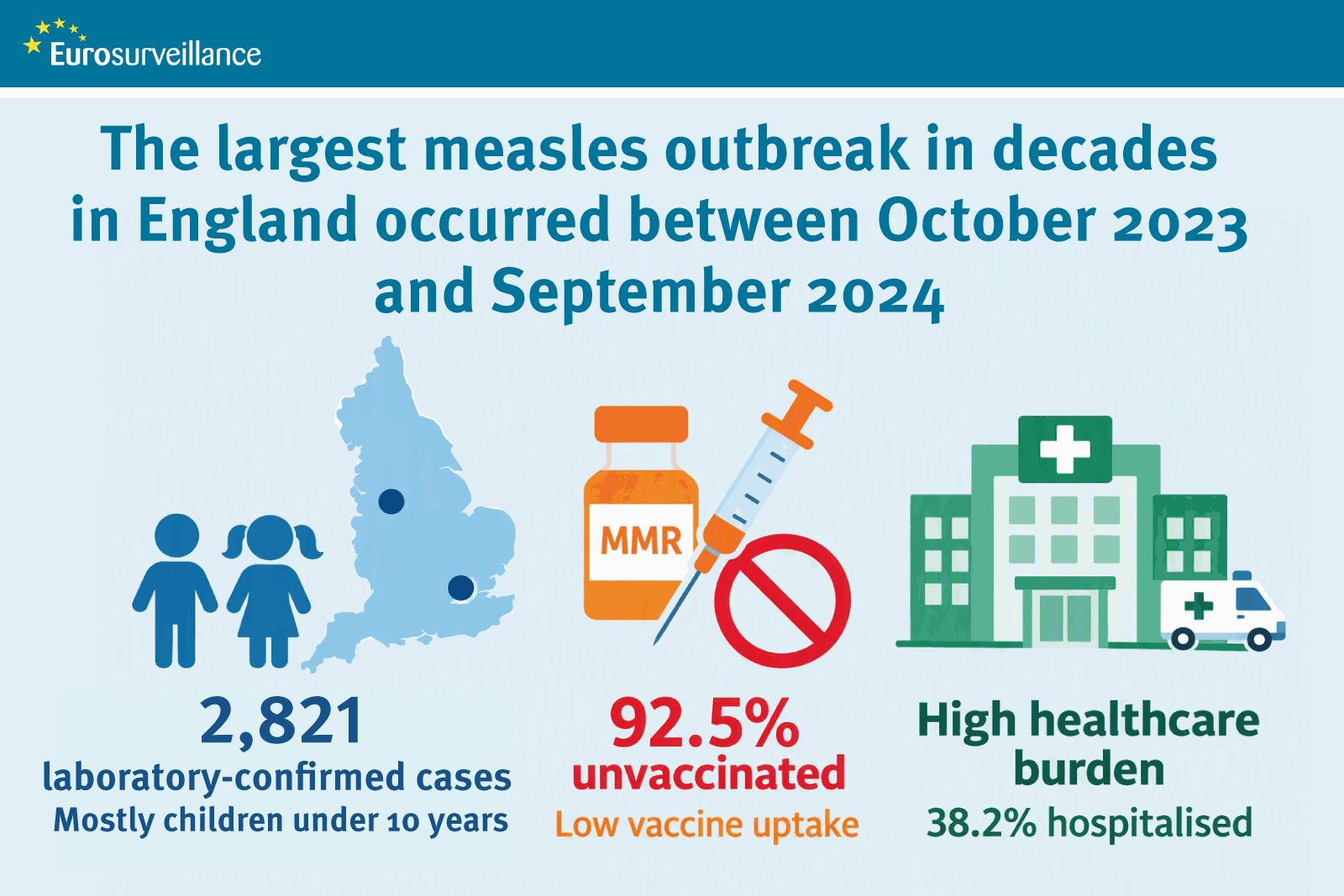
Study: Measles resurgence in England: challenges in maintaining elimination, 2023 to 2024
In a recent surveillance study published in the journal Eurosurveillance, researchers examined the spread, affected populations, and healthcare burden of England's largest measles outbreak in more than two decades.
The study analyzed national surveillance data on 2,821 laboratory-confirmed cases from October 2023 to September 2024 against a background of declining measles vaccination coverage.
The study found that 92.5% of confirmed cases had no recorded measles-mumps-rubella (MMR) vaccination, with young children in more deprived urban areas accounting for many infections. Around three-quarters of cases with linked health records attended an emergency department, and more than a third were admitted to hospital. The United Kingdom (UK) later lost measles elimination status following over a year of sustained transmission.
Together, these findings support maintaining high vaccination coverage in every community, including during periods with few reported cases.
Background
Measles is an airborne viral infection that can cause severe respiratory or neurological complications and death. It is highly contagious: one infected person can transmit the virus to nine in ten susceptible close contacts.
Following the introduction of the two-dose measles-mumps-rubella (MMR) vaccine schedule in 1996, endemic transmission was interrupted in the UK, which achieved World Health Organization (WHO) elimination status in 2016. After renewed transmission, the UK regained that status in 2021. Since January 2026, England has used the combined MMR and varicella (MMRV) vaccine in its routine schedule, with the second dose offered at 18 months.
Over the past decade, public health records document a decline in population-wide measles vaccination coverage. The WHO recommends at least 95% coverage with two doses of a measles-containing vaccine to maintain elimination. In 2023–2024, only 88.9% of children had received their first MMR dose by 24 months, the lowest uptake in a decade.
Earlier outbreaks often clustered within particular undervaccinated communities, but the 2023–2024 resurgence spread across a broader range of populations. The extent of transmission and its impact on hospital services prompted this national analysis.
About the study
The present study aimed to inform targeted vaccination policies by describing England's measles resurgence using linked national surveillance records. The UK Health Security Agency (UKHSA) conducted the study and examined suspected measles notifications and laboratory-confirmed cases with symptom onset between 1 October 2023 and 30 September 2024.
Suspected cases were offered self-swabbed oral fluid kits (OFKs) for immunoglobulin M (IgM) and immunoglobulin G testing, together with polymerase chain reaction (PCR) assays. Results from local laboratories and verified notifications were also included.
These results were combined with national case notifications, vaccination records and area-level Index of Multiple Deprivation (IMD) measures. The researchers linked 2,788 cases with available National Health Service (NHS) numbers to emergency department and hospital admission records.
Study findings
The study’s analyses found that, of the 15,587 suspected notifications, 2,821 were confirmed as measles infections, corresponding to a national incidence of 4.8 cases per 100,000 population.
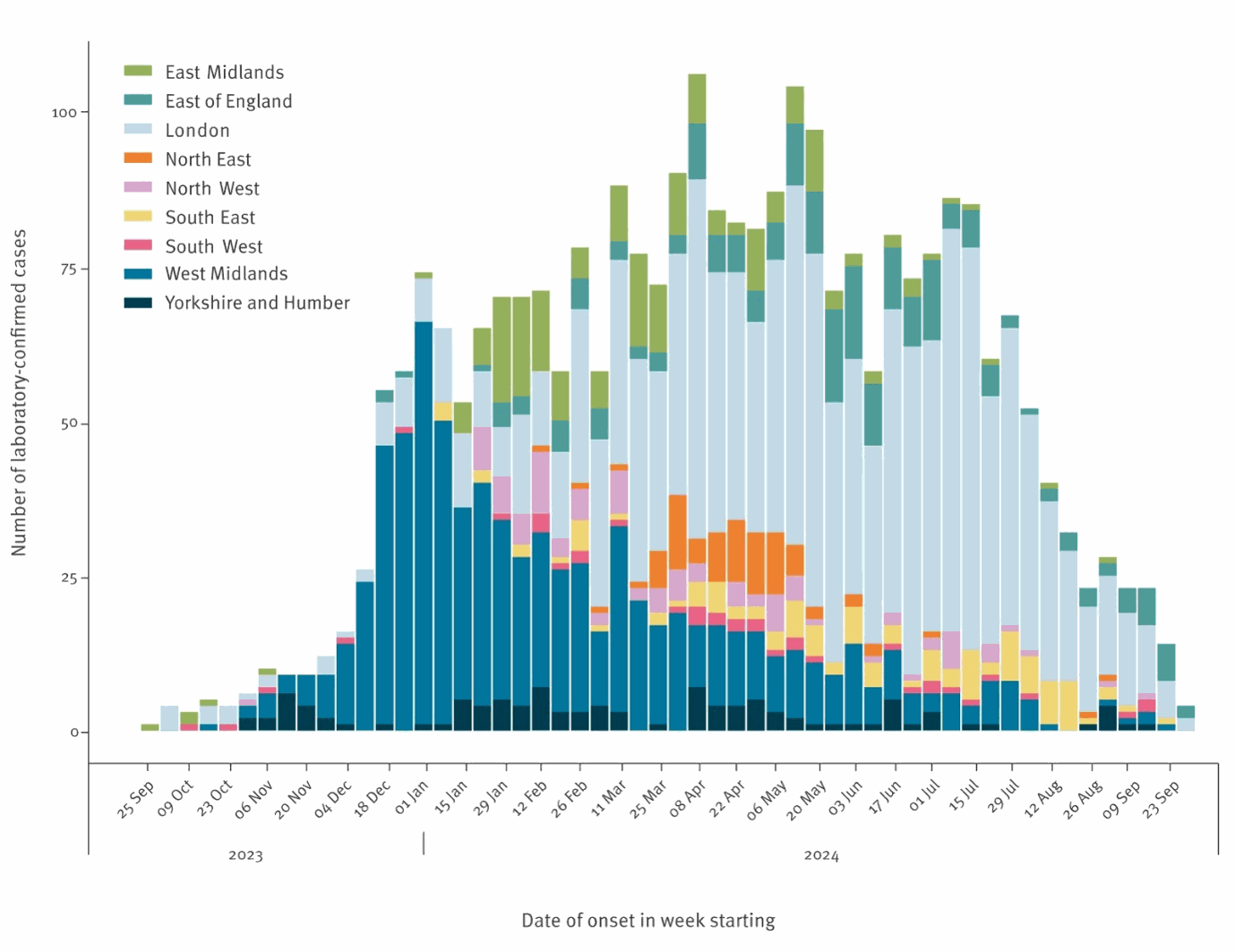
Epidemiological curve showing the weekly number of laboratory-confirmed measles cases, by region of residence, England, 1 October 2023–30 September 2024 (n = 2,821)
Cases rose sharply following measles importations that seeded early outbreaks in the West Midlands, particularly Birmingham, before transmission spread to other English regions. The early importations were traced to Pakistan and Romania, and cases peaked in London during April 2024.
London accounted for 45.5% of cases and the West Midlands for 25.2%, while the highest local incidence was recorded in Lambeth, south London.
The study showed that children under 10 years old comprised 58.6% of all confirmed cases, while infants under one year (too young for routine MMR vaccination) accounted for 11.7%. Overall, 92.5% of cases had no recorded MMR vaccination, whereas small minorities had received one or two doses. The authors cautioned that incomplete records may have classified some vaccinated people as unvaccinated.
Across England, 63.0% of cases resided in the two most deprived IMD quintiles, reflecting neighborhood-level deprivation rather than each person's circumstances. Laboratory analysis identified two circulating measles genotypes, D8 and B3, while 5.5% of cases were linked to international travel. Among the 2,788 cases linked to hospital records, 76.3% attended an emergency department (ED), and 38.2% were admitted to hospital. These figures describe healthcare use among detected cases, not the proportion of all infections needing urgent treatment.
Hospital admission was most common among infants under one year (51.6%) and adults aged 30 years and older (47.2%). The overall median length of stay (LOS) was 2.0 days, while the mean stay reached four days among adults aged 30 and older. Seven patients received intensive care, and one death was reported in a teenager with underlying health conditions.
The authors cautioned that mild infections may have escaped detection, some admissions were precautionary, and hospital records did not always establish measles as the reason for admission. Incomplete vaccination records could also have led to misclassification.
Conclusions
The present study indicates that falling childhood vaccination rates have contributed to broader measles transmission beyond previously affected undervaccinated groups, with particularly high incidence in deprived urban communities. A separate UKHSA evaluation estimated that national catch-up campaigns delivered roughly 180,000 additional MMR doses and helped reduce disparities in vaccine uptake across socioeconomic and ethnic groups. The authors called for sustained, locally tailored programs to restore at least 95% two-dose measles vaccine coverage across all communities and prevent further outbreaks.
Source:
Journal reference:
- Hani, E., Venkatraman, T., Stowe, J., Cordery, R., Ramsay, M., & Saliba, V. (2026). Measles resurgence in England: challenges in maintaining elimination, 2023 to 2024. Eurosurveillance, 31(45), 2600124. DOI: 10.2807/1560-7917.ES.2026.31.45.2600124. https://www.eurosurveillance.org/content/10.2807/1560-7917.ES.2026.31.45.2600124
 Annenberg poll reveals confusion over RFK Jr. vaccine recommendations